🎧 Listen to this episodeAbout 9 minutes. Narrated in Mr Sadek’s voice using AI technology. General information only, not personal medical advice.
🎧 Listen to the Spinemathema Podcast on Spotify → · Apple Podcasts →
Read the full article with references: Spine Research Roundup, 18 October 2026
Transcript
Hello and welcome to the Spinemathema podcast. I’m Ahmed Sadek, a neurosurgeon, and this is the Spine Research Roundup for the eighteenth of October twenty twenty six.
Every fortnight, I pick out a few new studies that matter to people living with back and neck problems, and I explain what they found in plain English.
This episode covers papers added to the medical research database PubMed between the sixth and the eighteenth of October. We have five topics today. Whether waiting longer for surgery on the neck makes a difference. How swallowing recovers after an operation through the front of the neck. A large British study of spine fractures that nobody knew were there. Light therapy for long term back pain. And whether the right kind of conversation can help you move more.
Let’s get started.
The first topic is a condition called degenerative cervical myelopathy. That’s when wear and tear in the neck presses on the spinal cord. It can cause clumsy hands, numbness, and problems with balance. Surgery to take the pressure off the cord is the standard treatment when the condition is moderate, severe, or getting worse. But a question I’m often asked is, how long can I safely wait?
Two reviews came out this fortnight that look at exactly this.
The first, by Szymoniuk and colleagues from Poland, was published in Neurosurgical Review. They pooled fourteen studies with just over three thousand one hundred people. People who had had symptoms for longer before their operation tended to have poorer scores afterwards on a standard scale that rates hand and leg function, sensation and bladder control. Earlier surgery was also linked with less neck pain and disability, although not with better overall quality of life. Importantly, the authors said they couldn’t recommend a cut off time, because the published data were too limited.
The second review, by Najjar and colleagues, was led from Nottingham and published in the European Spine Journal. It looked at eight studies with nearly four thousand people followed for at least a year. On the whole, nerve function was better than before surgery, although by how much varied a lot. Six of the studies linked longer symptoms with poorer recovery in at least one area. But the time limits they used ranged from four months to more than two years. And some people still improved even after having symptoms for a long time.
Both reviews were built mainly on observational studies, so they show a link rather than proof.
What does this mean for you? If you’ve been diagnosed with cervical myelopathy, it’s worth talking through the timing of treatment with your specialist, rather than putting that conversation off. Time does seem to matter, but there’s no fixed deadline, and a long history doesn’t mean surgery can’t help. Let your team know if your hands, your walking or your balance are getting worse. And if you suddenly lose strength in your arms or legs, or have new problems controlling your bladder or bowels, go to A and E or call nine nine nine straight away.
The second study stays with the neck. Many operations for myelopathy and trapped nerves in the neck are done from the front, through a small cut. A common early side effect is difficulty swallowing. Less is known about how long it lasts.
Bak and colleagues, a team from Toronto, published this in the Journal of Neurosurgery Spine. They looked again at one hundred and thirty two adults with cervical myelopathy who had surgery from the front of the neck as part of a large trial called CSM Protect. Most of them had more than one level of the neck operated on.
Here’s what they found. Before surgery, about one in nine already had moderate swallowing difficulty. Problems peaked around five weeks after the operation, when about two thirds of people noticed some difficulty, and fourteen percent described it as severe. By six months, that had fallen to about half. And at one year, a little over a third still had some difficulty. For most of them it was mild. About one in ten had moderate difficulty, and three percent had severe difficulty, at one year.
People who already had swallowing problems before surgery, and people whose operation involved a particular level of the neck called C five, were more likely to still have trouble at a year. Surprisingly, a shorter history of myelopathy symptoms was also linked with lasting problems.
This was a fairly small group, and most had larger operations, so the figures may not apply to a single level operation.
So, if you’re offered surgery from the front of the neck, expect some swallowing discomfort in the first few weeks. For most people it improves. Do mention any swallowing problems you already have before the operation. If difficulty carries on, tell your surgical team or your GP, so it can be looked at. And if you have any difficulty breathing, or new swelling in the neck after surgery, go to A and E or call nine nine nine straight away.
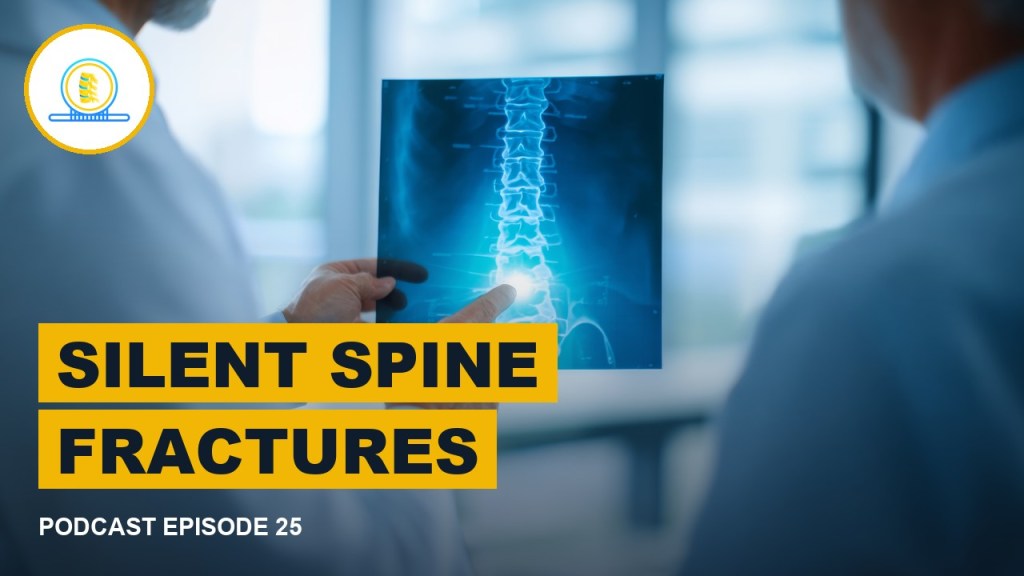
The third study is about what are sometimes called silent fractures of the spine. These are vertebral fractures that happen without a fall or any obvious symptoms, so they go unnoticed.
Wilson and colleagues, a team from Imperial College London and Oxford, published this in European Radiology. They used spine images taken during bone density scans, called DXA scans, from two thousand four hundred and forty six volunteers in UK Biobank, a large national research study. They were aged forty to seventy nine. None of them had symptoms. A fracture was counted if a vertebra had lost at least a quarter of its height.
They found moderate or severe fractures in about one in seven people. The figure rose with age, from about one in ten people in their forties, to about one in five in their seventies. And, perhaps surprisingly, fractures were more common in men than in women. Bone density, and most of the usual risk factors, were not good at predicting who had a fracture.
This was a snapshot in time, so it can’t tell us what happened to these people afterwards. And I should mention that some of the authors run a radiology practice.
The practical message is this. A normal bone density result doesn’t rule out a spine fracture, and men are affected too. If an X ray or scan report mentions a vertebral fracture, a wedge shape, or loss of height in a vertebra, ask your GP whether you need an assessment of your bone health. And sudden severe back pain after a minor fall, or even a cough, should be checked by your GP.
The fourth study moves us to long term low back pain. It’s about photobiomodulation, which is a long name for low level laser or light therapy. A device shines light on the skin over the painful area.
Tomazoni and colleagues in Brazil ran a randomised trial, published in the Journal of Physiotherapy. They recruited one hundred and forty eight adults whose back pain had lasted at least three months. Everyone did the same exercise programme, twelve sessions over six weeks. Half also had real light therapy, and half had a dummy version that looked the same. Neither the patients nor the people measuring the results knew who had which.
The result was clear. At six weeks, the difference between the groups was less than half a point on a ten point pain scale, which is too small to notice. The groups stayed similar for a whole year. There were no side effects from the treatment.
In other words, the exercise did the work, and the light added nothing useful. That fits with the National Institute for Health and Care Excellence, or NICE, guideline on low back pain. NICE recommends exercise, and advises against several machine based treatments, such as ultrasound and transcutaneous electrical nerve stimulation, or TENS, machines. It doesn’t mention light therapy specifically. So if you’re paying for treatment, I’d put your time and money into an exercise programme, ideally guided by a physiotherapist.
Our final paper is about motivation. Motivational interviewing is a style of supportive conversation that helps people find their own reasons and confidence to change a habit.
Barrett and colleagues, a team from Australia and the UK, published a review in the Annals of Behavioral Medicine. They brought together eight trials of motivational interviewing aimed at helping adults with low back pain to be more physically active.
People who received it did become more active than those who had usual care or simple advice. It was a moderate effect. But it made no clear difference to pain or disability on its own. And the researchers rated their confidence in the evidence as low for activity, and very low for pain and disability.
Even so, I think the message is a helpful one. NICE advises keeping active and exercise for low back pain, but many people find it hard to get started. Help with setting your own goals may make it easier to stick with. Start small, build up gradually, and choose something you enjoy, such as walking.
That brings us to the end of this roundup.
Before I go, a reminder that this podcast is general information, and not a substitute for advice about your own situation. Research takes time to change practice, so please don’t change your treatment based on a single study. Speak to your own GP or specialist about what’s right for you.
You can find the full written article, with links to every study, at spinemathema dot com.
And if you’ve found this helpful, please subscribe to the Spinemathema channel on YouTube, so you don’t miss the next roundup.
Thank you for listening, and take care of your spine.
References
The studies discussed in this episode. Each has a link to its record on PubMed or the publisher’s website.
- Szymoniuk M, Czyżewski W, Kochański M, et al. Symptom duration and postoperative outcomes in degenerative cervical myelopathy: a systematic review and meta-analysis. Neurosurg Rev. 2026 Oct 17;49(1):616. doi:10.1007/s10143-026-04543-z Link
- Najjar E, Akil A, Akil H, et al. One to two year outcomes after surgery for cervical myelopathy: a systematic review of symptom duration and baseline severity. Eur Spine J. 2026 Oct 7. Online ahead of print. doi:10.1007/s00586-026-10412-6 Link
- Bak AB, Pedro KM, Moghaddamjou A, Fehlings MG; CSM-Protect Study Group. Long-term dysphagia after multilevel anterior decompressive surgery for cervical myelopathy: findings from the phase III CSM-Protect trial. J Neurosurg Spine. 2026 Oct 9:1-6. Online ahead of print. doi:10.3171/2026.4.SPINE26260 Link
- Wilson DJ, Whitehouse RW, Allen GM, et al. Prevalence and predictors of silent vertebral compression fractures using DXA: a UK Biobank Imaging Study. Eur Radiol. 2026 Oct 13. Online ahead of print. doi:10.1007/s00330-026-12947-0 Link
- Tomazoni SS, de Oliveira MFD, Schardong J, et al. Photobiomodulation therapy has a negligible effect as an adjunct to motor control exercise in people with chronic non-specific low back pain: a randomised trial. J Physiother. 2026;72(4):271-277. doi:10.1016/j.jphys.2026.09.005 Link
- National Institute for Health and Care Excellence. Low back pain and sciatica in over 16s: assessment and management (NG59). Published 2016, last updated 29 July 2026. Link
- Barrett S, Dunford AR, Bewley T, et al. Motivational interviewing increases physical activity for adults with low back pain: a systematic review and meta-analysis. Ann Behav Med. 2026;60(1):kaag040. doi:10.1093/abm/kaag040 Link
This podcast is general information and is not a substitute for advice about your own situation. Please speak to your GP or specialist.
Last checked: October 2026

