🎧 Listen to this guideAbout 7 minutes. Narrated in Mr Sadek’s voice using AI technology. General information only, not personal medical advice.
On this page
Key points
- A Tarlov cyst (also called a perineural cyst) is a small sac of spinal fluid on a nerve root, usually in the sacrum at the base of the spine, most often at the S2 or S3 level.
- They are common. Studies find them on under 2 to about 13 in 100 scans of the lower spine, more often in women, and most cause no symptoms at all.
- A small number of cysts are thought to cause pain in the lower back, buttocks, pelvis or legs, often worse on sitting, and sometimes bladder, bowel or sexual symptoms. Linking symptoms to a cyst is difficult, so careful specialist assessment matters.
- Treatment options range from pain management and monitoring, to draining the cyst with a needle (sometimes sealing it with fibrin glue), to microsurgery. Most people with a cyst found by chance need no treatment.
- The evidence comes almost entirely from case series. There are no randomised trials, and results, complications and recurrence vary widely between centres.
Go to A&E or call 999 straight away if you have back pain and:
- Pain, tingling, weakness or numbness in both legs.
- Loss of feeling around your genitals or anus.
- Changes in your bladder or bowels, such as difficulty peeing, or peeing or pooing yourself.
- Changes in how your penis or vagina feels during sex, not being able to get or keep an erection, or not being able to orgasm.
- Chest pain.
- Pain that started after a serious accident, such as a car accident.
Several of these can be signs of cauda equina syndrome, which needs treatment in hospital as soon as possible. Do not drive to A&E: ask someone to drive you, or call 999 and ask for an ambulance.[1] If you already know you have a Tarlov cyst, do not assume new symptoms like these are caused by it. They still need urgent assessment.
What is a Tarlov cyst?
The spinal nerves are bathed in cerebrospinal fluid (CSF), the clear fluid that surrounds the brain and spinal cord. As each nerve root leaves the spine it is wrapped in thin layers of tissue. A Tarlov cyst is a pouch of CSF that forms within these layers, close to the nerve root’s ganglion (a small swelling on the nerve that carries sensory nerve cells).[2]
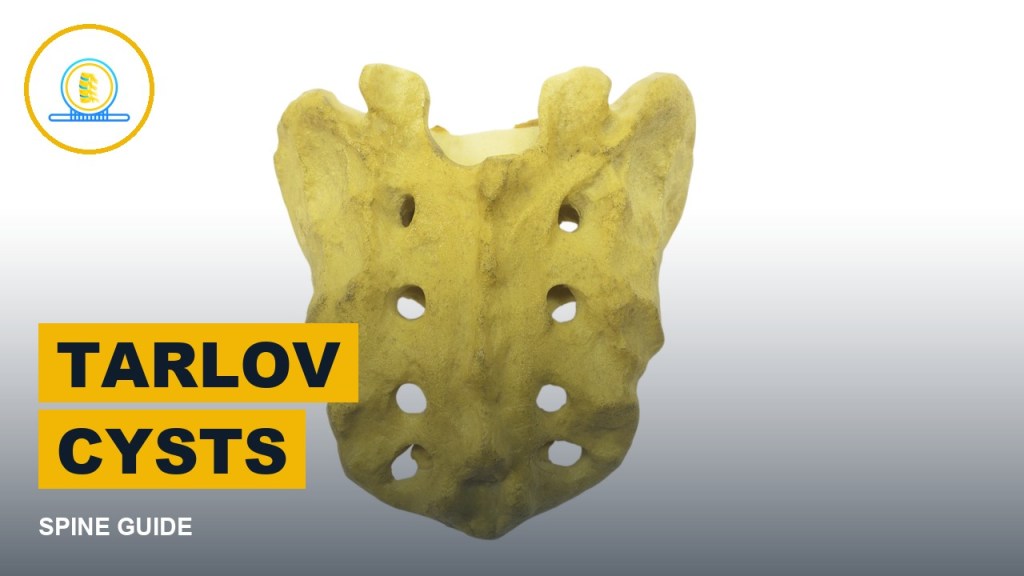
Most are found in the sacrum, the triangular bone at the base of the spine, most often on the S2 and S3 nerve roots.[2][3] Many people have more than one cyst, sometimes on both sides.[4][2]
Nerve fibres usually run in the wall of the cyst, and sometimes through it.[4][5] The cyst and the nerve are closely joined, which matters if surgery is considered.
The different names
- Tarlov cyst, after the doctor who first described them in 1938 as a finding at post-mortem examination.[6]
- Perineural (or perineurial) cyst, which describes where it sits: within the sheath around the nerve root.[2]
- Spinal meningeal cyst, a wider family of fluid-filled sacs related to the coverings of the spinal cord and nerves. A widely used 1988 classification divides them into three types. Type II covers cysts outside the main spinal sac that contain nerve root fibres,[7] which matches the description of Tarlov cysts above.
Spinal arachnoid cysts are a different condition, usually higher up in the spine, and are covered in our spinal arachnoid cysts guide.[8]
Why do they form?
Nobody knows for certain. One theory is that spinal fluid pressure slowly stretches a weak point in the nerve root sheath, with a one-way valve effect.[5][9] Conditions that weaken connective tissue, such as Ehlers-Danlos syndromes, seem to raise the risk.[10]
How common are they?
Tarlov cysts are a common chance finding on MRI scans of the lower back. How common depends on how the scan was done and who was scanned:
| Study | Who was scanned | Found a Tarlov cyst |
|---|---|---|
| Meta-analysis of 22 studies, 2021[3] | 13,266 people | About 4 in 100 overall |
| Series published 2005[6] | 3,535 people having MRI for lower back symptoms | 54 people, about 1.5 in 100 |
| US series, 1994[11] | 500 lower spine MRI scans | About 5 in 100 |
| Polish series, 2013[2] | 842 people having spinal MRI | 75 people, about 9 in 100 |
| French series, 2017[4] | 1,000 adults having MRI of the sacrum | About 13 in 100 |
So the answer is somewhere between under 2 and about 13 in 100, depending on the scan and the people studied.
- Women and men. Cysts are more common in women: about 6 in 100 women compared with 3 in 100 men in the meta-analysis.[3] In the French study, 68 in 100 people with cysts were women.[4]
- Age. The French study found cysts became more common with age.[4] The Polish study found no significant difference with age.[2]
- Children. Cysts are rare in children: about 1 in 200 in the meta-analysis, and none in the 100 children and teenagers in the French study.[3][4]
Do Tarlov cysts cause symptoms?
Specialists disagree about this. Most cysts cause no symptoms. In the 2021 meta-analysis, about 16 in 100 cysts matched the person’s symptoms.[3] In a 2005 series of 54 people with cysts, the cyst was judged to be the main cause of symptoms in 7. In 38 it was unimportant, and in 9 another problem at the same level was the real cause. Treating that other problem was enough.[6] In the 1994 series, about 1 in 100 people scanned had symptoms from their cyst.[11]
But some people are not taken seriously. A 2024 review based on more than 1,000 referrals argued that some cysts do cause symptoms that seriously affect wellbeing, mostly in women, and raised concern about gender bias in how these patients are managed.[12] A 2026 review from London described long delays, with many patients seen by several specialties before a neurosurgeon.[13]
Both can happen: a cyst can be wrongly blamed for symptoms from elsewhere, and a cyst causing symptoms can be wrongly dismissed.
Symptoms that have been linked to cysts
In people thought to have symptomatic cysts, reviews and case series describe:[10][13][14][15]
- Pain in the lower back, sacrum or buttocks, or pain, numbness or tingling around the genitals and anus (the perineum).
- Pain spreading down the leg, like sciatica. This was the most common symptom in one Swedish series.[16]
- Pain that is worse when sitting. A London review described sitting intolerance as one of the most telling features.[13]
- Pain that changes with position. This was reported by 62 in 100 women in one series.[14]
- Bladder symptoms such as urgency and needing to pee often, and bowel symptoms.[14][17]
- Sexual symptoms, such as pain during sex.[18][17]
- Leg weakness or muscle wasting, mainly with large cysts pressing on the motor nerve roots.[10]
Cysts have been reported more often in people with persistent genital arousal disorder, but this estimate was very uncertain.[3] Tailbone pain has other common causes, covered in our coccydynia guide.
Does the size of the cyst matter?
The sources disagree. In a small 2001 series, the people who did well after surgery all had cysts larger than 1.5 cm, while the 3 with smaller cysts did not improve much.[5] A 2018 systematic review found that cyst size did not significantly predict complete relief after surgery.[19] The 2026 London review concluded that size alone is not predictive. Signs that the cyst is pushing the nerve or reshaping the bone around it make it more likely to be relevant.[13]
Matching symptoms to the cyst
Symptoms should fit the nerve root involved and the side the cyst is on, but often they do not. In a US study of 242 people with pudendal neuralgia (a type of pelvic nerve pain), 39 had sacral Tarlov cysts, but in about 8 in 10 of those with full records the side or pattern of pain did not match the cyst.[20]
On the other hand, a London study of 65 women referred with pelvic symptoms and Tarlov cysts found nerve test abnormalities suggesting sacral nerve root damage in 57 in 100. The size and position of the cyst on MRI did not predict who had abnormal tests. The authors concluded that urinary incontinence was unlikely to be caused by the cyst.[17]
Can cysts get bigger?
Some do. In a US study of 28 people with symptomatic cysts scanned repeatedly over about 5 years, 7 of 42 cysts grew slowly and none shrank. Headaches that change with posture were linked with growth.[9] This small study may not apply to cysts found by chance.
How are they assessed?
The key question is whether the cyst is likely to be causing your symptoms. Other causes need to be considered, including gynaecological, urological and bowel problems, and other spinal or pelvic causes of pain such as sacroiliac joint pain.[13]
- MRI is the scan that usually finds them.[6][4] NICE advises against routine scans for back pain in a non-specialist setting, and suggests a scan in a specialist setting only if the result is likely to change your treatment.[21]
- CT myelography is a CT scan after dye is injected into the spinal fluid. It shows whether the cyst connects with the main spinal fluid space and how quickly it fills.[7][5] One surgical series used it in every patient to look for delayed filling of the cyst.[5]
- Nerve tests. Pelvic neurophysiology tests check how well the sacral nerves work.[17][13] Bladder pressure tests (urodynamics) may be used for bladder symptoms.[14][17]
- Diagnostic aspiration. Some centres drain the cyst with a needle under CT guidance. If symptoms ease while it is empty, this supports the cyst being the cause. In a Swedish series, 24 of 28 people improved after aspiration, and they were then offered surgery.[16][22]
Treatment
NICE guidance from 2007 on image-guided needle aspiration of spinal cysts, including Tarlov cysts, is still in place. It says the evidence is very limited but adequate to support its use in this rare condition, and that patients should understand the benefits are uncertain and further procedures may be needed.[8] A search of the NICE website found no guidance on fibrin glue sealing or on surgery for Tarlov cysts, and no clinical guideline on the condition itself.
No treatment, monitoring and pain management
A cyst found by chance that is not causing symptoms needs no treatment.[10][6] The 2024 systematic review suggested recording even chance findings in your notes, in case symptoms develop later.[10]
For symptoms thought to come from a cyst, the usual first step is conservative care: pain relief, with physical and psychological support where needed.[8][10] Ask your GP or pharmacist which pain relief is suitable for you. In one US centre, 72 of 167 people with symptomatic cysts were managed without a procedure.[22] How well this works has not been studied properly. In the Swedish series, 4 of 10 people who were offered surgery but chose not to have it had worse symptoms at long-term follow-up.[16]
Needle aspiration, with or without fibrin glue
Using CT to guide a needle, a radiologist drains the fluid from the cyst. On its own, this usually gives only temporary relief because the cyst tends to refill. In the 1994 series, relief lasted from 3 weeks to 6 months, and the cysts refilled in most cases.[11] NICE’s review of the early evidence reported the same.[8]
To stop refilling, some centres inject fibrin glue (a sealant made from blood clotting proteins) into the cyst after draining it. A series of 213 people at one US hospital reported that about 82 in 100 were satisfied at 1 year and 74 in 100 at 3 to 6 years, with no clinically significant complications.[23] A 2019 meta-analysis found that, compared with surgery, needle procedures had fewer complications but more cysts coming back, and more people whose symptoms got worse.[24]
Microsurgery
Surgery is considered for disabling symptoms that clearly fit the cyst and have not settled with other treatment.[10][16][25] The surgeon removes part of the back of the sacrum to reach the cyst (a sacral laminectomy or decompression).[5][18] Techniques differ, and none has been shown to be better in a randomised trial:[19]
- Fenestration: opening the cyst to let the fluid out, often combined with sealing.[16][15]
- Imbrication or plication: folding and stitching the cyst wall to make it smaller around the nerve.[15][25]
- Wrapping: wrapping the cyst to stop it re-expanding. The 2024 systematic review felt this appeared to give the best long-term results.[10]
- Sealing: closing the leak point with a patch of the patient’s own fat and fibrin glue.[26]
- Resection: removing part of the cyst wall and repairing it.[5][18]
Outcomes, risks and recurrence
These studies used different methods and definitions of success, so the figures cannot be compared directly.
| Source | What it looked at | Improvement | Complications | Cyst or symptoms returning |
|---|---|---|---|---|
| Dowsett 2018, systematic review[19] | 31 case series, 646 people, surgery | 32 in 100 complete relief, 50 in 100 partial, 16 in 100 no change, fewer than 1 in 100 worse | Reported as temporary | Not reported |
| Kameda-Smith 2024, meta-analysis[27] | 16 studies, 238 people, surgery | 81 in 100 symptom-free for more than 1 year | About 17 in 100 (range 12 to 23) | About 9 in 100 (range 3.5 to 15) |
| Sharma 2019, meta-analysis[24] | 333 people with surgery, 417 with needle procedures | About 84 in 100 in both groups | 21 in 100 surgery, 12 in 100 needle procedures | 8 in 100 surgery, 20 in 100 needle procedures |
| Chu 2022, Chinese series[26] | 265 people, microsurgical sealing | 81 in 100 at 3 years or more | 15 wound fluid leaks, 4 wound infections | Cyst smaller or gone in 94 in 100 scanned |
| Murphy 2016, US series[23] | 213 people, aspiration and fibrin glue | 82 in 100 satisfied at 1 year, 74 in 100 at 3 to 6 years | None clinically significant | Not reported |
The most common problems after surgery were wound infection and leakage of spinal fluid from the wound.[27] Temporary sciatica was also common after both surgery and needle procedures.[24] The 2024 systematic review found that surgical series reported somewhat better long-term results than needle procedures, with slightly higher risks.[10]
Pain may improve less than other symptoms
In a series of 44 people having surgery, perineal pain, bladder and sexual symptoms improved in all, but only 11 reported lasting pain control. The authors advised realistic expectations about pain relief.[18] A 2026 prospective study of 417 people found improvements in quality of life, pain and disability over 2 years after surgery, and the median comfortable sitting time rose from 15 to 45 minutes.[28] In a Finnish series of 97 people, 76 in 100 improved and 18 in 100 had a complication. People who had had previous lower back surgery were less likely to benefit.[29]
Recurrence
After aspiration alone, most cysts refill.[11][8] After surgery, recurrence was about 8 to 9 in 100 in two meta-analyses.[27][24] In a German series of 13 people followed for up to 14 years after plication surgery, 2 needed repeat surgery because the cyst came back.[25]
Bone erosion and other rare problems
A cyst can slowly thin the surrounding bone. This is a common finding on MRI: about 27 in 100 cysts in the French study had eroded the nearby bone, and about 5 in 100 extended forwards into the pelvis.[4] Rarely, very large cysts erode the sacrum or form a mass inside the pelvis.[10] Weakening of the bone can very occasionally lead to a stress fracture of the sacrum, which may need surgery to stabilise it.[30]
The evidence and its limits
There are no randomised trials comparing treatments for Tarlov cysts, or comparing treatment with careful monitoring. Almost all the evidence comes from case series, often from single centres with a special interest in one technique.[19][10] Centres choose different patients and measure success differently. Many series are small, look back at records and have short follow-up.[25] Experts do not agree on who should be treated or how.[12][24] A good result in a published series does not guarantee the same result for you.
When to get help
See your GP if you have back pain that has not improved after a few weeks of treating it at home, is stopping you doing day-to-day activities, is worse when sneezing, coughing or pooing, or if you are worried about it or struggling to cope.[1]
For emergencies, see the red box above. Ask for an urgent GP appointment or get help from NHS 111 if you have back pain and feel hot, cold, shivery or generally unwell, or if severe pain starts suddenly or gets worse quickly.[1]
If you have been told a cyst is causing your symptoms, or that it cannot be, and you are unsure, you can ask for a referral to a specialist spinal or neurosurgical team, or for a second opinion.
Questions to ask
- Do you think the cyst is causing my symptoms, or is it a chance finding? Why?
- Do my symptoms match the nerve root and the side the cyst is on?
- Would nerve tests, CT myelography or a trial aspiration help decide?
- If you suggest a procedure, how many of these do you do, and what are your results and complication rates?
- What is the chance that my pain, in particular, will improve, and what happens if the cyst comes back?
Frequently asked questions
My MRI report mentions a Tarlov cyst. Should I worry?
Usually not. Tarlov cysts are found on under 2 to about 13 in 100 scans of the lower spine, and most cause no symptoms.[3][6][4] Mention it to your doctor, especially if you have pain on sitting, pain in the buttocks or perineum, or bladder, bowel or sexual symptoms. Most cysts found by chance need no treatment.[10]
Can a Tarlov cyst cause bladder or bowel problems?
Some studies suggest cysts can affect the sacral nerves that control the bladder, bowel and sexual function.[10][17] But these symptoms have many causes, and one London study concluded that urinary incontinence was unlikely to be caused by the cyst.[17] A new change in bladder or bowel control needs urgent assessment: see the red box at the top of this page.[1]
Why does it hurt more when I sit?
Sitting puts pressure on the sacrum and the area around it. Specialists see pain on sitting as one of the more telling features of a cyst that may be causing symptoms, alongside altered sensation in the sacral or perineal area.[13] Pain on sitting also has other causes, such as tailbone problems.
Does the size of the cyst matter?
Not on its own. One small series found better surgical results with cysts larger than 1.5 cm,[5] but a systematic review did not find that size predicted complete relief,[19] and a 2026 review concluded that size alone is not predictive.[13]
Will draining the cyst with a needle fix it?
Draining alone usually gives temporary relief because the cyst tends to refill.[11][8] It can help show whether the cyst is causing symptoms.[16][22] Some centres seal the cyst with fibrin glue after draining it, with good results reported in one large series, but cysts come back more often than after surgery.[23][24]
Is surgery worth it?
For carefully selected people, reviews report improvement in most, but complications occurred in about 17 to 21 in 100 in two meta-analyses and 28 in 100 in one series, and cysts came back in about 8 to 9 in 100.[27][24][15] Pain may improve less than other symptoms.[18] The evidence is from case series only, so discuss the likely benefits and risks for you in detail.
Can a Tarlov cyst get bigger?
Some grow slowly. In one study of people with symptomatic cysts, 7 of 42 cysts grew over about 5 years and none shrank.[9] Rarely, large cysts thin the sacral bone enough to cause a fracture.[30]
Is a Tarlov cyst the same as a spinal arachnoid cyst?
No. Both contain spinal fluid, but Tarlov cysts sit on the nerve roots, usually in the sacrum, while arachnoid cysts are usually higher up the spine.[8][7] See our spinal arachnoid cysts guide.
Further reading
- Spinemathema guide: MRI scanning
- Spinemathema guide: Spinal arachnoid cysts
- Spinemathema guide: Coccydynia (tailbone pain)
- Spinemathema guide: Sacroiliac joint pain
- Spinemathema guide: Cauda equina syndrome
- Spinemathema guide: Getting a second opinion
- NHS: Back pain
- NICE HTG143: Therapeutic percutaneous image-guided aspiration of spinal cysts
Share this guide

Show the QR code to someone, or send them the link:
References
- NHS. Back pain. NHS website; page last reviewed 5 March 2026. Link
- Burdan F, Mocarska A, Janczarek M, et al. Incidence of spinal perineurial (Tarlov) cysts among East-European patients. PLoS One. 2013;8(8):e71514. Link
- Klepinowski T, Orbik W, Sagan L. Global incidence of spinal perineural Tarlov’s cysts and their morphological characteristics: a meta-analysis of 13,266 subjects. Surg Radiol Anat. 2021;43(6):855-863. Link
- Kuhn FP, Hammoud S, Lefèvre-Colau MM, Poiraudeau S, Feydy A. Prevalence of simple and complex sacral perineural Tarlov cysts in a French cohort of adults and children. J Neuroradiol. 2017;44(1):38-43. Link
- Voyadzis JM, Bhargava P, Henderson FC. Tarlov cysts: a study of 10 cases with review of the literature. J Neurosurg. 2001;95(1 Suppl):25-32. Link
- Langdown AJ, Grundy JR, Birch NC. The clinical relevance of Tarlov cysts. J Spinal Disord Tech. 2005;18(1):29-33. Link
- Nabors MW, Pait TG, Byrd EB, et al. Updated assessment and current classification of spinal meningeal cysts. J Neurosurg. 1988;68(3):366-377. Link
- National Institute for Health and Care Excellence. Therapeutic percutaneous image-guided aspiration of spinal cysts (HTG143, previously IPG223). Published 27 June 2007, last updated 1 August 2007; migrated to HealthTech guidance January 2026 with recommendations unchanged. Link
- Yang AI, Rinehart CD, McShane BJ, Hitti FL, Welch WC. Growth of lumbosacral perineural (Tarlov) cysts: a natural history analysis. Neurosurgery. 2020;86(1):88-92. Link
- Paredes Mogica JA, Feigenbaum F, Pilitsis JG, Schrot RJ, Oaklander AL, De EJB. Sacral Tarlov perineurial cysts: a systematic review of treatment options. J Neurosurg Spine. 2024;40(3):375-388. Link
- Paulsen RD, Call GA, Murtagh FR. Prevalence and percutaneous drainage of cysts of the sacral nerve root sheath (Tarlov cysts). AJNR Am J Neuroradiol. 1994;15(2):293-297. Link
- Murphy K, Nasralla M, Pron G, Almohaimede K, Schievink W. Management of Tarlov cysts: an uncommon but potentially serious spinal column disease, review of the literature and experience with over 1000 referrals. Neuroradiology. 2024;66(1):1-30. Link
- Haq IZ, Casey ATH. When to refer patients with sacral Tarlov cysts: a practical framework for identifying likely symptomatic cysts. Br J Neurosurg. 2026. Online ahead of print. Link
- Baker M, Wilson M, Wallach S. Urogenital symptoms in women with Tarlov cysts. J Obstet Gynaecol Res. 2018;44(9):1817-1823. Link
- Medani K, Lawandy S, Schrot R, Binongo JN, Kim KD, Panchal RR. Surgical management of symptomatic Tarlov cysts: cyst fenestration and nerve root imbrication, a single institutional experience. J Spine Surg. 2019;5(4):496-503. Link
- Fletcher-Sandersjöö A, Mirza S, Burström G, et al. Management of perineural (Tarlov) cysts: a population-based cohort study and algorithm for the selection of surgical candidates. Acta Neurochir (Wien). 2019;161(9):1909-1915. Link
- Hentzen C, Cabrilo I, Malladi P, et al. Sacral Tarlov cysts: neurophysiology abnormalities and correlation with pelvic sensory and visceral symptoms. Eur J Neurol. 2023;30(9):2838-2848. Link
- Galarza M, Chaban G, Gazzeri R, et al. Functional recovery following resection of large Tarlov cyst malformation: a multicentre longitudinal cohort study. Acta Neurochir (Wien). 2021;163(10):2769-2776. Link
- Dowsett LE, Clement F, Coward S, et al. Effectiveness of surgical treatment for Tarlov cysts: a systematic review of published literature. Clin Spine Surg. 2018;31(9):377-384. Link
- Lim VM, Khanna R, Kalinkin O, Castellanos ME, Hibner M. Evaluating the discordant relationship between Tarlov cysts and symptoms of pudendal neuralgia. Am J Obstet Gynecol. 2020;222(1):70.e1-70.e6. Link
- National Institute for Health and Care Excellence. Low back pain and sciatica in over 16s: assessment and management (NG59). Published 30 November 2016, last updated 29 July 2026. Link
- Tracz J, Judy BF, Jiang KJ, et al. Interventional approaches to symptomatic Tarlov cysts: a 15-year institutional experience. J Neurointerv Surg. 2024;16(7):737-741. Link
- Murphy K, Oaklander AL, Elias G, Kathuria S, Long DM. Treatment of 213 patients with symptomatic Tarlov cysts by CT-guided percutaneous injection of fibrin sealant. AJNR Am J Neuroradiol. 2016;37(2):373-379. Link
- Sharma M, SirDeshpande P, Ugiliweneza B, Dietz N, Boakye M. A systematic comparative outcome analysis of surgical versus percutaneous techniques in the management of symptomatic sacral perineural (Tarlov) cysts: a meta-analysis. J Neurosurg Spine. 2019;30(5):623-634. Link
- Weigel R, Polemikos M, Uksul N, Krauss JK. Tarlov cysts: long-term follow-up after microsurgical inverted plication and sacroplasty. Eur Spine J. 2016;25(11):3403-3410. Link
- Chu W, Chen X, Wen Z, et al. Microsurgical sealing for symptomatic sacral Tarlov cysts: a series of 265 cases. J Neurosurg Spine. 2022;37(6):905-913. Link
- Kameda-Smith MM, Fathalla Z, Ibrahim N, Astaneh B, Farrokhyar F. A systematic review of the efficacy of surgical intervention in the management of symptomatic Tarlov cysts: a meta-analysis. Br J Neurosurg. 2024;38(1):49-60. Link
- Feigenbaum F, Parks SE, Martin MP, et al. Health-related quality-of-life outcomes in surgical patients with sacral Tarlov cysts: a 2-year prospective study. Neurosurgery. 2026;98(5):1156-1165. Link
- Abdi D, Huttunen J, Leinonen V, Savolainen S, Danner N. Operative treatment of Tarlov cysts, outcomes and predictors of improvement after surgery: a series of 97 consecutive patients and a systematic review of literature. Global Spine J. 2025;15(2):1041-1048. Link
- Puffer RC, Gates MJ, Copeland W 3rd, Krauss WE, Fogelson J. Tarlov cyst causing sacral insufficiency fracture. Oper Neurosurg. 2017;13(3):E4-E7. Link
This article is general information and is not a substitute for advice about your own situation. Please speak to your GP or specialist before making any change to your treatment.
Last checked: October 2026

