🎧 Listen to this guideAbout 10 minutes. Narrated in Mr Sadek’s voice using AI technology. General information only, not personal medical advice.
Key points
- Facet joints are small paired joints at the back of each level of the spine. Like other joints, they can wear, become inflamed or be injured, and cause back or neck pain.
- No single symptom, examination test or scan reliably shows that a facet joint is the cause. Wear in these joints is very common on scans of people with no pain.
- Estimates of how often facet joints cause long-term low back pain range from about 5 in 100 to over 50 in 100. Neck figures are higher, especially after whiplash.
- NICE advises self-management, staying active and exercise first. It advises against spinal injections as a treatment for low back pain, but suggests considering radiofrequency denervation for selected people after a positive test block.
- Surgery is rarely the answer to facet joint pain alone. It is mainly considered for a related problem, such as a trapped nerve or a slipped vertebra.
Go to A&E or call 999 straight away if you have back pain together with:
- Pain, tingling, weakness or numbness in both legs.
- Loss of feeling around your genitals or bottom.
- Changes in your bladder or bowels.
- Changes in sexual sensation or function.
- Chest pain, or pain that started after a serious accident.
Do not drive yourself.[1]
What are facet joints?
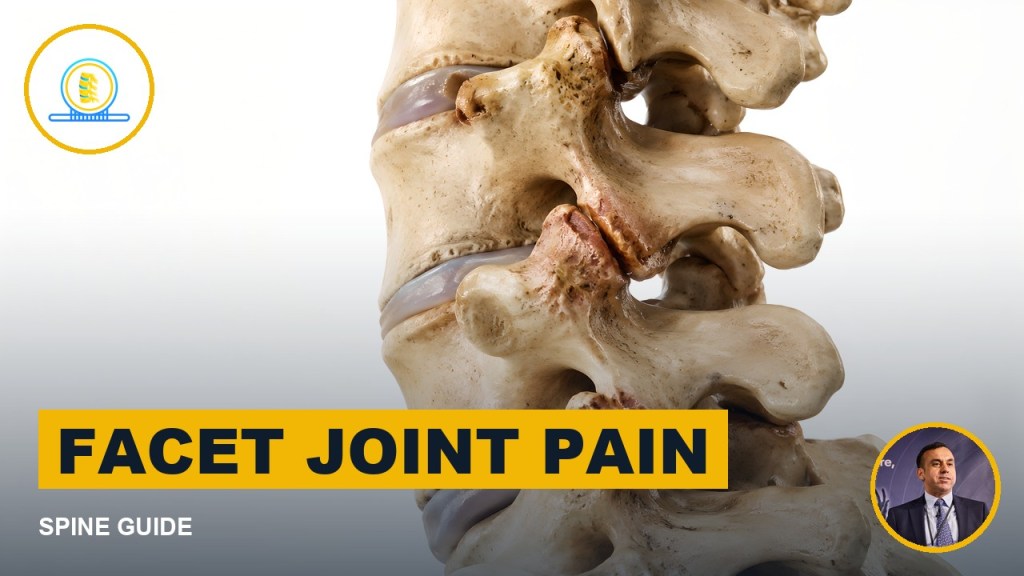
At the back of each level of your spine sits a pair of small interlocking joints, one on each side, called facet (or zygapophysial) joints. They slide over each other as you bend and twist, and help guide and limit movement.[2][3] Each has a capsule with a rich nerve supply, which is why an irritated joint can hurt.[2][3]
Pain from each joint travels along small nerves called medial branches, from the same level and the level above.[3] Our guides to lumbar medial branch nerve injections and radiofrequency treatment for facet joint back pain explain those procedures.
How does facet joint pain start?
Wear and tear (osteoarthritis or spondylosis). This is the most common cause, and is closely tied to wear of the discs.[3] As a disc thins, more weight passes through the facet joints; weak back muscles and extra body weight add to the load.[2] The cartilage can wear, bony spurs form and the joint can become inflamed.[2][3] It usually comes on gradually.[4]
After an injury. A mechanical injury is often the trigger for neck facet joint pain.[5] Whiplash, a neck injury from sudden movement of the head, most often follows traffic accidents, slips or falls, and sport.[6]
With spondylolisthesis. This is where one vertebra slips forward on the one below, most often in the lower back.[7] The age-related type is mostly linked to facet joint osteoarthritis, as worn joints hold the level less well.[3] It does not always cause symptoms.[7]
In advanced arthritis, a fluid-filled sac (synovial cyst) can bulge from the joint and press on a nerve.[3]
Where you feel it
Lower back (lumbar) facet pain
- An ache low in the back, on one or both sides, which may spread over the buttocks, hips, groin or thighs. BASS calls this “hands in pocket” pain and notes it can be mistaken for a hip problem.[2]
- The spread usually stops above the knee, without numbness or weakness, though it can occasionally reach the foot and look like sciatica.[3]
- Stiffness worst in the morning or after keeping still, easing once you get moving.[2][3]
- Pain on leaning back or twisting, and sudden spasm if you get up too quickly: the back “going”.[2]
Neck (cervical) facet pain
- Neck pain on one or both sides. In injection studies, upper neck joints sent pain into the head; lower joints to the base of the neck, top of the shoulder and shoulder blade.[5]
- After whiplash, common symptoms are neck pain and stiffness, headaches, and pain and spasms in the shoulders and arms.[6]
Why no single symptom or test settles it
NICE’s evidence review found no reliable clinical or scan features that separate facet joint pain from other back pain.[8] One review found no useful examination test for the facet joint.[9] In a later review, 14 studies looked at the facet joint, and only one test helped: a nuclear medicine scan (SPECT) showing increased activity in a joint, and even that shifted the odds only modestly.[10]
Consensus groups agree there is no telltale sign.[11][5] Tenderness beside the spine, pain worse on leaning back or twisting, no sciatica and no sign of sacroiliac joint pain make facet pain more likely.[8] In the neck, so do a history of whiplash and tenderness over the joints.[5] Pain below the knee, or pain worse on coughing, makes it less likely.[11]
How common is it?
Estimates vary widely, depending on who was studied and how strict the test was.
| Group studied | Estimate | Source |
|---|---|---|
| Final diagnoses in 2,374 people with low back pain seen by US spine surgeons | about 5 in 100 | [11] |
| Complete relief with placebo-controlled blocks (206 people) | 15 in 100 | [12] |
| Controlled blocks in a US pain clinic | 31 to 34 in 100 | [13][14] |
| NICE evidence review (75 to 100% relief from blocks) | 25 to 40 in 100 | [8] |
| NICE committee’s estimate in clinical practice | 40 to 60 in 100 | [8] |
| Some reviews of block studies | over 50 in 100 | [11] |
| Long-term neck pain | 26 to 70 in 100 | [5][13] |
| Long-term neck pain after whiplash | 54 to 60 in 100 | [5][15] |
Do I need a scan?
Wear in the facet joints is extremely common in people without pain. In a community study of 188 adults having CT scans, facet arthritis was found in 24 in 100 people under 40 and 89 in 100 of those in their sixties, and it was not linked to back pain in the past year.[16] A review of 3,110 people without symptoms found disc wear rising from 37 in 100 at age 20 to 96 in 100 at 80.[17] In the neck, one study found facet arthritis on CT in 33 in 100 people scanned for other reasons.[5]
NICE advises against routine imaging for low back pain outside specialist care, and says specialists should consider it only if the result is likely to change treatment. No scan is needed before radiofrequency denervation.[18] Consensus groups found weak or no evidence that MRI or CT can pick out a painful facet joint.[11][5] An MRI may be arranged for pain, numbness or weakness in the legs, or if a serious cause is suspected.[7][18] See our MRI guide.
Diagnosis: the medial branch block
The most accepted test is a medial branch block.[4] This is the injection Mr Sadek uses: lumbar medial branch nerve injections, placed next to the small nerves, rather than steroid injections into the facet joint itself. Under X-ray, a little local anaesthetic is placed next to the medial branch nerves. If your usual pain eases clearly but briefly, the facet joints are likely to be an important source.[8] NICE says radiofrequency denervation should only follow a positive block.[18]
A block can seem positive when the facet joints are not the cause (a false positive), for example from a placebo response, sedation, or anaesthetic spreading to nearby tissue.[11] Estimates for a single block:
- Lower back: 27 in 100[13] to about 50 in 100;[14] a trial using salt water injections found 30 in 100.[11]
- Neck: 36 to 55 in 100[5] to 63 in 100.[13]
A response to a dummy injection never means your pain is imagined.[11]
Treatment
First: self-management, staying active and exercise
NICE’s guideline NG59 recommends information to help you manage your pain, encouragement to keep up normal activities, and considering a group exercise programme. Manual therapy, such as manipulation or massage, should only be used alongside exercise. It advises against belts, corsets, traction, acupuncture and TENS.[18] The NHS advises staying active, avoiding long spells in bed, heat for stiffness, and back exercises.[1]
For neck pain, NICE’s Clinical Knowledge Summary advises staying active and physiotherapy with stretching and strengthening exercise,[19] and the NHS advises keeping your neck moving without a collar.[20] Consensus groups suggest about 3 months of non-surgical treatment before lower back facet procedures, and 6 weeks before neck blocks.[11][5]
Pain relief
Painkillers can help you keep moving; check with your pharmacist or GP which suits you.[1] NICE advises against several types of medicine for long-term low back pain.[18]
Steroid injections into the facet joints
These are different from medial branch injections: the needle goes into the joint itself rather than next to its nerves. Mr Sadek does not use them; he uses lumbar medial branch nerve injections, described above. NICE advises that spinal injections should not be offered as a treatment for low back pain.[18] Views differ: BASS states that 80% of patients get significant benefit,[2] while a 2025 review of 21 studies found success rates of 13 to 74 in 100, with very low quality evidence and no benefit shown in sham-controlled trials.[21]
Radiofrequency denervation
This uses heat to stop the medial branch nerves carrying pain signals.[8] NICE suggests considering referral for radiofrequency denervation for chronic low back pain when non-surgical treatment has not worked, the pain seems to come mainly from structures supplied by the medial branch nerves, and it scores 5 or more out of 10, but only after a positive block.[18] The committee judged the evidence mostly moderate to low quality, so this is a “consider” rather than an “offer” recommendation.[8]
The evidence is mixed:
- A 2015 Cochrane review of 23 trials (1,309 people) found moderate-quality evidence that facet denervation eased pain more than a placebo procedure in the short term, by about 1.5 points out of 10, but no high-quality evidence.[22]
- In the Dutch MINT facet trial (251 people, not blinded), everyone had a 3-month exercise programme. Adding radiofrequency denervation made a difference of 0.18 points at 3 months, well below the 2 points set as meaningful.[23]
- In a trial of 24 people with facet pain after whiplash, confirmed by placebo-controlled blocks, pain took a median 263 days to return to half its former level, against 8 days after a sham procedure.[24]
- Consensus groups conclude that carefully selected people may benefit.[11][5]
NG59 covers low back pain only. For neck pain lasting over 12 weeks despite primary care, NICE’s Clinical Knowledge Summary suggests considering a pain clinic referral.[19] Our radiofrequency guide covers the procedure and risks.
When surgery is, and isn’t, relevant
NICE advises against spinal fusion for low back pain except in a research trial, and against disc replacement.[18] Surgery becomes relevant when bony overgrowth or a synovial cyst narrows the spinal canal or presses on a nerve.[3] NICE suggests considering decompression for sciatica that matches the scan when other treatment has not helped.[18] For spondylolisthesis, a specialist may discuss fusion or decompression if other treatments have not worked.[7] See our sciatica and lumbar spinal stenosis guides.
Outlook
Back pain usually improves within a few weeks, though it can last longer or keep coming back.[1] Most neck pain lasts a few weeks.[20] Whiplash usually gets better within 2 to 3 months,[6] although NICE’s summary notes that about half of people fully recover within 6 months and up to half still have symptoms at a year.[25] After radiofrequency denervation the nerves may regrow, so treatment may need repeating.[8] These figures describe back and neck pain generally, not proven facet pain.
When to get help
See a GP if back pain has not improved after a few weeks of treating it at home, stops you doing everyday activities, is worse at night, or you have lost weight without trying.[1] See a GP if neck pain or stiffness has not gone after a few weeks, or you have pins and needles or a cold arm.[20] Ask for an urgent GP appointment or contact NHS 111 if you have back pain and feel hot, cold, shivery or generally unwell, or the pain is severe, sudden or getting worse quickly.[1] After a neck injury, do the same for severe pain despite painkillers, pins and needles, an “electric shock” feeling, problems walking, or weak hands, arms or legs.[6]
Go to A&E or call 999 straight away if you have back pain with pain, tingling, weakness or numbness in both legs; loss of feeling around your genitals or bottom; changes in your bladder or bowels; changes in sexual sensation or function; chest pain; or pain that started after a serious accident. These can be signs of cauda equina syndrome or another serious problem. Do not drive yourself.[1]
Frequently asked questions
Is facet joint pain the same as arthritis?
Often, but arthritis on a scan is common in people without pain, so it does not prove the cause.[3][16]
My scan mentions facet joint degeneration. Is that causing my pain?
Not necessarily. These changes are common with age, with or without pain.[16][17]
Can facet joint pain cause leg pain?
It can spread to the buttock, groin or thigh, usually stopping above the knee without numbness or weakness.[3][2] Pain, numbness or tingling running down one leg is more typical of sciatica,[7] which a facet joint cyst can occasionally cause.[3]
Will I need an injection?
Most people do not. NICE advises against injections as a treatment for low back pain; a block is used as a test before radiofrequency denervation.[18]
My block helped for only a few hours. Did it fail?
No. Short-lived relief is expected from a test block; radiofrequency denervation aims for longer relief.[8]
Does facet pain after whiplash get better?
Many people recover within months.[6][25] For pain that persists, a small trial found radiofrequency denervation gave lasting relief in carefully tested people.[24]
Further reading
- Spinemathema guide: Lumbar medial branch nerve injections
- Spinemathema guide: Radiofrequency treatment
- Spinemathema guide: Degenerative disc disease
- NICE NG59: Low back pain and sciatica
- NHS: Back pain
- NHS: Whiplash
Share this guide

Show the QR code to someone, or send them the link:
References
- NHS. Back pain. NHS website; page last reviewed 5 March 2026. Link
- British Association of Spine Surgeons. Lumbar facet joint syndrome: injection treatment (patient booklet). Issue 2, August 2021. Link
- Perolat R, Kastler A, Nicot B, et al. Facet joint syndrome: from diagnosis to interventional management. Insights Imaging. 2018;9(5):773-789. Link
- Cohen SP, Raja SN. Pathogenesis, diagnosis, and treatment of lumbar zygapophysial (facet) joint pain. Anesthesiology. 2007;106(3):591-614. Link
- Hurley RW, Adams MCB, Barad M, et al. Consensus practice guidelines on interventions for cervical spine (facet) joint pain from a multispecialty international working group. Reg Anesth Pain Med. 2022;47(1):3-59. Link
- NHS. Whiplash. NHS website; page last reviewed 19 August 2026. Link
- NHS. Spondylolisthesis. NHS website; page last reviewed 17 March 2026. Link
- National Guideline Centre for NICE. Low back pain and sciatica in over 16s: assessment and management. Invasive treatments (NG59 full guideline), chapter 23: radiofrequency denervation for facet joint pain. November 2016. Link
- Hancock MJ, Maher CG, Latimer J, et al. Systematic review of tests to identify the disc, SIJ or facet joint as the source of low back pain. Eur Spine J. 2007;16(10):1539-1550. Link
- Han CS, Hancock MJ, Sharma S, et al. Low back pain of disc, sacroiliac joint, or facet joint origin: a diagnostic accuracy systematic review. EClinicalMedicine. 2023;59:101960. Link
- Cohen SP, Bhaskar A, Bhatia A, et al. Consensus practice guidelines on interventions for lumbar facet joint pain from a multispecialty, international working group. Reg Anesth Pain Med. 2020;45(6):424-467. Link
- MacVicar J, MacVicar AM, Bogduk N. The prevalence of “pure” lumbar zygapophysial joint pain in patients with chronic low back pain. Pain Med. 2021;22(1):41-48. Link
- Manchikanti L, Boswell MV, Singh V, et al. Prevalence of facet joint pain in chronic spinal pain of cervical, thoracic, and lumbar regions. BMC Musculoskelet Disord. 2004;5:15. Link
- Manchikanti L, Kosanovic R, Pampati V, et al. Low back pain and diagnostic lumbar facet joint nerve blocks: assessment of prevalence, false-positive rates, and a philosophical paradigm shift from an acute to a chronic pain model. Pain Physician. 2020;23(5):519-530. Link
- Lord SM, Barnsley L, Wallis BJ, Bogduk N. Chronic cervical zygapophysial joint pain after whiplash. A placebo-controlled prevalence study. Spine (Phila Pa 1976). 1996;21(15):1737-1744. Link
- Kalichman L, Li L, Kim DH, et al. Facet joint osteoarthritis and low back pain in the community-based population. Spine (Phila Pa 1976). 2008;33(23):2560-2565. Link
- Brinjikji W, Luetmer PH, Comstock B, et al. Systematic literature review of imaging features of spinal degeneration in asymptomatic populations. AJNR Am J Neuroradiol. 2015;36(4):811-816. Link
- National Institute for Health and Care Excellence. Low back pain and sciatica in over 16s: assessment and management (NG59). Recommendations. Published 30 November 2016; last updated 29 July 2026. Link
- NICE Clinical Knowledge Summaries. Neck pain: non-specific. Last revised April 2023. Link
- NHS. Neck pain. NHS website; page last reviewed 27 April 2023. Link
- Fogarty AE, Buttner JA, Duszynski B, et al. The effectiveness of fluoroscopically guided lumbar facet steroid joint injections: a systematic review. Interv Pain Med. 2025;4(2):100587. Link
- Maas ET, Ostelo RW, Niemisto L, et al. Radiofrequency denervation for chronic low back pain. Cochrane Database Syst Rev. 2015;(10):CD008572. Link
- Juch JNS, Maas ET, Ostelo RWJG, et al. Effect of radiofrequency denervation on pain intensity among patients with chronic low back pain: the Mint randomized clinical trials. JAMA. 2017;318(1):68-81. Link
- Lord SM, Barnsley L, Wallis BJ, McDonald GJ, Bogduk N. Percutaneous radio-frequency neurotomy for chronic cervical zygapophyseal-joint pain. N Engl J Med. 1996;335(23):1721-1726. Link
- NICE Clinical Knowledge Summaries. Neck pain: whiplash injury. Last revised November 2023. Link
This article is general information and is not a substitute for advice about your own situation. Please speak to your GP or specialist before making any change to your treatment.
Last checked: October 2026

