
Key points
- The SLIP trial randomly assigned 66 people aged 50 to 80 with a stable, mild degenerative spondylolisthesis and spinal stenosis to laminectomy alone or laminectomy plus an instrumented fusion.
- At 2 years, physical health scores had improved more after fusion (an average gain of 15.2 points against 9.5), a small but statistically significant difference.
- Back related disability improved in both groups, and the difference between them was not statistically significant.
- Repeat operations were less common after fusion (14% against 34%), but fusion meant more blood loss and a longer hospital stay.
- The Swedish Spinal Stenosis Study, published in the same journal issue, found no benefit from adding fusion. Both trials are useful when weighing up the choice with your surgeon.
Landmark trial: why this question matters
Degenerative spondylolisthesis happens when one vertebra in the lower back slips forward on the one below, usually because the joints and discs have worn. The slip often narrows the spinal canal, causing lumbar spinal stenosis: pain, heaviness or tingling in the legs on walking, often with back pain.
When surgery is needed, the surgeon removes bone and ligament from the back of the spine to free the nerves. This is a laminectomy, also called a decompression. Many surgeons also add a spinal fusion, fixing the slipped vertebra to the one below with screws and rods, so that the slip cannot progress. The trial authors noted that whether adding this fusion actually leads to better results for people with a mild slip was not known.[1]
How the trial worked
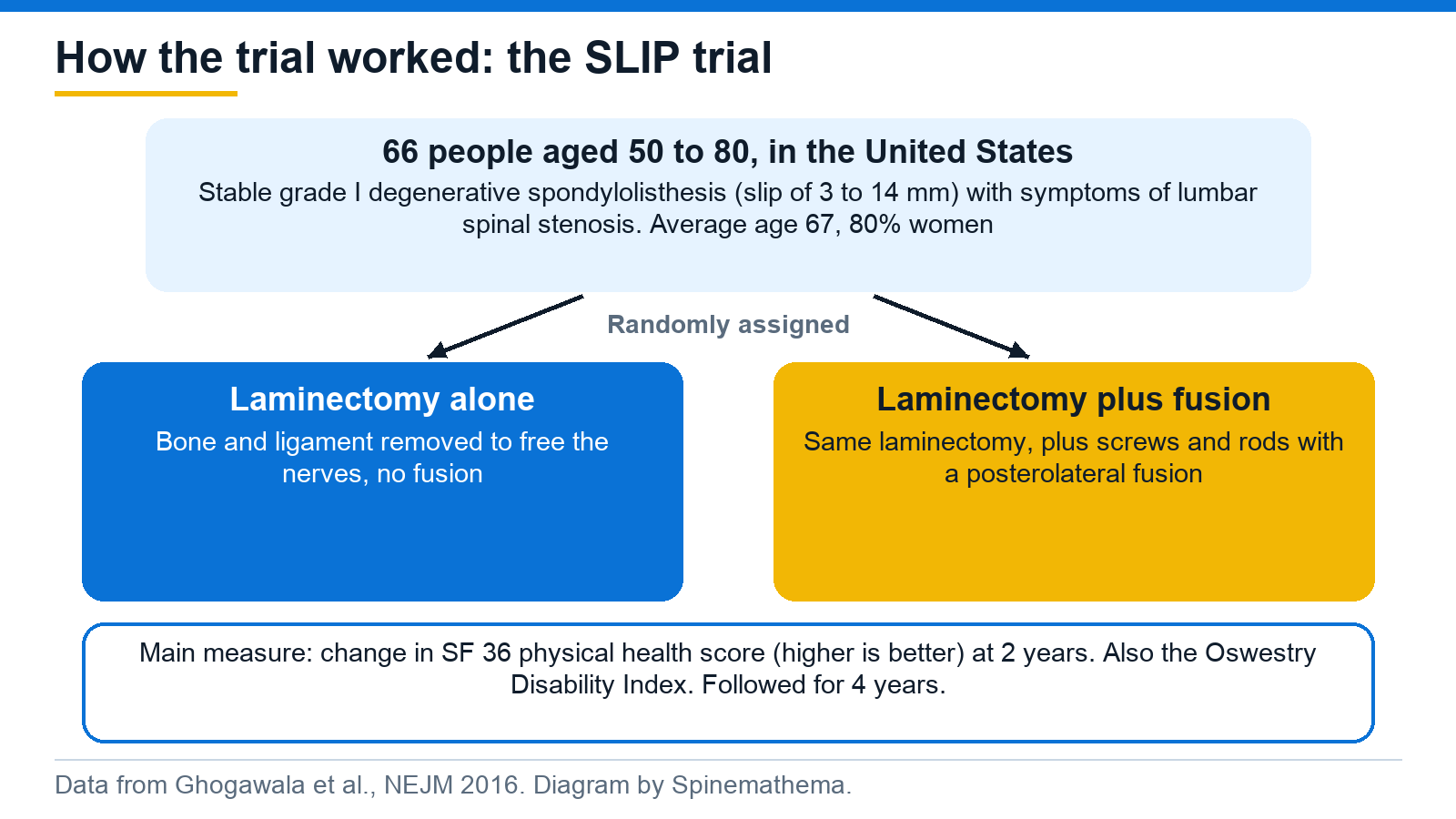
The SLIP trial, registered as the Greenwich Lumbar Stenosis SLIP Study, was a multicentre trial in the United States. It enrolled people aged 50 to 80 who had symptoms of lumbar spinal stenosis and a stable grade I degenerative spondylolisthesis, meaning a forward slip of between 3 and 14 millimetres.[1] The trial registration lists the main exclusions: previous surgery at the narrowed level, a slip that moved more than 3 millimetres on bending X-rays, a slip linked to a stress fracture (spondylolysis), and serious medical illness.[5]
66 patients were randomly assigned to one of two operations. Their average age was 67, and 80% were women. One group had a laminectomy alone. The other had the same laminectomy plus a posterolateral fusion, with pedicle screws fixed to titanium alloy rods.[1]
The main measure was the change in the physical component score of the SF 36, a widely used questionnaire about general physical health, 2 years after surgery. Higher scores mean better health. The Oswestry Disability Index (ODI), which measures how much back trouble limits daily life, was a secondary measure. Patients were followed for 4 years. Follow-up was 89% at 1 year, 86% at 2 years and 68% at 4 years.[1]
What it found
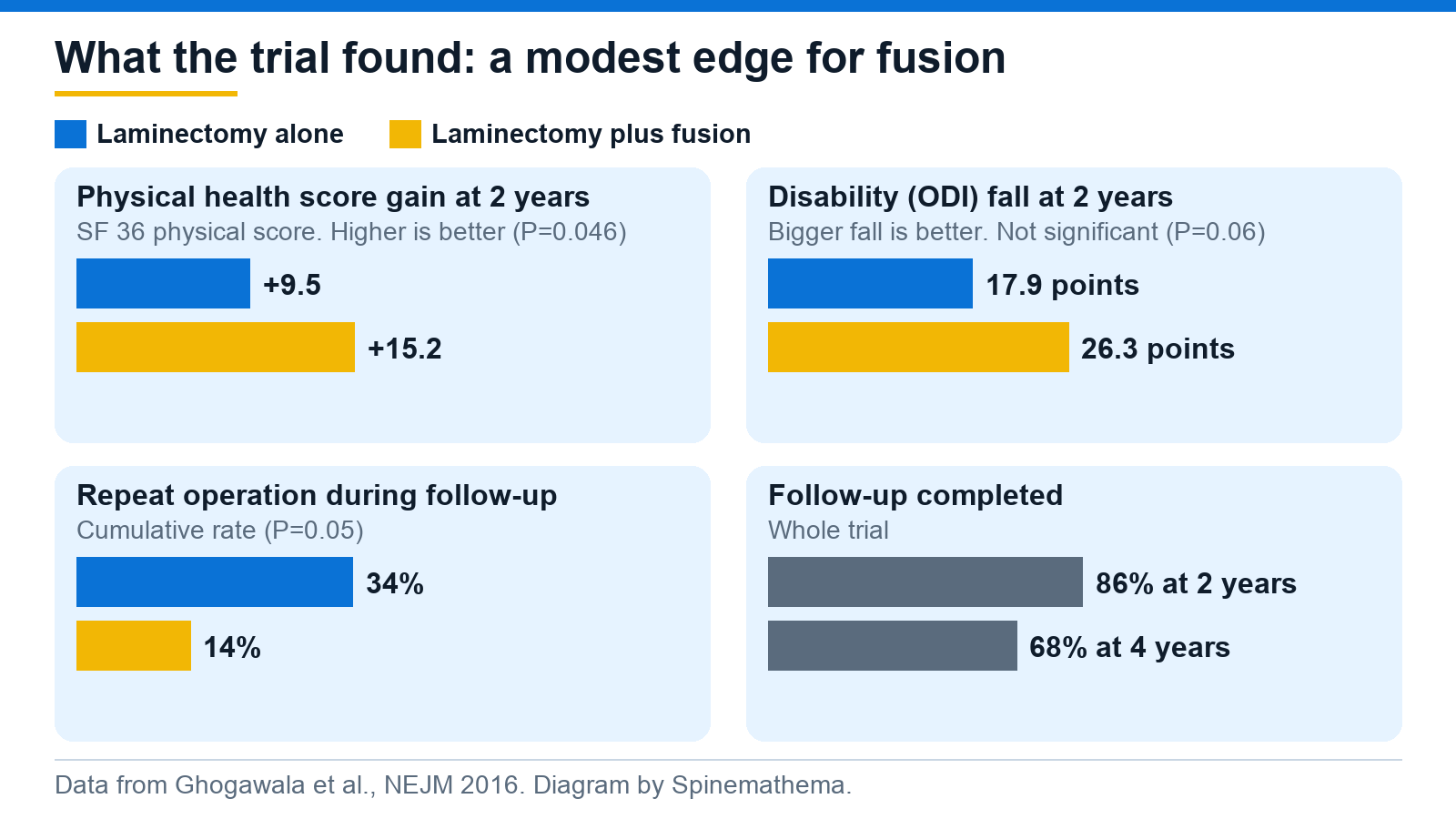
At 2 years, the physical health score had risen by an average of 15.2 points in the fusion group and 9.5 points in the laminectomy alone group. The difference of 5.7 points was statistically significant, although only just (P=0.046), and the range of plausible values was wide (0.1 to 11.3 points). The advantage for fusion was still present at 3 and 4 years.[1]
Back related disability improved in both groups. The ODI fell by an average of 26.3 points after fusion and 17.9 points after laminectomy alone, a difference that was not statistically significant (P=0.06).[1]
The fusion operation caused more blood loss and a longer hospital stay. On the other hand, the cumulative rate of repeat surgery was 14% in the fusion group and 34% in the laminectomy alone group (P=0.05).[1] The authors concluded that adding fusion gave a slightly greater but clinically meaningful improvement in physical health.[1]
Two trials, two answers
SLIP was published in the New England Journal of Medicine on 14 April 2016, in the same issue as the Swedish Spinal Stenosis Study.[2] The Swedish trial randomly assigned 247 people with stenosis, 135 of whom had a degenerative slip, and found no difference in disability at 2 years between decompression alone and decompression plus fusion. Its 5 year report found the same, with similar rates of further surgery in both groups (22% and 24%).[2,3] An editorial in the same issue discussed the two trials together.[4]
| SLIP (United States) | Swedish Spinal Stenosis Study | |
|---|---|---|
| People randomised | 66 | 247 |
| Who was included | All had a stable grade I slip | Stenosis with or without a slip (135 with) |
| Main measure | SF 36 physical health score | Oswestry Disability Index |
| Main result | Small advantage for fusion | No difference |
| Repeat surgery | 14% fusion, 34% laminectomy alone | 24% fusion, 22% decompression alone at 5 years |
Several things may explain the different answers. The trials measured different main outcomes, enrolled different patients and were very different in size. On the disability questionnaire that both trials used, neither found a statistically significant difference at 2 years.[1,2]
Limitations
- Small numbers. With 66 patients, the main result only just reached statistical significance, and the true size of the benefit is uncertain.[1]
- Missing data later on. By 4 years, only 68% of patients were followed up, which makes the longer term results less certain.[1]
- Repeat surgery. The difference in reoperations (P=0.05) sat right on the usual threshold for statistical significance.[1]
- No blinding. The trial registration lists no masking, so patients knew which operation they had, and the main outcomes were questionnaires.[5]
- A narrow group. Only people with a stable, mild slip were included, so the results do not tell us about larger or unstable slips, or about people with serious medical illness.[1,5]
- Age of the trial. Surgical techniques have continued to develop since 2016, including less invasive ways of decompressing the spine.
What it means for you
If you have a mild degenerative slip and stenosis, the evidence does not point firmly one way. SLIP suggests fusion may give a modest extra gain in physical health and fewer repeat operations. The Swedish study suggests a decompression alone gives similar results with a smaller operation and shorter hospital stay.[1,2] Your own symptoms, the features of your slip, your general health and your priorities all matter.
Questions you might ask your surgeon include:
- Is my slip stable, and has it been checked on standing or bending X-rays?
- Is my main problem leg pain, back pain, or both?
- What would recovery look like after each operation, and how long would I be in hospital?
- What are the chances I would need another operation with each approach?
If you develop numbness around the bottom or genitals, new problems passing urine or controlling your bowels, or rapidly worsening weakness in the legs, seek urgent medical help. These can be signs of cauda equina syndrome.
References
- Ghogawala Z, Dziura J, Butler WE, et al. Laminectomy plus Fusion versus Laminectomy Alone for Lumbar Spondylolisthesis. N Engl J Med. 2016;374(15):1424-1434. PMID: 27074067. Link
- Försth P, Ólafsson G, Carlsson T, et al. A Randomized, Controlled Trial of Fusion Surgery for Lumbar Spinal Stenosis. N Engl J Med. 2016;374(15):1413-1423. PMID: 27074066. Link
- Karlsson T, Försth P, Öhagen P, Michaëlsson K, Sandén B. Decompression alone or decompression with fusion for lumbar spinal stenosis: five-year clinical results from a randomized clinical trial. Bone Joint J. 2024;106-B(7):705-712. PMID: 38945544. Link
- Peul WC, Moojen WA. Fusion for Lumbar Spinal Stenosis: Safeguard or Superfluous Surgical Implant? N Engl J Med. 2016;374(15):1478-1479. PMID: 27074071. Link
- ClinicalTrials.gov. Greenwich Lumbar Stenosis SLIP Study: A Multi-center, Randomized, Prospective Clinical Trial Comparing Spinal Laminectomy to Laminectomy With Instrumented Pedicle Screw Fusion for Lumbar Stenosis With Grade I Spondylolisthesis. NCT00109213. Link
This article is general information and is not a substitute for advice about your own situation. Please speak to your GP or specialist before making any change to your treatment.


Leave a comment