
Key points
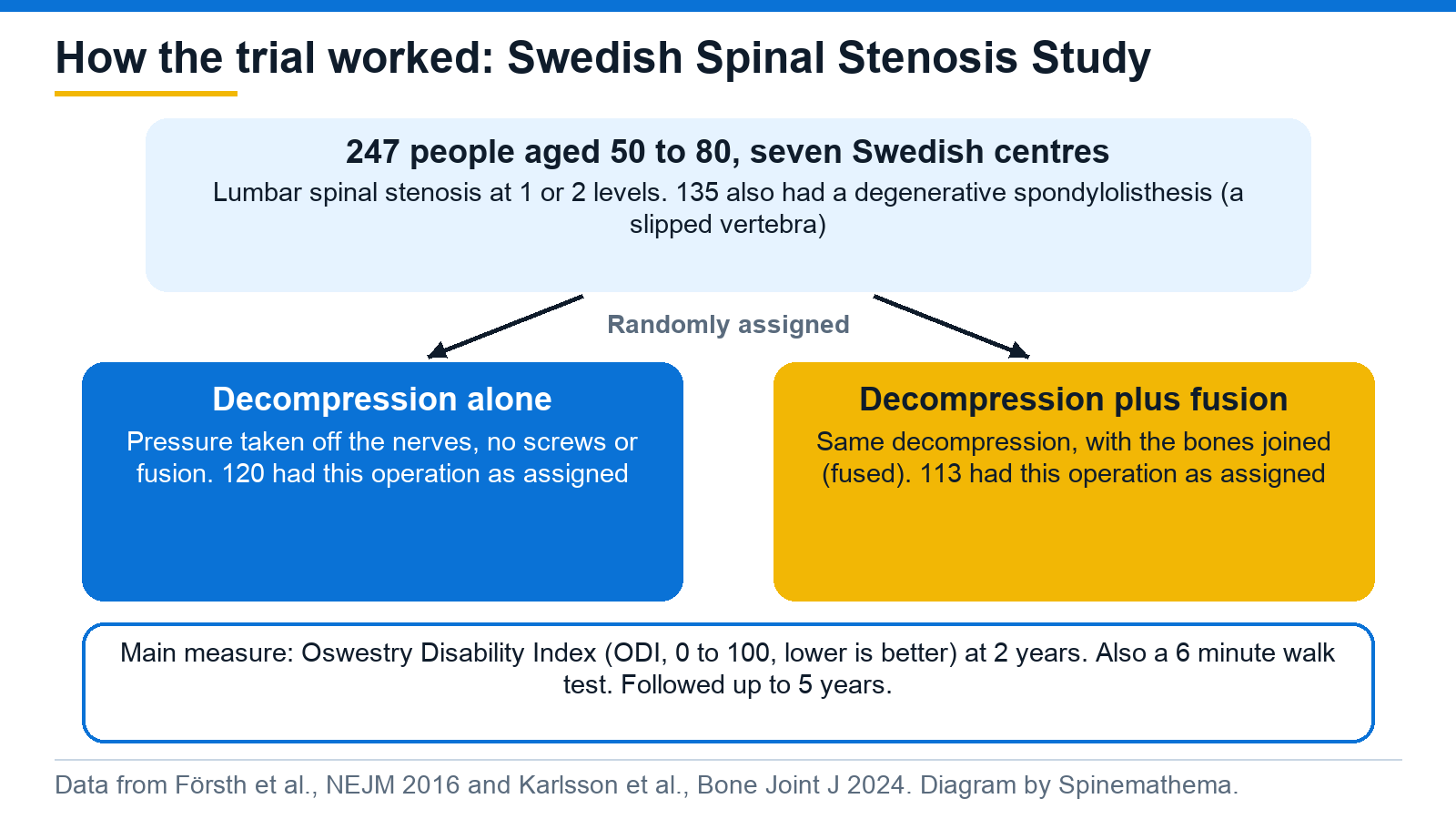
- The Swedish Spinal Stenosis Study randomly assigned 247 people aged 50 to 80 with lumbar spinal stenosis to a decompression alone or a decompression plus spinal fusion.
- 135 of them also had a degenerative spondylolisthesis (one vertebra slipped forward on the one below), which has often been seen as a reason to add a fusion.
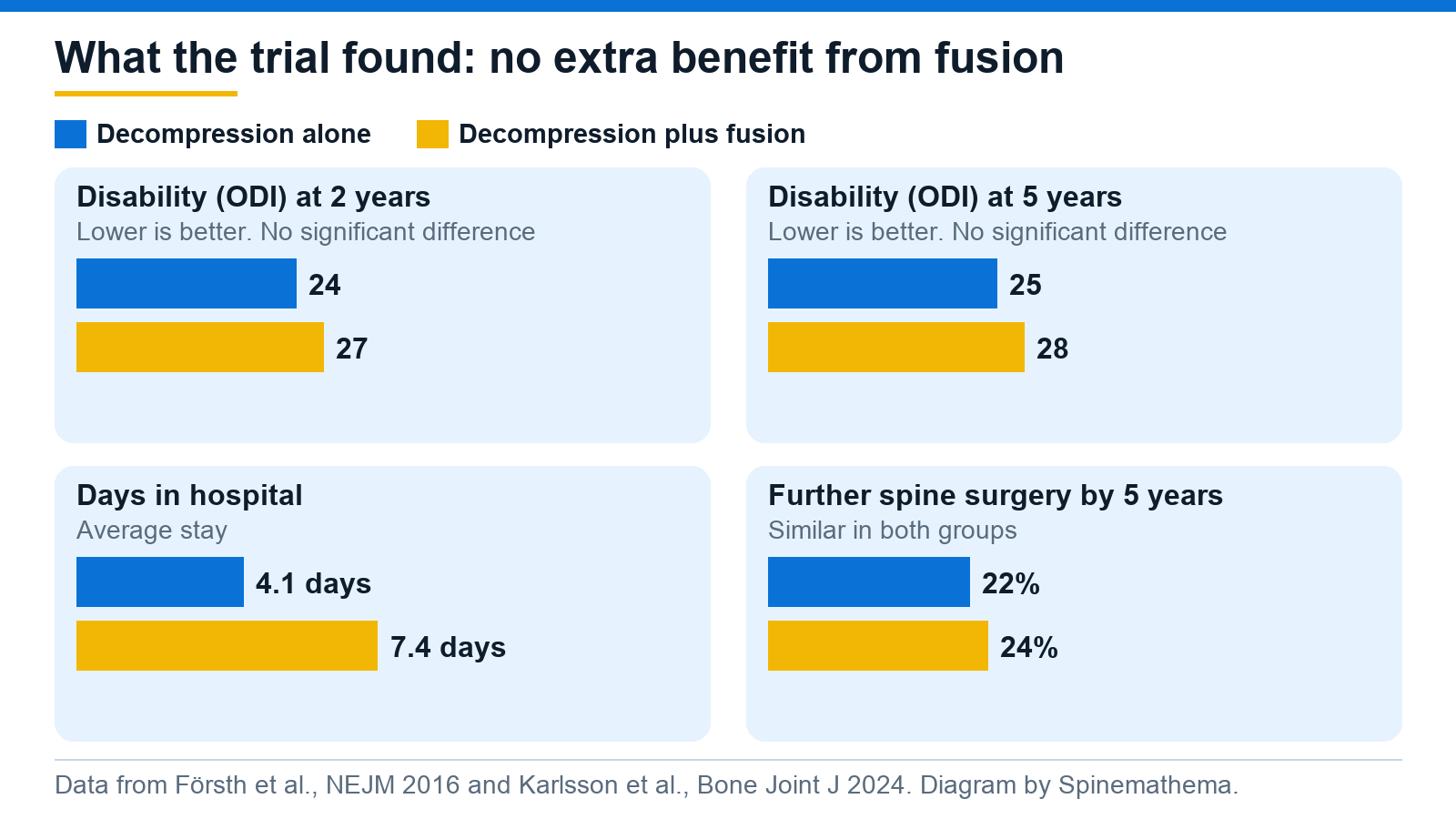
- At 2 years, disability scores and walking distance were similar in the two groups, whether or not a slip was present. The same was true at 5 years.
- Fusion meant a longer operation, more bleeding, higher costs and a longer hospital stay (7.4 days against 4.1 days on average).
- About one in five people in each group had further spine surgery, so adding a fusion did not lower the chance of another operation.
Landmark trial: why this question matters
Lumbar spinal stenosis is a narrowing of the spinal canal in the lower back, usually caused by bulging discs and age-related thickening of the joints and ligaments. It typically causes pain, heaviness or numbness in the legs when walking, which eases on sitting or bending forward. You can read more on our lumbar spinal stenosis page. When symptoms do not settle, the usual operation is a decompression: the surgeon removes bone and thickened ligament to give the nerves more room.
In some people, one vertebra has also slipped forward on the one below. This is called degenerative spondylolisthesis. For many years surgeons often added a spinal fusion in this situation, joining two vertebrae with bone graft and usually screws and rods, to stop the slip getting worse after the decompression. A fusion makes the operation bigger, though, and when this trial was planned the benefit of adding one had not been tested in controlled trials.[1]
How the trial worked
Patients were recruited between September 2006 and February 2012 at seven Swedish hospitals: Uppsala University Hospital, four regional public hospitals and two private spine centres.[2] Everyone was aged 50 to 80 and had stenosis at one or two neighbouring levels of the lower spine.[1] They had leg symptoms on walking and back pain, symptoms for more than 6 months, and narrowing confirmed on MRI.[2]
247 patients were randomly assigned to one of two operations. The randomisation was balanced for whether a slip was present, which was the case in 135 people.[1] In the decompression alone group, surgeons mostly removed the central bony arch, and sometimes made smaller openings on both sides. In the fusion group, patients had the same decompression plus a fusion, most often with screws and rods (102 of 113 people). The surgeon chose the exact technique.[2]
The main measure was the Oswestry Disability Index (ODI) 2 years after surgery. This questionnaire scores how much back trouble limits daily life, from 0 to 100, with higher scores meaning more disability. A 6 minute walk test and costs were also recorded.[1] The main analysis included only people who had the operation they were assigned to: 14 did not, and 5 were lost to follow-up.[1] Of the 233 who had their assigned operation, 120 had decompression alone and 113 had decompression plus fusion.[2]
What it found
At 2 years there was no significant difference in disability. The average ODI score was 24 after decompression alone and 27 after fusion. Walking was also similar: 405 metres in 6 minutes after decompression alone and 397 metres after fusion. The results were much the same in people with and without a slip.[1]
The fusion operation took longer, caused more bleeding and cost more. The average hospital stay was 7.4 days after fusion and 4.1 days after decompression alone. Over an average of 6.5 years, further lumbar spine surgery was needed by 22% of the fusion group and 21% of the decompression alone group.[1]
Five years on
A 5 year report was published in 2024. Of the eligible patients, 213 (95%) completed follow-up. The average ODI score was 25 after decompression alone and 28 after fusion, again not a significant difference. Quality of life scores were a little better after decompression alone. Further surgery had been needed by 22% of the decompression alone group and 24% of the fusion group, but for different reasons. After decompression alone it was mostly renewed narrowing at the same level (19 of 26 reoperations). After fusion it was mostly narrowing at the level just above the fusion (23 of 27).[2]
A separate MRI study from the same trial looked at scans 2 years after surgery. New narrowing at the operated level or the level above was seen in 47% of the fusion group and 29% of the decompression alone group. Narrowing above the fusion was the main reason. Renewed narrowing at the operated level itself was less common after fusion (4% against 14%).[3]
Limitations
- No blinding. Patients, surgeons and research staff all knew which operation had been done, which could colour how people rated their results.[2]
- Per protocol analysis. The main analysis left out the 14 people who did not have their assigned operation.[1]
- How the slip was measured. Slips were judged on X-rays taken lying down, the usual practice when the trial began. Standing and bending X-rays, now widely used to judge how much a slip moves, were not part of the assessment.[2]
- Who was left out. People with a stress fracture of the vertebra (spondylolysis), a sideways curve of more than 20 degrees, or previous surgery for stenosis or instability were excluded.[2] The results do not directly apply to them.
- Size of difference. The trial was designed to detect a difference of 12 or more ODI points.[2] It could not rule out a smaller benefit either way.
- Mixed techniques. Surgeons chose how to decompress and fuse, so the trial compares two approaches rather than two exact operations.
A different answer in the same journal
The trial was published in the New England Journal of Medicine in April 2016, in the same issue as the American SLIP trial.[4] SLIP studied 66 people who all had a stable, mild slip, and found a slightly greater improvement in physical health scores after fusion, with fewer repeat operations. The two trials differed in size, in the main outcome measured and in the patients included. An editorial in the same issue discussed both.[5]
What it means for you
For many people with lumbar spinal stenosis, including those with a mild degenerative slip, this trial suggests that a decompression alone gives similar results to a decompression plus fusion over 5 years, with a smaller operation and a shorter hospital stay. The authors concluded that their results support decompression alone as the preferred operation.[2] Newer, less invasive ways of decompressing the spine, such as tubular decompression, build on the same principle.
That does not mean fusion is never right. Some people have features this trial did not include, and surgeons weigh several factors together. A good conversation with your surgeon might cover:
- Whether my slip moves on standing or bending X-rays, and how that affects the choice.
- What a decompression alone would involve, and how long I would be in hospital.
- What the chances are that I would need another operation later, with either approach.
- Whether there is anything about my spine, such as a curve or previous surgery, that makes a fusion more likely to help.
If you develop numbness around the bottom or genitals, new problems passing urine or controlling your bowels, or rapidly worsening weakness in the legs, seek urgent medical help. These can be signs of cauda equina syndrome.
References
- Försth P, Ólafsson G, Carlsson T, et al. A Randomized, Controlled Trial of Fusion Surgery for Lumbar Spinal Stenosis. N Engl J Med. 2016;374(15):1413-1423. PMID: 27074066. Link
- Karlsson T, Försth P, Öhagen P, Michaëlsson K, Sandén B. Decompression alone or decompression with fusion for lumbar spinal stenosis: five-year clinical results from a randomized clinical trial. Bone Joint J. 2024;106-B(7):705-712. PMID: 38945544. Link
- Karlsson T, Försth P, Skorpil M, et al. Decompression alone or decompression with fusion for lumbar spinal stenosis: a randomized clinical trial with two-year MRI follow-up. Bone Joint J. 2022;104-B(12):1343-1351. PMID: 36453045. Link
- Ghogawala Z, Dziura J, Butler WE, et al. Laminectomy plus Fusion versus Laminectomy Alone for Lumbar Spondylolisthesis. N Engl J Med. 2016;374(15):1424-1434. PMID: 27074067. Link
- Peul WC, Moojen WA. Fusion for Lumbar Spinal Stenosis: Safeguard or Superfluous Surgical Implant? N Engl J Med. 2016;374(15):1478-1479. PMID: 27074071. Link
This article is general information and is not a substitute for advice about your own situation. Please speak to your GP or specialist before making any change to your treatment.


Leave a comment