🎧 Listen to this guideAbout 9 minutes. Narrated in Mr Sadek’s voice using AI technology. General information only, not personal medical advice.
On this page
- What is an annular tear?
- Tear or fissure: why the name has changed
- How common is it?
- Can an annular fissure cause pain?
- What is a high-intensity zone (HIZ)?
- Does an annular fissure heal?
- Do I need a scan?
- What helps?
- When to see a GP
- Questions to ask your specialist
- Frequently asked questions
- Further reading
- References
Key points
- An annular tear, now usually called an annular fissure, is a split in the tough outer ring of a spinal disc. It is one of the most common phrases on an MRI report of the lower back.
- It is often found in people with no back pain at all. In a large review of people without symptoms, it was seen in about 19% of 20 year olds and 29% of 80 year olds.
- Despite the name, it is usually not a fresh injury. Fissures tend to develop slowly as discs age, and a new bout of back pain rarely shows up as a new change on a scan.
- A fissure can sometimes be a source of back pain, and a disc with a fissure can go on to bulge or herniate and press on a nerve. Your specialist will match the scan to your symptoms, not treat the scan.
- Treatment follows NICE advice for low back pain: information, staying active and exercise. NICE does not recommend spinal injections or disc replacement for low back pain, and fusion is considered only in rare circumstances and/or as part of a research study. Some symptoms need urgent or emergency help.
📄 Download a one-page summary to print or share (PDF)
Go to A&E or call 999 straight away if you have back pain together with:
- Pain, tingling, weakness or numbness in both legs.
- Loss of feeling around your genitals or your bottom (anus).
- Changes in your bladder or bowels, such as difficulty peeing, or peeing or pooing yourself.
- Changes in how your penis or vagina feels during sex, not being able to get or keep an erection, or not being able to orgasm.
- Chest pain.
- Pain that started after a serious accident, such as a car accident.
Several of these can be signs of cauda equina syndrome, which needs treatment in hospital as soon as possible. Do not drive yourself to A&E: ask someone to drive you, or call 999 for an ambulance.[1] Ask for an urgent GP appointment or contact NHS 111 if you have back pain and feel hot, cold, shivery or generally unwell, or if the pain is severe, starts suddenly or is getting worse quickly.[1]
What is an annular tear?
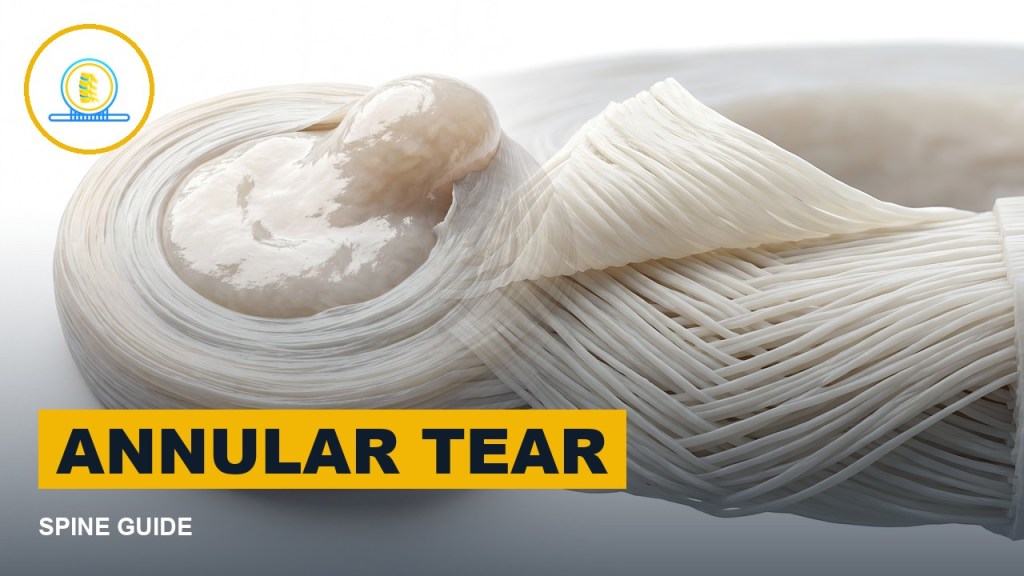
Between each pair of bones in your spine sits an intervertebral disc. Each disc has a soft, jelly-like centre (the nucleus pulposus) held in place by a tough outer ring called the annulus fibrosus. The annulus is built from many layers of strong fibres, a bit like the layers of an onion.
An annular tear, or annular fissure, is a place where those layers have separated or split. On an MRI scan it often shows up as a thin line or a small bright spot at the edge of the disc. This guide is about the lower back (the lumbar spine). Fissures can also be seen in the neck, but that is not covered here.
Tear or fissure: why the name has changed
In 2014, the North American spine and radiology societies updated the shared vocabulary used to describe discs on scans. ‘Annular fissure’ became the recommended term, and ‘annular tear’ the older one.[5][6] You may see either on your report.
Many specialists prefer ‘fissure’ because ‘tear’ sounds like something you did to your back last week. That is rarely the case. In a study that scanned 200 people before any serious back pain and again during a new episode, most scans were unchanged, and new findings were no more common after a minor injury than when the pain came on by itself.[7]
An annular fissure is a description of how a disc looks on a scan. It is not, on its own, a diagnosis of where your pain is coming from.
How common is it?
Very common, including in people who have never had back pain. A review that pooled 33 studies of more than 3,000 people without symptoms found an annular fissure in about 19% of 20 year olds, rising to about 29% of 80 year olds.[3] In the same review, signs of disc wear were seen in 37% of 20 year olds and 96% of 80 year olds. The authors concluded that many of these changes are part of normal ageing.
A second review compared adults aged 50 or under with and without back pain. Fissures were a little more common in people with back pain, but the difference was small enough that it could have been due to chance. Some other findings, such as a disc bulge or a disc that has pushed out further (an extrusion), were clearly more common in people with pain.[4]
Can an annular fissure cause pain?
Sometimes. In a healthy disc, nerve fibres reach only the outer third of the annulus. In discs removed during surgery for long-standing back pain, researchers found nerves and small blood vessels growing deeper into the disc, along the edges of the fissures.[8][9] This may explain why a damaged disc can become a source of pain in some people. Pain thought to come from the disc itself is called discogenic pain.
But research that follows people over time gives a mixed picture. In a group of adults with no back pain at the start, having a fissure on the first scan did not predict who went on to develop back pain over the next 3 years. Depression at the start was a stronger predictor of new back pain than anything on the scan.[10] When the same group was looked at again, a fissure that newly appeared during those 3 years was linked to new long-term back pain. However, new fissures were rare, and they explained very few of the people who developed pain.[11]
Put simply, a fissure can be a source of pain for some people, but seeing one on your scan does not prove it is the cause of yours. Muscles, joints, nerves and other parts of the disc can all produce similar pain, and much back pain has no single cause that a scan can show.[1]
When a fissure leads to a slipped disc
The soft centre of the disc can push out through a weak area of the annulus. This is a slipped (herniated) disc. If it presses on or irritates a nerve, it can cause sciatica: pain, tingling, numbness or weakness travelling down the leg. Sciatica is a different problem from a fissure alone, and it has its own guides on this site.
What is a high-intensity zone (HIZ)?
Some reports mention a high-intensity zone, or HIZ. This is a small bright spot at the back edge of the disc on one type of MRI image, and it usually marks a fissure. It was first described in 1992, in 28% of 500 people scanned for back pain.[12] In a group of people who had an MRI of the tummy and pelvis for other reasons, about 11% had one.[13]
A 2024 review of 25 studies found that when an HIZ is present, the disc is more likely to be a source of pain. But about half of people whose pain was thought to come from the disc had no HIZ at all.[14] So an HIZ is a clue for your specialist to weigh up, not proof.
Does an annular fissure heal?
On scans, fissures usually look much the same over time. In one study of people who had more than one MRI, the bright signal of a fissure was still there in 88% after an average of almost 2 years. The scan also could not tell how old a fissure was.[15]
That can sound discouraging, but it is the pain that matters, not the picture. The NHS says back pain usually improves within a few weeks, although it can sometimes last longer or keep coming back.[1] Many people whose pain has settled would still show the same fissure if they were scanned again. That is one reason a repeat scan just to ‘check on’ a fissure is rarely helpful.
Do I need a scan?
Most people with back pain do not. NICE advises against routine imaging for low back pain outside specialist settings, and says that even after a referral to a specialist you may not need a scan. A scan should be considered only when the result is likely to change your treatment.[2] Because fissures are so common in people without pain, a scan done without a clear reason can find one and cause worry without changing what helps. Our guide to MRI scans explains when a scan is useful.
What helps?
There is no special treatment for a fissure seen on a scan. Back pain with or without a fissure is managed the same way, following the NICE guideline for low back pain and sciatica.[2]
- Understanding and staying active. NICE advises information about back pain and encouragement to carry on with normal activities as much as you can.[2] The NHS advises not to stay in bed for long periods.[1]
- Exercise. NICE suggests considering a group exercise programme, chosen to suit your needs and preferences.[2] Walking, swimming, yoga and pilates may also help. If an exercise makes your pain worse, stop and ask your GP or physiotherapist for advice.[1]
- Hands-on treatment. Manual therapy, such as spinal manipulation, mobilisation or massage, may be considered, but only alongside exercise.[2]
- Pain relief. Ask a pharmacist or your GP which painkiller is suitable for you. A heat pack or an ice pack wrapped in a tea towel can also help.[1]
- Physiotherapy. In many areas you can refer yourself to NHS physiotherapy without seeing a GP first.[1] See our guide to physiotherapy for back and neck pain.
NICE advises that belts or corsets, traction, acupuncture, ultrasound and TENS machines should not be offered for low back pain.[2]
Injections and treatments into the disc
NICE advises that spinal injections should not be offered for low back pain.[2] Some clinics offer treatments aimed directly at a fissured disc:
- Heat treatments to the disc, using a fine probe to heat the outer ring or the centre. NICE says these raise no major safety concerns, but the evidence that they work is inconsistent or limited, so they should only be used with special arrangements for consent and audit or research. You should be told that the treatment may not help and that your pain may flare up afterwards.[16][17]
- Injections of platelet-rich plasma or stem cells into the disc. A 2022 review rated the evidence for these as very low quality.[18] If you are offered one, it is reasonable to ask what evidence supports it and what it will cost.
- Discography, a test that injects dye into discs to see whether this reproduces your pain. In a 10 year study, discs that had been injected were more likely to wear (35% compared with 14%) and to herniate than the same discs in people who had not had the test.[19] Read more in our guide to discography.
Is surgery ever needed?
Rarely, and not because of a fissure on a scan alone. Spinal fusion for low back pain is considered only in rare circumstances and/or as part of a research study: NICE advises that it should not be offered for low back pain except as part of a randomised controlled trial. NICE also advises that disc replacement should not be offered for low back pain.[2] If a fissured disc goes on to herniate and causes sciatica that does not improve with non-surgical care, an operation to free the nerve may be considered, when the scan matches your symptoms.[2] See our guide to lumbar discectomy and decompression.
When to see a GP
The NHS advises seeing a GP if you have back pain and:[1]
- It does not improve after treating it at home for a few weeks.
- It is stopping you doing your day-to-day activities.
- You are worried about the pain or are struggling to cope.
- You have lost weight without trying to.
- There is a lump or swelling in your back, or your back has changed shape.
- It does not improve with rest or is worse at night.
- It is worse when sneezing, coughing or pooing.
- It is coming from the top of your back, between your shoulders, rather than your lower back.
For pain, tingling, weakness or numbness in both legs, numbness around the genitals or bottom, or changes in bladder, bowel or sexual function, see the red box at the top of this page and go to A&E or call 999 straight away. Our warning signs page has a card you can save.
Questions to ask your specialist
- Do you think the fissure on my scan is the cause of my pain, or a normal finding for my age?
- Is there anything else on my scan that matters more?
- Is there any sign that disc material is pressing on a nerve?
- What exercise or activity would you recommend for me, and what should I avoid for now?
- If my pain is not improving, what would be the next step?
Frequently asked questions
Did I injure my back to cause an annular tear?
Usually not. Despite the name, most annular fissures develop slowly as discs age, and they are common in people who have never had back pain.[3] In a study that scanned people before and during a new bout of serious back pain, most scans had not changed, and new findings were no more common after a minor injury.[7] That is why the recommended term is now ‘annular fissure’.[5][6]
Is an annular tear serious?
On its own, it is not dangerous. It is seen in about 1 in 5 people aged 20 and nearly 3 in 10 aged 80 who have no back pain.[3] It can sometimes be a source of pain, and a disc with a fissure can go on to herniate and press on a nerve.[8][9] The warning signs in the red box on the guide need urgent help whatever your scan shows.[1]
Will my annular tear heal?
On scans, fissures often look the same for a long time: in one study the bright signal was still there in 88% after almost 2 years.[15] But back pain usually improves within a few weeks, even though it can last longer or come back.[1] The scan does not need to change for you to feel better.
Can I still exercise and lift with an annular tear?
NICE advises staying as active as you can and considering a group exercise programme suited to your needs.[2] The NHS suggests that walking, swimming, yoga and pilates may help, and to stop an exercise and seek advice if it makes your pain worse.[1] A physiotherapist can help you build back up to heavier activity.
My report mentions a high-intensity zone. What does that mean?
A high-intensity zone (HIZ) is a small bright spot at the back of the disc on one type of MRI image, usually marking a fissure. When it is present, the disc is more likely to be a source of pain, but about half of people with pain thought to come from the disc do not have one.[14] It is a clue for your specialist, not proof.
Do I need an injection or an operation for an annular tear?
Usually not. NICE advises that spinal injections and disc replacement should not be offered for low back pain. Fusion is considered only in rare circumstances and/or as part of a research study; NICE advises it should not be offered for low back pain except in a randomised controlled trial.[2] NICE says heat treatments to the disc should only be used with special arrangements because the evidence is weak.[16][17] If a fissured disc herniates and causes sciatica that does not settle, an operation to free the nerve may be considered.[2]
Further reading
- NHS: Back pain
- NHS: Sciatica
- NICE NG59: Low back pain and sciatica in over 16s
- Spinemathema guide: Degenerative disc disease
- Spinemathema guide: Slipped disc
- Spinemathema guide: MRI scans
- Spinemathema guide: Physiotherapy for back and neck pain
- Spinemathema guide: Cauda equina syndrome
References
- NHS. Back pain. NHS website; page last reviewed 5 March 2026. Link
- National Institute for Health and Care Excellence. Low back pain and sciatica in over 16s: assessment and management (NG59). Published 30 November 2016; last updated 29 July 2026. Link
- Brinjikji W, Luetmer PH, Comstock B, et al. Systematic literature review of imaging features of spinal degeneration in asymptomatic populations. AJNR Am J Neuroradiol. 2015;36(4):811-6. Link
- Brinjikji W, Diehn FE, Jarvik JG, et al. MRI findings of disc degeneration are more prevalent in adults with low back pain than in asymptomatic controls: a systematic review and meta-analysis. AJNR Am J Neuroradiol. 2015;36(12):2394-9. Link
- Fardon DF, Williams AL, Dohring EJ, et al. Lumbar disc nomenclature: version 2.0. Recommendations of the combined task forces of the North American Spine Society, the American Society of Spine Radiology and the American Society of Neuroradiology. Spine J. 2014;14(11):2525-45. Link
- Martín-Noguerol T, López-Úbeda P, Paulano-Godino F, Luna A. Natural language processing-based analysis of the level of adoption by expert radiologists of the ASSR, ASNR and NASS version 2.0 of lumbar disc nomenclature: an eight-year survey. Quant Imaging Med Surg. 2024;14(11):7780-7790. Link
- Carragee E, Alamin T, Cheng I, et al. Are first-time episodes of serious LBP associated with new MRI findings? Spine J. 2006;6(6):624-35. Link
- Freemont AJ, Peacock TE, Goupille P, et al. Nerve ingrowth into diseased intervertebral disc in chronic back pain. Lancet. 1997;350(9072):178-81. Link
- Peng B, Wu W, Hou S, et al. The pathogenesis of discogenic low back pain. J Bone Joint Surg Br. 2005;87(1):62-7. Link
- Jarvik JG, Hollingworth W, Heagerty PJ, et al. Three-year incidence of low back pain in an initially asymptomatic cohort: clinical and imaging risk factors. Spine. 2005;30(13):1541-8. Link
- Suri P, Boyko EJ, Goldberg J, Forsberg CW, Jarvik JG. Longitudinal associations between incident lumbar spine MRI findings and chronic low back pain or radicular symptoms: retrospective analysis of data from the longitudinal assessment of imaging and disability of the back (LAIDBACK). BMC Musculoskelet Disord. 2014;15:152. Link
- Aprill C, Bogduk N. High-intensity zone: a diagnostic sign of painful lumbar disc on magnetic resonance imaging. Br J Radiol. 1992;65(773):361-9. Link
- Campos M, Vial R, Castro J, Urrutia J. Prevalence of lumbar high-intensity zone: assessment using a screening tool independent of spinal symptoms. Acta Orthop Belg. 2019;85(1):47-53. Link
- Yang L, He L, Hu H, et al. Does the high-intensity zone of lumbar intervertebral disc at magnetic resonance imaging have diagnostic value for discogenic low back pain? A meta-analysis. BMC Musculoskelet Disord. 2024;25(1):869. Link
- Munter FM, Wasserman BA, Wu HM, Yousem DM. Serial MR imaging of annular tears in lumbar intervertebral disks. AJNR Am J Neuroradiol. 2002;23(7):1105-9. Link
- National Institute for Health and Care Excellence. Percutaneous electrothermal treatment of the intervertebral disc annulus for low back pain and sciatica (HTG398, formerly IPG544). 2016. Link
- National Institute for Health and Care Excellence. Percutaneous intradiscal radiofrequency treatment of the intervertebral disc nucleus for low back pain (HTG399, formerly IPG545). 2016. Link
- Schneider BJ, Hunt C, Conger A, et al. The effectiveness of intradiscal biologic treatments for discogenic low back pain: a systematic review. Spine J. 2022;22(2):226-237. Link
- Carragee EJ, Don AS, Hurwitz EL, et al. 2009 ISSLS Prize Winner: Does discography cause accelerated progression of degeneration changes in the lumbar disc: a ten-year matched cohort study. Spine. 2009;34(21):2338-45. Link
This article is general information and is not a substitute for advice about your own situation. Please speak to your GP or specialist before making any change to your treatment.
Last checked: October 2026

