Key points
- SPORT was a large American trial that randomly assigned 501 people with a slipped disc and sciatica to an operation (discectomy) or to non-surgical care.
- Both groups improved a great deal over two years. The surgery group did slightly better, but for the main measures the difference was small and not statistically significant.
- Many people did not stick to the treatment they were given: by two years, 60% of the surgery group and 45% of the non-surgical group had had an operation.
- Surgery gave faster and clearer relief of leg pain, and complications were uncommon.
- The trial supports a shared decision: for most people with a slipped disc and no emergency signs, both waiting with good non-surgical care and surgery are reasonable choices.
Why this study matters
When a disc in the lower back bulges or ruptures, it can press on a nerve and cause sciatica: pain, tingling or numbness that runs down the leg. You can read more on our slipped disc and sciatica pages. Many people get better without an operation, but some go on to have a lumbar discectomy, where the surgeon removes the piece of disc pressing on the nerve.
When the Spine Patient Outcomes Research Trial (SPORT) was set up, discectomy was the most common operation in the United States for back and leg symptoms, yet the benefit of surgery compared with non-surgical care was still debated. The authors noted that slipped discs often show up on scans in people with no symptoms, can shrink over time without surgery, and that operation rates varied up to 15 fold between regions of the United States.[1] SPORT was designed to give a fairer comparison.
How the trial worked
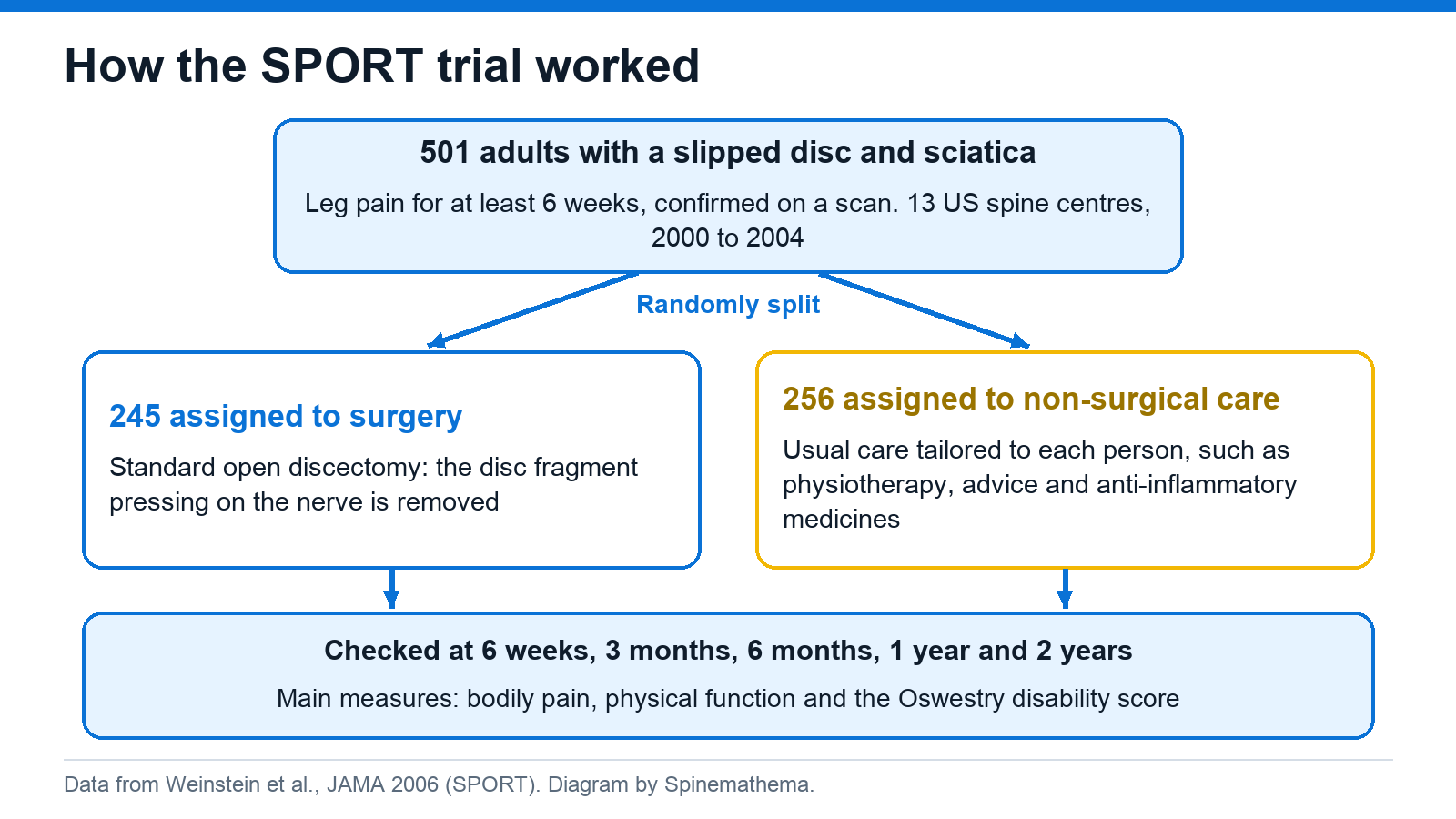
SPORT recruited adults from 13 spine centres in 11 US states between March 2000 and November 2004.[1] Everyone had leg pain from a slipped disc confirmed on a scan (97% had MRI), signs of an irritated nerve on examination, and symptoms for at least 6 weeks despite some non-surgical treatment. All were considered suitable for surgery. People with cauda equina syndrome, previous back surgery, and a few other conditions were excluded.
Of 1,991 eligible people, 501 (25%) agreed to be randomised: 245 to surgery and 256 to non-surgical care.[1] The operation was a standard open discectomy. Non-surgical care was “usual care” tailored to each person, with the protocol recommending at least active physiotherapy, education with home exercises, and anti-inflammatory medicines if tolerated. During the trial, more than 50% of patients receiving non-surgical treatment had injections such as epidural steroids.
The main measures were bodily pain and physical function (from a questionnaire called the SF-36) and the Oswestry Disability Index, a score of how much back problems affect daily life. These were recorded at 6 weeks, 3 months, 6 months, 1 year and 2 years. In total, 472 people (94%) attended at least one follow-up visit and were included in the analysis.[1]
What it found
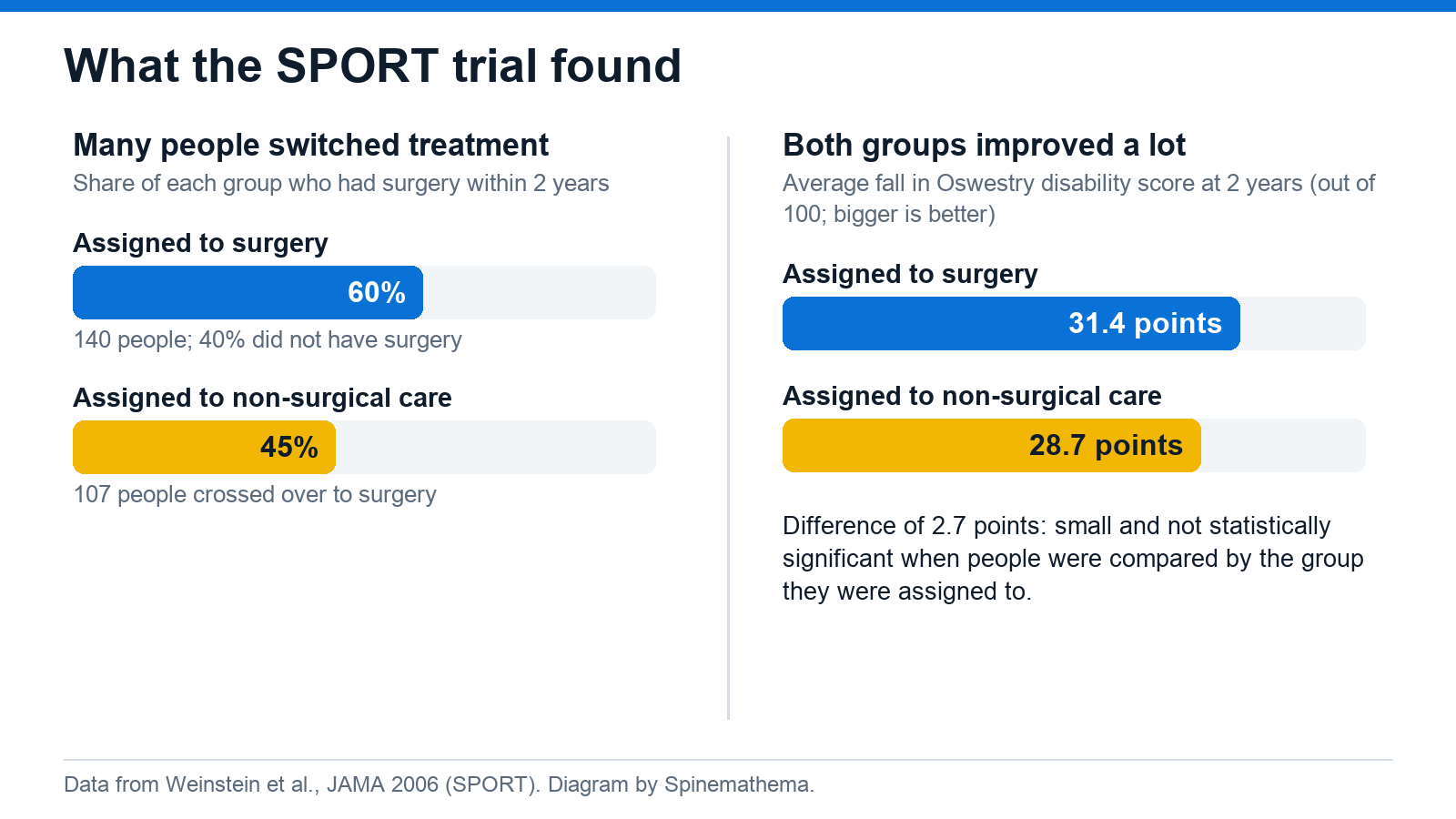
The first striking finding was how many people changed treatment. Only 50% of those assigned to surgery had their operation within 3 months, while 30% of those assigned to non-surgical care had surgery in the same period.[1] By two years, 140 people (60%) in the surgery group and 107 people (45%) in the non-surgical group had undergone surgery. People who crossed over to surgery tended to have worse pain and disability at the start; those who declined surgery tended to have milder symptoms and to feel they were already improving.
When people were analysed in the group they were originally assigned to (an “intention to treat” analysis), both groups improved substantially. The surgery group did slightly better on every measure at every time point, but for the three main measures the differences were small and not statistically significant.[1]
| Improvement at 2 years (intention to treat) | Assigned to surgery | Assigned to non-surgical care | Difference |
|---|---|---|---|
| Bodily pain (SF-36, higher is better) | 40.3 points | 37.1 points | 3.2 (not significant) |
| Physical function (SF-36, higher is better) | 35.9 points | 35.9 points | 0 (not significant) |
| Oswestry disability score (fall) | 31.4 points | 28.7 points | 2.7 (not significant) |
| Sciatica bothersomeness (fall, scale 0 to 24) | 10.1 points | 8.5 points | 1.6 (significant) |
Leg pain was where surgery stood out. On the Sciatica Bothersomeness Index, the surgery group improved more at 3 months, 1 year and 2 years, and this difference was statistically significant. Self-rated improvement also slightly favoured surgery.[1]
The researchers also ran an “as treated” analysis, comparing people by the treatment they actually received and adjusting for differences between them. This showed much larger, statistically significant benefits for surgery. At 1 year, for example, the advantage was 15.0 points for bodily pain, 17.5 points for physical function and 15.0 points on the Oswestry score.[1]
Safety
Complications were uncommon. There were no deaths around the time of surgery. The most common problem during the operation was a small tear in the lining around the nerves (dural tear), in 4% of patients, and 95% had no complications after surgery. About 4% needed a further operation within a year, more than half of these for a repeat disc herniation at the same level. No one in either group developed cauda equina syndrome.[1]
Limitations
- Crossover. So many people switched treatment in both directions that the intention to treat comparison mixes the two groups together and is likely to underestimate the real effect of surgery. The authors themselves concluded that no firm statement about superiority or equivalence could be made from that analysis alone.[1]
- The as treated results are less secure. Once people choose their own treatment, the protection of randomisation is lost. Statistical adjustment helps, but the authors could not exclude that differences between the groups affected the results.
- No blinding. Patients knew which treatment they had, and there was no sham operation, so some of the benefit could reflect expectations.
- Who took part. Only a quarter of eligible people agreed to be randomised, and people who could not tolerate their symptoms for 6 weeks were not included.
- Non-surgical care varied from person to person, so the trial cannot say how surgery compares with any single treatment such as an injection.
Later reports from SPORT followed patients for longer. At eight years, crossover remained high (49% of the non-surgical group and 60% of the surgery group had surgery), intention to treat differences in the main measures were still small and not statistically significant, and outcomes changed little between four and eight years in either group.[2]
What this means for patients
For someone with a slipped disc and sciatica, with no emergency signs, SPORT offers a reassuring message: most people improve a lot whichever path they take. Surgery tends to relieve leg pain faster and more completely, while careful non-surgical care allows many people to avoid an operation altogether. Neither choice is wrong.
That makes this a decision to share between you and your surgeon, based on how severe your pain is, how long it has lasted, how it affects your work and life, and how you feel about the risks of an operation. UK guidance from NICE suggests considering surgery for sciatica when non-surgical treatment has not improved pain or function and the scan matches the symptoms.[3] Options along the way may include nerve root injections, and for some people an operation such as lumbar discectomy or endoscopic discectomy.
Seek urgent help if you develop numbness around the bottom or genitals, new problems controlling your bladder or bowels, or rapidly worsening leg weakness. These can be signs of cauda equina syndrome, which needs emergency assessment and was not part of this trial.
References
- Weinstein JN, Tosteson TD, Lurie JD, et al. Surgical vs nonoperative treatment for lumbar disk herniation: the Spine Patient Outcomes Research Trial (SPORT): a randomized trial. JAMA. 2006;296(20):2441-2450. PMID: 17119140. Link
- Lurie JD, Tosteson TD, Tosteson AN, et al. Surgical versus nonoperative treatment for lumbar disc herniation: eight-year results for the Spine Patient Outcomes Research Trial. Spine. 2014;39(1):3-16. PMID: 24153171. Link
- National Institute for Health and Care Excellence. Low back pain and sciatica in over 16s: assessment and management (NG59). Published 30 November 2016, last updated 29 July 2026. Recommendations 1.3.5 and 1.3.8. Link
This article summarises published research for general education. It is not a substitute for advice about your own situation. Please speak to your GP or specialist before making any change to your treatment.


Leave a comment