Key points
- A disc does not actually “slip”. Part of its soft centre pushes out through a weakness in its tough outer wall.
- This can press on a nearby nerve root and cause sciatica.
- Many disc prolapses shrink naturally over time, and most people recover without surgery.
- Surgery (discectomy) is an option for persistent, severe leg pain or nerve weakness.
What is a slipped disc?
Your spine is made up of bones called vertebrae, stacked on top of each other. Between each pair sits an intervertebral disc, which acts as a shock absorber and allows the spine to bend and twist.
Each disc has two parts: a tough, fibrous outer ring called the annulus, and a softer, gel-like centre called the nucleus. With age and everyday wear, the outer ring can develop small tears. In a disc prolapse (also called a disc herniation), some of the soft centre pushes out through one of these tears.
The term “slipped disc” is a little misleading, because the disc itself stays in place. In the lower back, prolapses most often happen at the two lowest levels, known as L4/L5 and L5/S1, because these levels carry the most load and movement.
Why does it happen?
Often there is no single cause. Discs naturally lose water content and become less flexible with age, which makes them more prone to tears. Factors that may increase the risk include:
- Age, with prolapses most common between 30 and 50
- Heavy lifting, especially with bending and twisting at the same time
- Jobs involving long periods of sitting, driving or repetitive lifting
- Smoking, which reduces the blood supply that keeps discs healthy
- Being overweight, which increases the load on the lower back
- Family history, as genetics play a part in disc health
Sometimes a prolapse follows a clear moment such as lifting or a sneeze. Equally often, symptoms come on gradually with no obvious trigger.
Symptoms
- Lower back pain, which can be sudden in onset
- Leg pain (sciatica) if the disc presses on a nerve root, often travelling below the knee
- Numbness, pins and needles or weakness in the leg or foot
- Pain that is worse on sitting, bending, coughing or sneezing
Not every disc prolapse causes symptoms. Disc bulges and prolapses are commonly seen on MRI scans of people with no back or leg pain at all, particularly as we get older. This is why scan results always need to be interpreted alongside your symptoms and examination.
Seek urgent medical help (A&E or 999) if you have back pain or sciatica with:
- Numbness around your bottom, genitals or inner thighs (the “saddle” area)
- Difficulty passing urine, or loss of bladder or bowel control
- New sexual dysfunction
- Sciatica in both legs, or rapidly worsening weakness in a leg or foot
These can be signs of cauda equina syndrome, which needs emergency assessment. Do not wait for a routine appointment.
How is it diagnosed?
A diagnosis is usually suspected from your symptoms and an examination of the nerves in your legs. An MRI scan confirms the diagnosis and shows exactly where the disc is pressing. It is usually arranged if symptoms are severe, not improving, or if treatment such as an injection or surgery is being considered.
Will it get better on its own?
In many cases, yes. The body often gradually reabsorbs the prolapsed part of the disc, particularly larger prolapses, and inflammation around the nerve settles. Most people see a significant improvement over weeks to a few months.
While this happens, the aim is to manage pain and stay as active as possible:
- Keep moving, with regular short walks and gradual return to normal activities
- Use simple pain relief, as advised by your pharmacist or GP
- See a physiotherapist for tailored exercises and advice
- Avoid prolonged bed rest, which tends to slow recovery
If leg pain is severe or slow to settle, a nerve root injection may be offered to calm the irritated nerve.
When is surgery considered?
Surgery may be discussed if:
- Severe leg pain continues despite several weeks of non-surgical treatment
- There is significant or worsening weakness in the leg or foot
- There are signs of cauda equina syndrome, which is an emergency
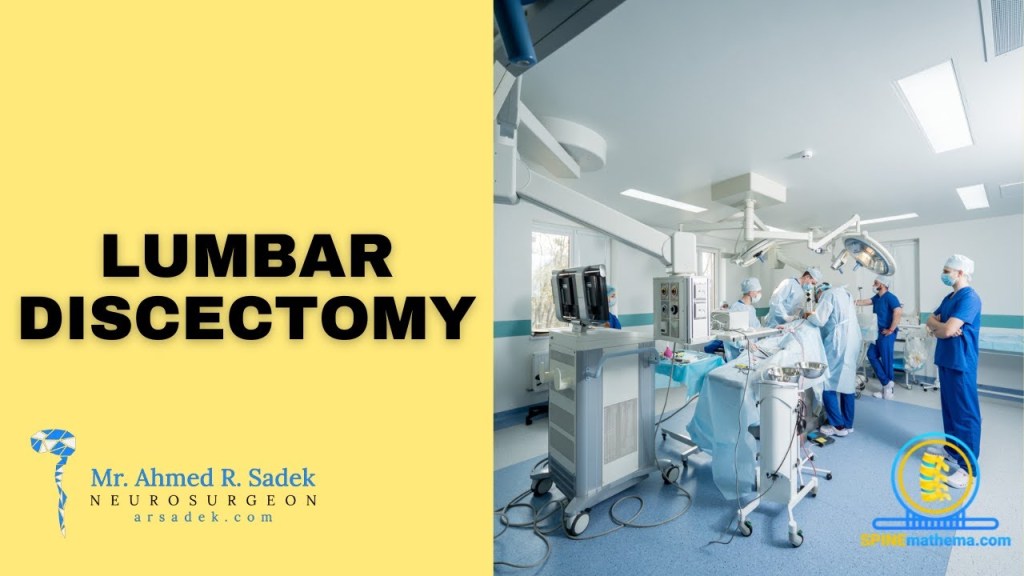
Lumbar discectomy
A microdiscectomy removes the part of the disc that is pressing on the nerve. It is usually carried out under general anaesthetic through a small incision in the back, using a microscope for precision. Most patients are up and walking the same day and go home the same or next day.
Discectomy is generally very effective for relieving leg pain. It is less predictable for back pain, so it is mainly recommended when leg symptoms are the main problem. In the video below, I explain the operation and its risks in more detail.
Risks of surgery
All surgery carries some risk. Your surgeon will discuss these in detail before you decide, but they include:
- Infection or bleeding
- A small tear in the protective lining around the nerves (a dural tear), which is usually repaired at the time of surgery
- Nerve injury, which is rare
- Blood clots in the legs or lungs
- The disc prolapsing again at the same level in a small proportion of patients
Recovery and prevention
After a disc prolapse, whether or not you have surgery, staying active is one of the most helpful things you can do. Most people return to desk-based work within a few weeks, and to more physical work over a longer period, guided by their team.
Keeping your core and back muscles strong, maintaining a healthy weight, not smoking and using good lifting technique may all help to protect your discs in the future.
This guide is general information and is not a substitute for advice about your own situation. Please speak to your GP or specialist.


Leave a comment