

Key points
- Metastatic spinal cord compression (MSCC) happens when cancer that has spread to the spine presses on the spinal cord. NICE advises it is treated as an oncological emergency.
- In the Patchell trial, 101 people with MSCC were randomly assigned to surgery followed by radiotherapy, or to radiotherapy alone.
- After treatment, 84% of the surgery group could walk, compared with 57% of those who had radiotherapy alone.
- Of 32 people who could not walk at the start, 10 of 16 regained walking after surgery, compared with 3 of 16 after radiotherapy alone.
- The trial was small, stopped early and is now 20 years old. In the UK, NICE guidance (NG234, 2023) sets out urgent pathways, including an MRI scan within 24 hours.
What is metastatic spinal cord compression?
Some cancers can spread (metastasise) to the bones of the spine. If a deposit presses on the spinal cord, or on the bundle of nerves at the bottom of the spine (the cauda equina), it can cause pain, weakness, numbness and problems with the bladder and bowels. This is called metastatic spinal cord compression, or MSCC. NICE advises that, in someone with a past or current cancer diagnosis, symptoms or signs of cord compression should be treated as an oncological emergency.[2]
NICE also lists back pain features that can suggest cancer has spread to the spine: severe pain that does not let up, pain that keeps getting worse, pain on standing, sitting or moving, pain made worse by coughing, sneezing or straining on the toilet, night pain that disturbs sleep, a tender spot on the spine, and pain or cramping in the legs when walking. In someone with cancer, NICE advises specialist advice within 24 hours if these occur.[2]
Seek help immediately if you have, or have had, cancer and develop:
- Problems controlling your bladder or bowels
- Difficulty walking or a change in the way you walk
- Weakness in your arms or legs
- Numbness, pins and needles or loss of feeling
- Nerve pain spreading out from the spine (radicular pain)
NICE lists these as symptoms and signs suggesting cord compression.[2] Contact your cancer team or acute oncology service straight away, and if you cannot reach them, seek emergency care. Do not wait for a routine appointment.
Landmark trial: why this question matters
Before this trial, the standard treatment for MSCC was corticosteroids and radiotherapy, and the role of surgery had not been established.[1] Being able to walk matters enormously to quality of life, so the question was whether an operation to remove the tumour pressing on the cord, followed by radiotherapy, could keep more people on their feet than radiotherapy alone.
How the trial worked
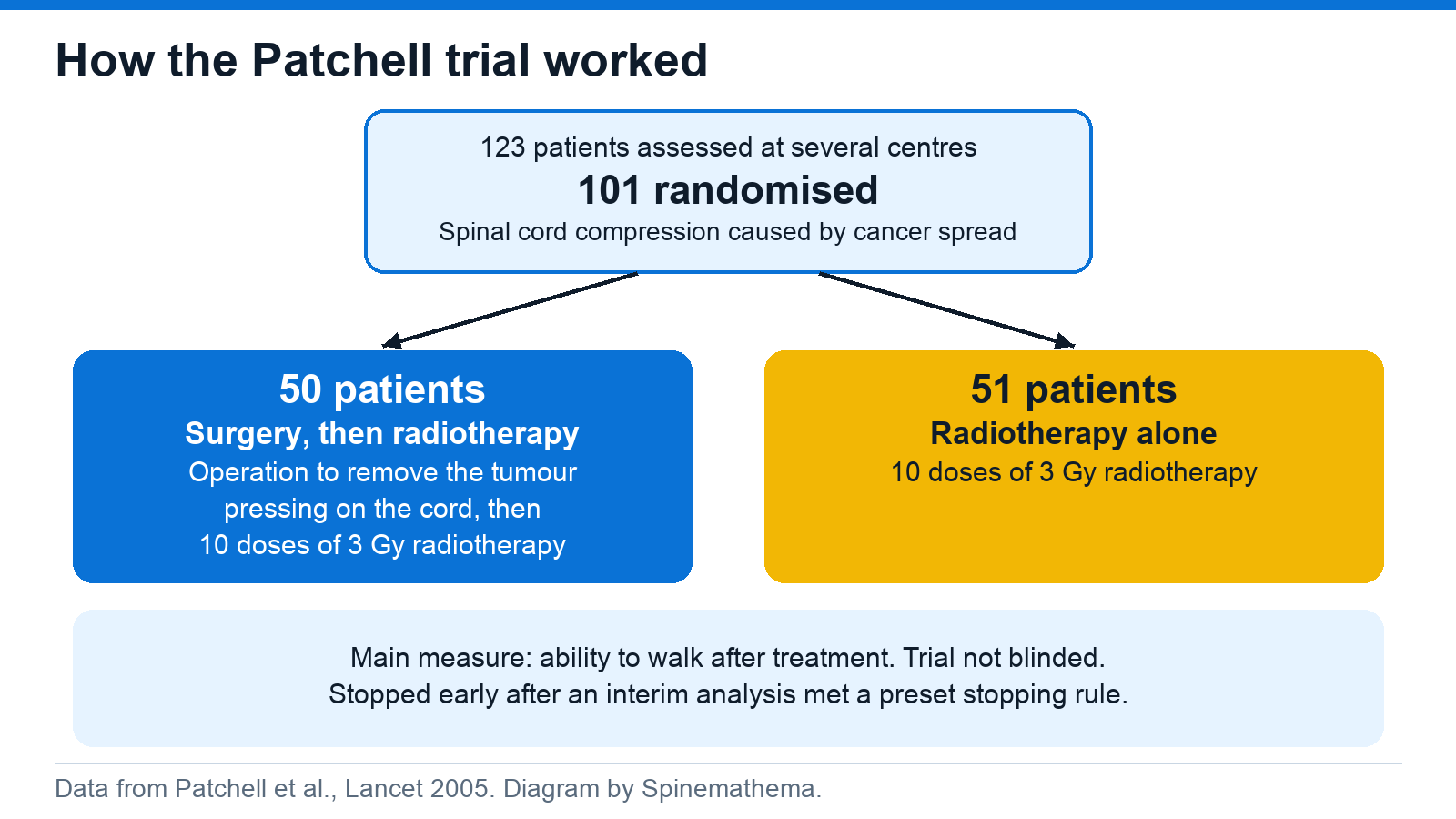
Patchell and colleagues, based in Lexington, Kentucky, USA, ran a randomised trial across several institutions and published it in The Lancet in 2005.[1] People with spinal cord compression caused by metastatic cancer were randomly assigned to direct decompressive surgery followed by radiotherapy (50 patients) or to radiotherapy alone (51 patients). Both groups had the same radiotherapy: ten treatments (fractions) of 3 Gy each.
The main measure was the ability to walk after treatment. Other measures included bladder control (continence), muscle strength and function, the need for steroids and strong painkillers (opioids), and survival time. Results were analysed by intention to treat, meaning people were compared in the groups they were assigned to. The trial was not blinded.
The trial was stopped early. A planned interim analysis met a predetermined stopping rule, by which point 123 patients had been assessed and 101 randomised.[1]
What it found
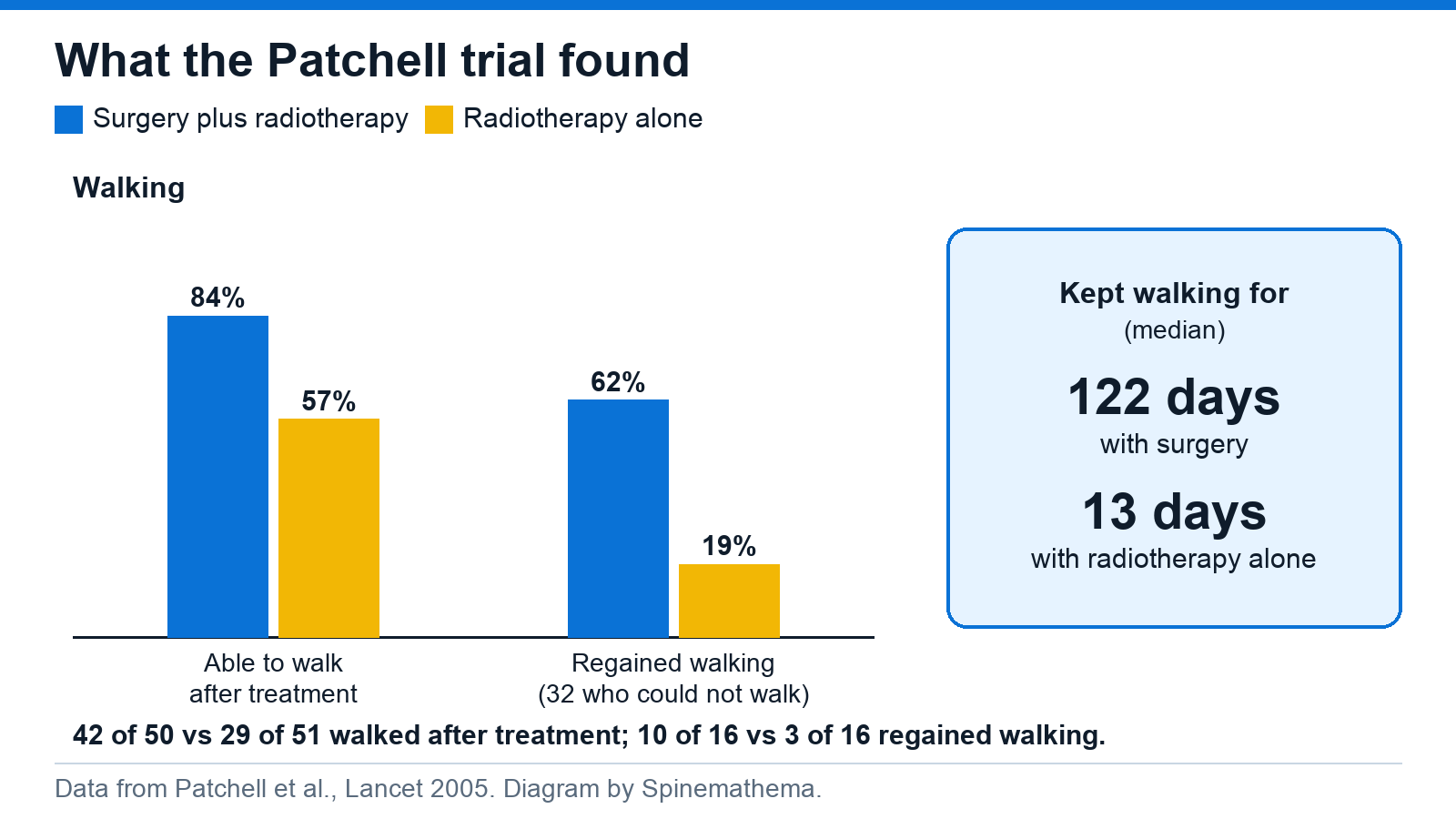
Significantly more people in the surgery group could walk after treatment: 42 of 50 (84%), compared with 29 of 51 (57%) with radiotherapy alone.[1] People who had surgery also kept the ability to walk for much longer, a median of 122 days compared with 13 days.
The difference was most striking in the 32 people who could not walk when they entered the trial. After surgery, 10 of 16 (62%) walked again, compared with 3 of 16 (19%) after radiotherapy alone. The surgery group also needed significantly less corticosteroid and opioid medication.[1] The published summary lists continence and survival time as other outcomes but does not give those figures, so we have not reported them here.
| Outcome | Surgery plus radiotherapy | Radiotherapy alone |
|---|---|---|
| Able to walk after treatment | 42 of 50 (84%) | 29 of 51 (57%) |
| Kept the ability to walk (median) | 122 days | 13 days |
| Regained walking, among those unable to walk at entry | 10 of 16 (62%) | 3 of 16 (19%) |
Limitations
- The trial was small, with 101 patients, and the comparison among people who could not walk involved only 32.
- It was stopped early after an interim analysis. Trials stopped early because of benefit can overestimate the size of an effect.
- It was not blinded, and walking was judged by people who knew which treatment had been given.
- Only 101 of the 123 people assessed were randomised, and the published summary does not set out every exclusion, so the results apply to selected patients. Surgery is not suitable for everyone with MSCC.
- The trial is now 20 years old and treatment has changed. It used ten doses of 3 Gy, whereas NICE now recommends a single 8 Gy dose for most people with MSCC having radiotherapy, considering several doses for those at high risk of side effects.[2]
How MSCC care is organised in the UK
NICE guideline NG234, Spinal metastases and metastatic spinal cord compression, was published in September 2023.[2] It asks every area to have a designated MSCC service. The first point of contact is an MSCC coordinator, a role that should be covered 24 hours a day, 7 days a week and based in an oncology service. The service should be multidisciplinary, including acute oncology, oncology, radiology, spinal surgery, physiotherapy and palliative care.
For someone with suspected MSCC, NICE recommends an MRI scan as soon as possible and always within 24 hours. People with neurological symptoms or signs should be offered dexamethasone, a steroid, as soon as possible. Before any operation, a treatment plan should be agreed by specialists such as an oncologist and a spinal surgeon. Surgery intended to halt or reverse neurological decline should be offered as soon as possible after symptoms begin, followed by radiotherapy once the person has recovered. If MSCC is not suitable for surgery, NICE recommends urgent radiotherapy within 24 hours, with some exceptions.[2]
What it means for you
The Patchell trial changed thinking about MSCC. For the patients it studied, removing the tumour pressing on the cord and then giving radiotherapy kept more people walking, and for longer, than radiotherapy alone. Today, NICE includes spinal surgery as one of the core specialties in every MSCC service.
Surgery is not right for everyone. NICE guidance takes into account the person’s overall outlook, whether the spine is stable and whether surgery is suitable, and recommends that a senior specialist develops a personalised care plan with each person. If you are facing this decision, ask your team what each option is likely to achieve for you, and what matters most to you should be part of that conversation.
Speed matters. If you have cancer and notice any of the warning signs above, contact your cancer team or acute oncology service straight away rather than waiting to see if things settle.
References
- Patchell RA, Tibbs PA, Regine WF, et al. Direct decompressive surgical resection in the treatment of spinal cord compression caused by metastatic cancer: a randomised trial. Lancet. 2005;366(9486):643-648. Link
- National Institute for Health and Care Excellence. Spinal metastases and metastatic spinal cord compression. NICE guideline NG234. Published 6 September 2023. Link
This article is general information and is not a substitute for advice about your own situation. Please speak to your GP or specialist before making any change to your treatment.


Leave a comment