
Key points
- NORDSTEN was a Norwegian trial at 16 public hospitals comparing three ways of doing a keyhole style decompression operation for lumbar spinal stenosis.
- 437 people were randomly allocated to one of the three techniques. None of them had a slipped vertebra (spondylolisthesis).
- At 2 years, disability scores had improved by a similar amount in all three groups, and complication rates were similar.
- The only clear difference was operating time: opening both sides took about half an hour longer.
- At 5 years, the three groups were still doing equally well, and rates of further spinal surgery were similar.
Landmark trial: why this question matters
Lumbar spinal stenosis is a narrowing of the spinal canal in the lower back. It often causes pain, heaviness or numbness in the legs on walking, which eases on sitting or bending forward. When symptoms are severe and do not settle, surgery to make more room for the nerves (a decompression) is a common option. The trial authors describe it as the most often performed operation on the adult lower back.[1]
The traditional operation was a full laminectomy, which removes the bony roof at the back of the spine. Over recent decades surgeons have moved to less invasive techniques that keep the midline structures in place. There are several of these, and before NORDSTEN there was little good evidence on whether any one of them works better. That matters to patients, because the techniques differ in how much muscle and bone are disturbed. If you are offered a decompression, you may reasonably ask whether the method chosen makes a difference. Our page on tubular decompression describes one keyhole approach.
How the trial worked
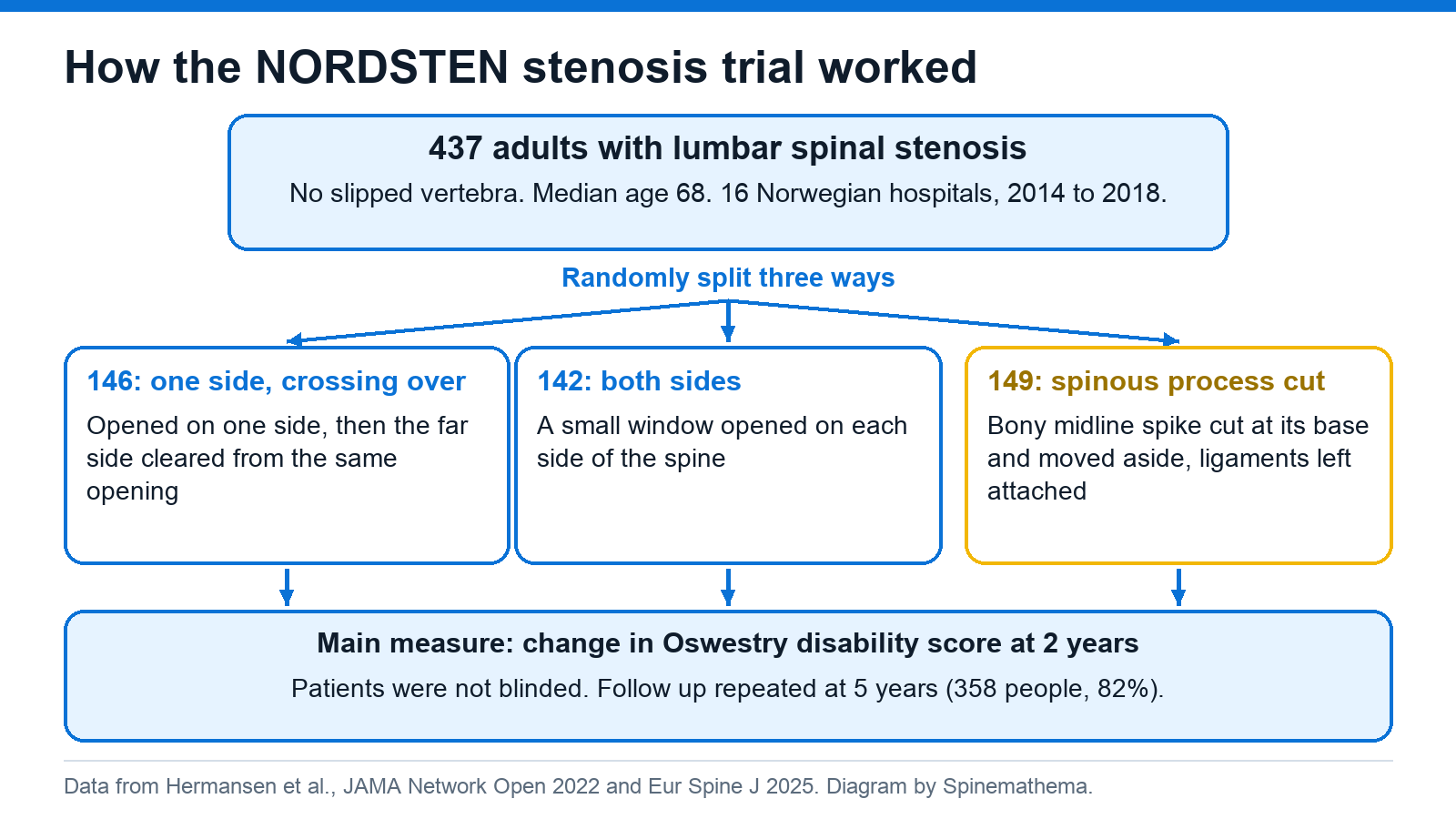
NORDSTEN (the Norwegian Degenerative Spondylolisthesis and Spinal Stenosis study) is made up of two randomised trials. This spotlight is mainly about the spinal stenosis trial. Between February 2014 and October 2018, 437 adults with symptoms of stenosis and matching MRI findings were recruited at orthopaedic and neurosurgical departments in 16 Norwegian public hospitals.[1] People with a slipped vertebra (degenerative spondylolisthesis) were excluded. The median age was 68 and 53% were men.
A computer randomly allocated each person to one of three techniques:[1]
- Unilateral laminotomy with crossover (146 people): the surgeon opens a small window on one side, then tilts the view across to clear the opposite side through the same opening.
- Bilateral laminotomy (142 people): a small window is opened on each side of the spine.
- Spinous process osteotomy (149 people): the bony spike in the midline is cut at its base and moved aside, with its ligaments left attached, so the canal can be cleared from the middle.
The main measure was the change in the Oswestry Disability Index, a questionnaire scored from 0 to 100 where lower means less disability, from before surgery to 2 years afterwards. The researchers also recorded leg and back pain, quality of life, walking related symptoms, operating time, blood loss, complications and repeat operations.[1] Patients were followed up again at 5 years.[2]
What it found
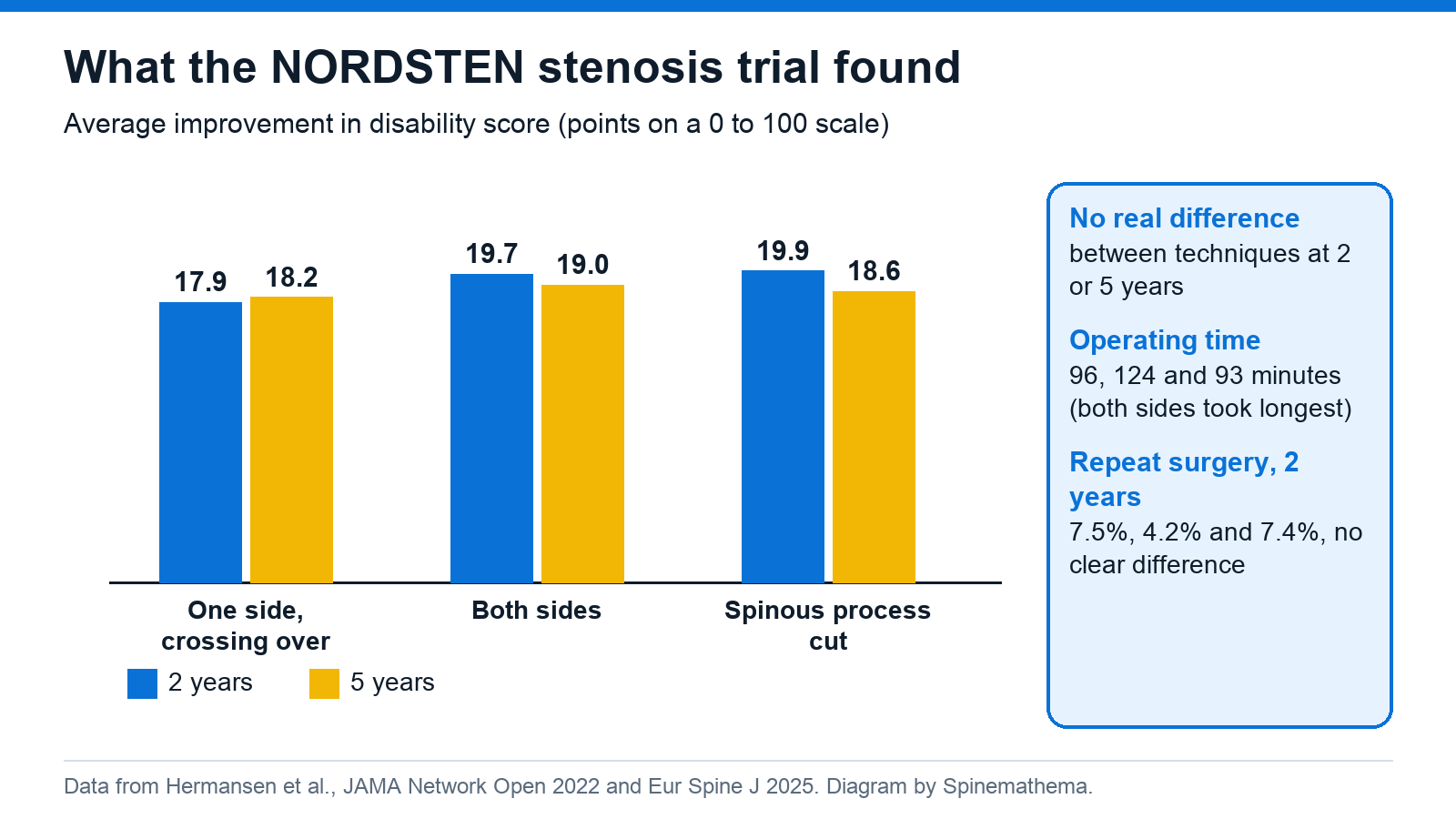
All three groups improved, and by a similar amount. At 2 years the average disability score had fallen by 17.9 points after unilateral laminotomy with crossover, 19.7 points after bilateral laminotomy and 19.9 points after spinous process osteotomy.[1] These differences were not statistically significant. Across the whole trial, about 7 in 10 people (69.5%) met the definition of success, a drop of more than 30% in their disability score.
Leg pain, back pain, quality of life, hospital stay, blood loss and complications were similar between the groups. The one clear difference was operating time: about 124 minutes for bilateral laminotomy, compared with about 96 and 93 minutes for the other two.[1] Over 2 years, 11 of 146 people (7.5%) in the crossover group, 6 of 142 (4.2%) in the bilateral group and 11 of 149 (7.4%) in the osteotomy group had a further operation, which was not a statistically significant difference.
The 5 year follow up, published in 2025, included 358 people (82% of those who took part). The average improvement in disability was 18.2, 19.0 and 18.6 points in the three groups, with no significant difference. Rates of subsequent spinal surgery were also similar.[2] In other words, the benefit held up over time, and no technique pulled ahead.
The sister trial: is a fusion needed when a vertebra has slipped?
The second NORDSTEN trial asked a different question. It included people with stenosis and a degenerative spondylolisthesis (a forward slip of 3 mm or more) and compared decompression alone with decompression plus an instrumented spinal fusion. At 2 years, 71.4% of the decompression alone group and 72.9% of the fusion group had at least a 30% improvement in disability, showing that decompression alone was not worse.[3] The 5 year report, covering the 267 people randomised, found 63% success in both groups, and the average improvement in disability was 17.8 points in both.[4] By 5 years, 16% of the decompression group and 18% of the fusion group had had a further lumbar operation.
Limitations
- Patients knew which operation they had, and the questionnaires were filled in by patients, so expectations could have influenced the scores. The statistician analysing the data was blinded.
- Recruitment stopped at 437 rather than the planned 465. The authors calculated that the trial still had close to the intended statistical power.
- None of the techniques was compared with a full laminectomy, because most centres had already stopped using it.
- People with a slipped vertebra were excluded from this trial, so the results apply to stenosis without spondylolisthesis.
- Partway through, the rules were relaxed to allow people with milder disability to join. The authors found no sign that this changed the results.
- All surgeons were familiar with all three techniques. Results may differ where a surgeon mainly uses one method.
- The 5 year paper was available to us as an abstract only, so we report only its headline figures.
What this means for you
If you are considering a decompression for lumbar stenosis without a slipped vertebra, NORDSTEN offers reassurance. The three common midline sparing techniques gave similar improvements in disability and pain, similar complication rates and similar chances of needing further surgery, and these results lasted to 5 years. It is more useful to focus on whether surgery is right for you at all, and on the experience of your surgeon with their chosen approach, than on the name of the technique.
Surgery is not the only option. Many people with stenosis manage well with physiotherapy, activity changes and pain relief. Talk through the likely benefits, risks and alternatives with your spinal team, and ask how they would approach your particular scan and symptoms. Our SPORT spotlight looks at the evidence comparing surgery with non-surgical care.
This article explains a research study and is general information only. It is not a substitute for advice from your own doctor or surgeon about your situation.
References
- Hermansen E, Austevoll IM, Hellum C, et al. Comparison of 3 Different Minimally Invasive Surgical Techniques for Lumbar Spinal Stenosis: A Randomized Clinical Trial. JAMA Netw Open. 2022;5(3):e224291. Link
- Hermansen E, Indrekvam K, Franssen E, et al. ISSLS Prize in Clinical Science 2025: A randomized trial on three different minimally invasive decompression techniques for lumbar spinal stenosis. Five years follow up from the NORDSTEN-SST. Eur Spine J. 2025;34(5):1590-1599. Link
- Austevoll IM, Hermansen E, Fagerland MW, et al. Decompression with or without Fusion in Degenerative Lumbar Spondylolisthesis. N Engl J Med. 2021;385(6):526-538. Link
- Kgomotso EL, Hellum C, Fagerland MW, et al. Decompression alone or with fusion for degenerative lumbar spondylolisthesis (Nordsten-DS): five year follow up of a randomised, multicentre, non-inferiority trial. BMJ. 2024;386:e079771. Link
This article is general information and is not a substitute for advice about your own situation. Please speak to your GP or specialist before making any change to your treatment.


Leave a comment