Key points
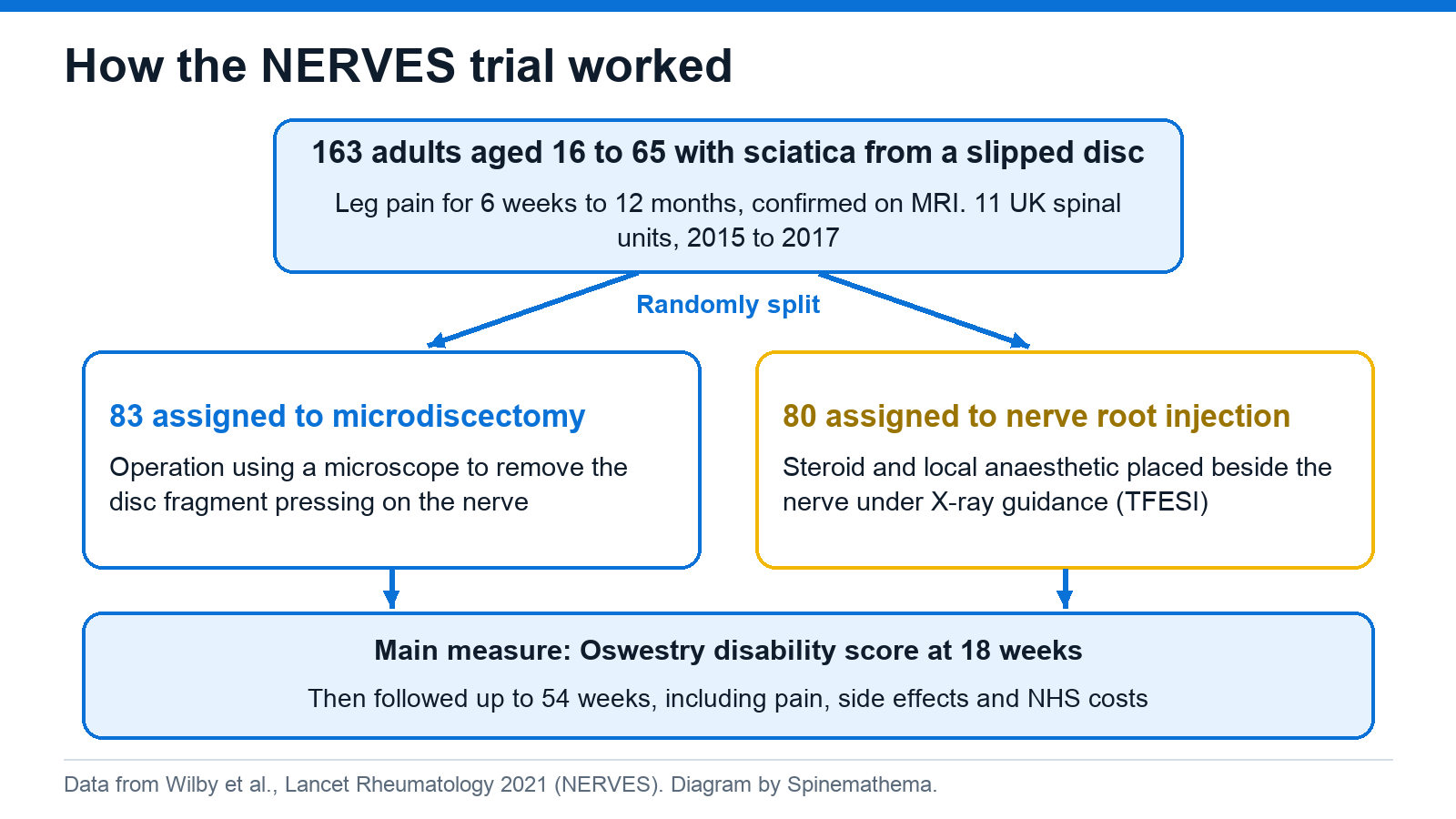
- NERVES was a UK trial at 11 NHS spinal units comparing microdiscectomy with a targeted steroid injection (transforaminal epidural steroid injection, or TFESI) for sciatica caused by a slipped disc.
- 163 people took part. At 18 weeks, disability scores had improved by a similar amount in both groups, with no statistically significant difference.
- There were 4 serious adverse events after surgery and none after injection.
- Over 54 weeks, surgery cost the NHS more (£6,683 versus £4,422 per patient) and was unlikely to be cost effective as a first invasive treatment.
- Of the 80 people offered an injection first, 47 (59%) had not needed surgery by the end of the trial. Others went on to have an operation.
Why this study matters
Most people with sciatica from a slipped disc improve with time, painkillers and staying active. When the leg pain persists, the two main options in the NHS are a nerve root injection or an operation to remove the disc fragment, usually a microdiscectomy (see our lumbar discectomy page).
Before NERVES, there was little high quality evidence directly comparing these two. The authors note that the NHS cost of a microdiscectomy was about £4,500, compared with about £700 for an injection, and that earlier studies comparing surgery with injections came from single centres.[1] NERVES (short for Nerve Root Block Versus Surgery) was described by its authors as the first multicentre randomised trial to compare the two head to head.
How the trial worked
Between March 2015 and December 2017, 1,055 patients were screened at 11 UK spinal units and 163 (15%) took part.[1] They were aged 16 to 65, had sciatica from a slipped disc confirmed on MRI, had symptoms for between 6 weeks and 12 months, and had leg pain that had not settled with at least one non-invasive treatment. People with significant ankle weakness, threatened cauda equina syndrome or a far lateral disc prolapse were excluded.
A computer randomly assigned 83 people to surgery and 80 to injection.[1] Surgery was a standard open microdiscectomy using an operating microscope, carried out by senior spinal surgeons or by trainees under their direct supervision. The injection was a transforaminal epidural steroid injection (TFESI): steroid and local anaesthetic placed beside the affected nerve root under X-ray guidance. A second injection was allowed if the first partly helped. Treatment was recommended within 6 weeks of randomisation, and people could switch to the other treatment if the first did not work.
The main measure was the Oswestry Disability Questionnaire, a score from 0 to 100 where lower means less disability, at 18 weeks after randomisation. Patients were then followed to 54 weeks, with leg pain, back pain, side effects and NHS costs recorded.[1]
What it found
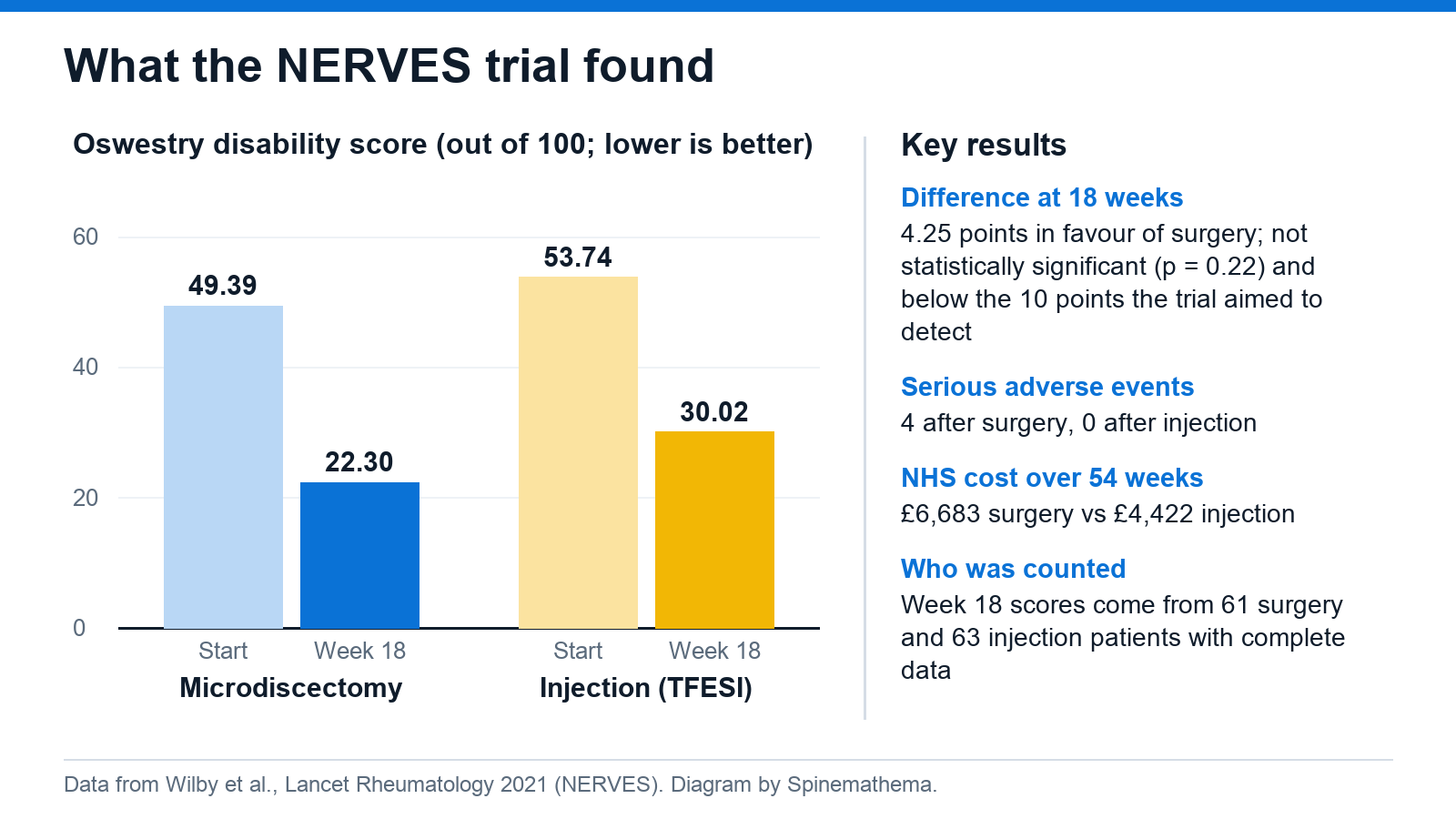
Both groups improved by a similar amount. At 18 weeks, the average disability score was 22.30 in the surgery group and 30.02 in the injection group, from starting scores of 49.39 and 53.74. After allowing for starting scores, surgery was 4.25 points better on average, but this was not statistically significant (p = 0.22) and was less than the 10 point difference the trial was designed to detect.[1]
| At 18 weeks | Surgery | Injection (TFESI) |
|---|---|---|
| Disability score (Oswestry, lower is better) | 22.30 | 30.02 |
| Average improvement from the start | 26.74 points | 24.52 points |
| Improved by 10 points or more | 45 of 61 (74%) | 43 of 63 (68%) |
| Symptoms worse than at the start | 8 of 61 (13%) | 6 of 63 (10%) |
Leg pain improved somewhat more after surgery (58.3 points on a 100 point scale, compared with 43.6 points after injection, at 18 weeks), but across all time points the difference between groups was not statistically significant. Back pain, a sciatica specific score and an overall back outcome score showed similar patterns.[1]
Safety
There were 18 adverse events in 15 people who had surgery and 8 events in 3 people who had an injection. All 4 serious adverse events followed surgery, involving prolonged hospital stay, repeat surgery or repair of a fluid collection around the nerves. One of the 105 people who had surgery during the trial developed foot drop. No serious adverse events followed injection, and no one died.[1]
Cost
Over 54 weeks, NHS costs averaged £6,683 for the surgery group and £4,422 for the injection group. Surgery cost £38,737 for each quality adjusted life year gained, well above the £20,000 threshold NICE commonly uses, with only a 0.17 probability of being cost effective at that threshold.[1]
Limitations
- Small numbers. The trial recruited 163 people, and the primary analysis included 124 (61 surgery, 63 injection). The authors acknowledge that, given the confidence intervals, a 10 point difference in favour of surgery could have been missed.[1]
- Missing data. 39 of 163 participants (24%) had no valid primary outcome. Sensitivity analyses gave similar answers, but missing data always adds uncertainty.
- Open label. Patients and clinicians knew which treatment was given, which can influence questionnaire scores.
- The 18 week endpoint. This is fairly early, and the trial followed patients for only 54 weeks, so it cannot tell us about longer term outcomes or recurrence.
- Crossover. 33 of the 80 people (41%) in the injection group had surgery at some point during the trial. Among the 63 people analysed at 18 weeks, 13 (21%) had already had surgery by then. This reflects real practice, where injection is often a first step, but it means the injection group is partly an “injection then surgery if needed” group.
- Who was included. People with significant weakness or emergency symptoms were excluded, and injection techniques varied with local practice.
What this means for patients
For sciatica from a slipped disc lasting up to a year, without significant weakness or emergency signs, NERVES suggests that a targeted nerve root injection is a reasonable first invasive treatment. Many people improve enough to avoid an operation, and serious complications in this trial occurred only after surgery. This fits UK guidance from NICE, which suggests considering epidural injections of local anaesthetic and steroid for acute and severe sciatica, and considering surgery when non-surgical treatment has not improved pain or function.[2]
Surgery still has an important place. The authors note that surgery is still likely to be needed for a considerable number of patients for whom injection is less effective, and leg pain tended to improve more after surgery. Other trials, such as the American SPORT trial, found that surgery gave faster relief of leg pain, although both surgical and non-surgical groups improved substantially over time.[3] For some people, a less invasive option such as endoscopic discectomy may also be worth discussing.
The best choice depends on how severe and long lasting your pain is, how it affects your work and daily life, and how you weigh the risks of each option. It is a decision to make together with your surgeon.
Seek urgent help if you develop numbness around the bottom or genitals, new problems controlling your bladder or bowels, or rapidly worsening leg weakness. These can be signs of cauda equina syndrome, which needs emergency assessment and was not part of this trial.
References
- Wilby MJ, Best A, Wood E, et al. Surgical microdiscectomy versus transforaminal epidural steroid injection in patients with sciatica secondary to herniated lumbar disc (NERVES): a phase 3, multicentre, open-label, randomised controlled trial and economic evaluation. Lancet Rheumatol. 2021;3(5):e347-e356. doi:10.1016/S2665-9913(21)00036-9. PMID: 33969319. Link
- National Institute for Health and Care Excellence. Low back pain and sciatica in over 16s: assessment and management (NG59). Published 30 November 2016, last updated 29 July 2026. Recommendations 1.3.5 and 1.3.8. Link
- Weinstein JN, Tosteson TD, Lurie JD, et al. Surgical vs nonoperative treatment for lumbar disk herniation: the Spine Patient Outcomes Research Trial (SPORT): a randomized trial. JAMA. 2006;296(20):2441-2450. PMID: 17119140. Link
This article summarises published research for general education. It is not a substitute for advice about your own situation. Please speak to your GP or specialist before making any change to your treatment.


Leave a comment