Key points
- The Sciatica Trial, run by a group from Leiden and The Hague, randomly assigned 283 people with 6 to 12 weeks of severe sciatica to early surgery or to about six more months of non surgical (conservative) care, with surgery later if needed.
- Early surgery relieved leg pain faster, and people felt they had recovered sooner.
- By one year, disability and leg pain were similar in both groups, and 95% of people in each group reported recovery. The groups stayed similar at two and five years.
- Fewer than half of the people in the conservative group ended up having an operation: 39% by one year and 46% by five years.
- The trial supports a shared decision about timing: surgery offers quicker relief, while waiting gives a good chance of avoiding an operation altogether.
Landmark trial: why this question matters
Sciatica is pain that runs from the lower back down the leg, often with tingling or numbness. The most common cause is a slipped disc pressing on a nerve root. Many people improve without an operation, but the pain can be severe and can stop people working, sleeping and moving normally. For those who do not settle, an operation called a lumbar discectomy removes the piece of disc pressing on the nerve.
The authors of this trial pointed out that disc surgery was often done when sciatica had not settled within about 6 weeks, yet nobody knew the best time to operate.[1] So the question was not really “surgery or no surgery”. It was “operate early, or keep going with non surgical care for longer and operate only if needed?” That is exactly the choice many patients face.
How the trial worked
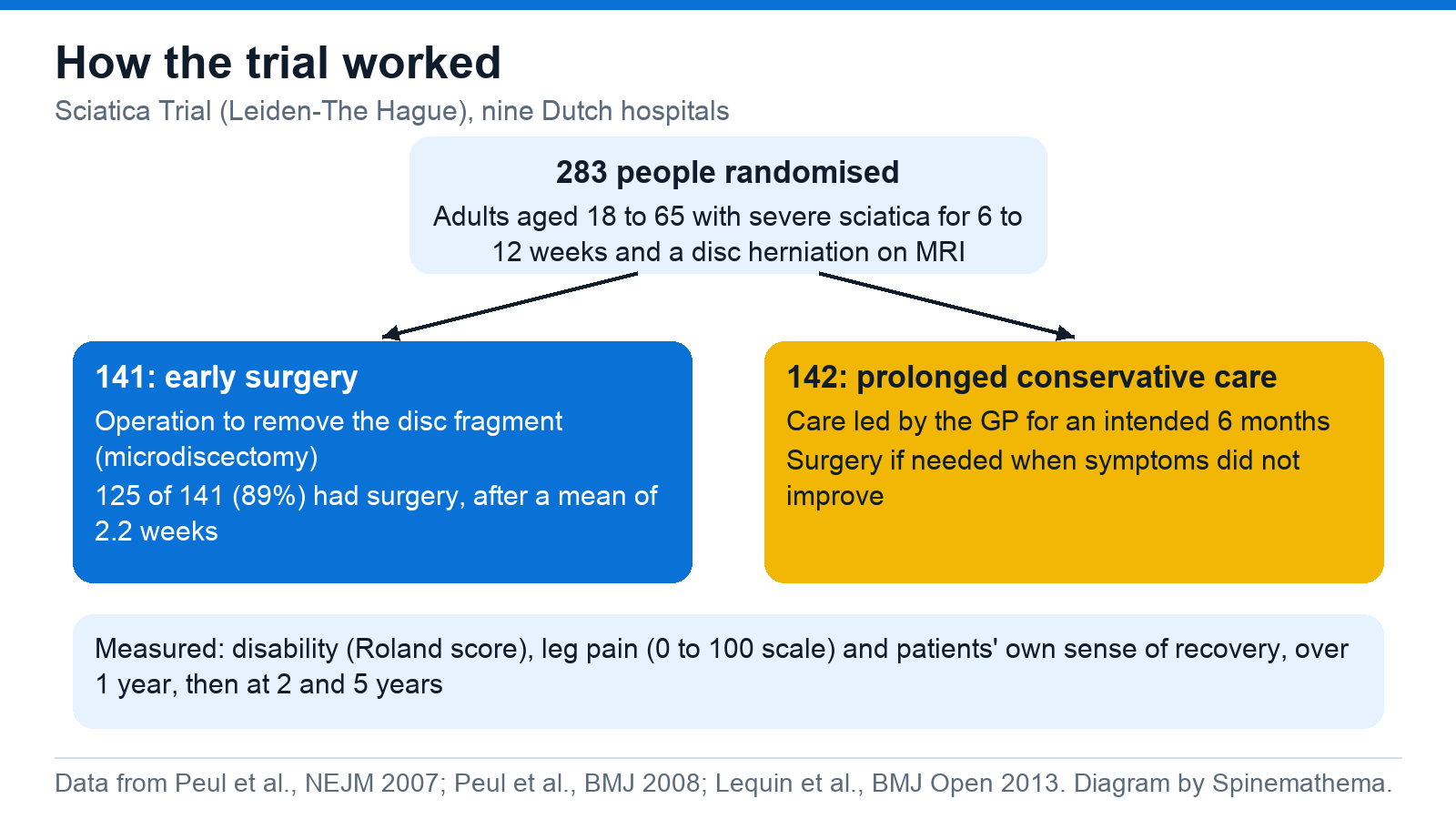
The trial took place in nine Dutch hospitals.[2] It included adults aged 18 to 65 who had had severe sciatica for 6 to 12 weeks, with a disc herniation confirmed on an MRI scan.[1][3] In total, 283 people were randomly assigned by a computer to one of two strategies.[1]
- Early surgery (141 people): a microdiscectomy, which removes the disc fragment through a small opening using magnification.[3] In this group, 125 people (89%) had the operation, on average 2.2 weeks after joining the trial.[1]
- Prolonged conservative care (142 people): an intended six months of non surgical care guided by the family doctor (GP), mainly aimed at getting back to daily activities, with surgery offered if symptoms did not improve.[2][3]
Patients were told beforehand that the study compared two strategies for the timing of treatment, rather than surgery against no surgery.[3] The main measures were a disability questionnaire (the Roland score), leg pain on a scale from 0 to 100, and each person’s own sense of whether they had recovered. These were tracked over the first year, and the team later reported results at two years and five years.[1][2][3]
What it found
Faster relief with early surgery
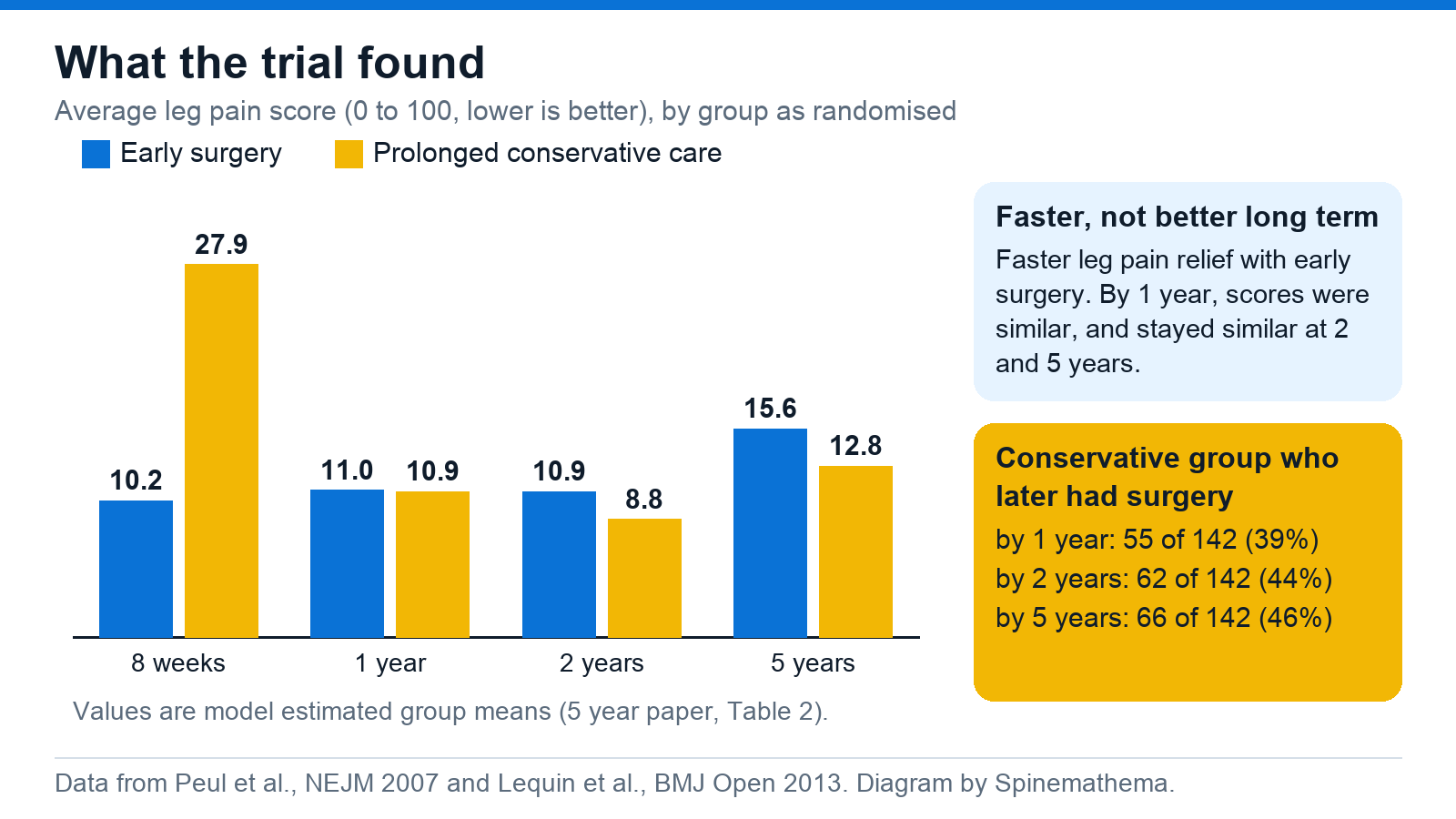
Leg pain eased faster in the early surgery group, and people in that group reported recovering at a faster rate.[1] At 8 weeks, the average leg pain score was 10.2 out of 100 in the early surgery group compared with 27.9 in the conservative group.[3]
Similar results by one year
Over the first year there was no significant difference in disability between the groups. After one year, the chance of reporting recovery was 95% in both groups.[1] At two years, disability was still similar, and the early advantage in leg pain was no longer significant from six months onwards.[2] At five years, with 231 of the original 283 people (82%) still providing data, there were no significant differences between the groups.[3]
How many people in the conservative group had surgery?
Of the 142 people assigned to conservative care, 55 (39%) had surgery within the first year, on average 18.7 weeks after joining.[1] This rose to 62 (44%) by two years[2] and 66 (46%) by five years.[3] Put the other way round, more than half avoided an operation. Interestingly, 16 people (11%) assigned to early surgery recovered before their operation and never had surgery during the five years.[3]
Not everyone recovered fully
At two years, 20% of all patients reported an unsatisfactory outcome.[2] At five years, 49 people (21%) had an unsatisfactory recovery, with almost identical numbers in each group. Being over 40, having very severe leg pain at the start, and a higher score on a questionnaire measuring the emotional side of pain were linked with a less good outcome.[3] Repeat disc surgery within five years was needed by 9 people (7%) in the early surgery group and by 8 (12%) of the conservative group patients who had an operation.[3]
Limitations
- Switching between strategies. Nearly half the conservative group eventually had surgery, and some of the surgery group did not. This is realistic, but it means the comparison is between two strategies rather than between surgery and no surgery.[1][3]
- No blinding. As in any trial of an operation against non surgical care, patients knew which group they were in, and the main outcomes were reported by the patients themselves.
- Loss to follow-up. By five years, 18% of patients had dropped out of follow-up.[3]
- Who was included. Only adults aged 18 to 65 with 6 to 12 weeks of severe sciatica took part, so the results may not apply to older people or to sciatica that has lasted much longer.[1][3]
- Age of the trial. The main results were published in 2007, in a Dutch health system where GPs guided conservative care. Surgical and non surgical care have continued to develop since then.
The trial sits alongside the American SPORT trial, which reached broadly similar conclusions; you can read our SPORT spotlight for comparison.
What it means for you
If you have had sciatica from a slipped disc for a couple of months and you have no warning signs, this trial suggests there is no single right answer. Early surgery is likely to ease your leg pain sooner, which matters if the pain is severe or stopping you working. Continuing with good non surgical care, such as physiotherapy, pain relief and sometimes nerve root injections, gives you a better than even chance of avoiding an operation, and if you do need surgery later, the evidence suggests the result by one year is likely to be similar.
The right choice depends on how severe your pain is, how it affects your life, and how you feel about surgery and its risks. This is a decision to make together with your surgeon.
Seek urgent help if you develop numbness around the bottom or genitals, new problems controlling your bladder or bowels, or rapidly worsening leg weakness. These can be signs of cauda equina syndrome, which needs emergency assessment.
References
- Peul WC, van Houwelingen HC, van den Hout WB, et al. Surgery versus prolonged conservative treatment for sciatica. N Engl J Med. 2007;356(22):2245-2256. PMID: 17538084. Link
- Peul WC, van den Hout WB, Brand R, et al. Prolonged conservative care versus early surgery in patients with sciatica caused by lumbar disc herniation: two year results of a randomised controlled trial. BMJ. 2008;336(7657):1355-1358. PMID: 18502911. Link
- Lequin MB, Verbaan D, Jacobs WC, et al. Surgery versus prolonged conservative treatment for sciatica: 5-year results of a randomised controlled trial. BMJ Open. 2013;3(5):e002534. PMID: 23793663. Link
This article is general information and is not a substitute for advice about your own situation. Please speak to your GP or specialist before making any change to your treatment.


Leave a comment