
Key points
- The CSM-S trial compared operations from the front (ventral) and the back (dorsal) of the neck for cervical spondylotic myelopathy, which is pressure on the spinal cord from wear and tear.
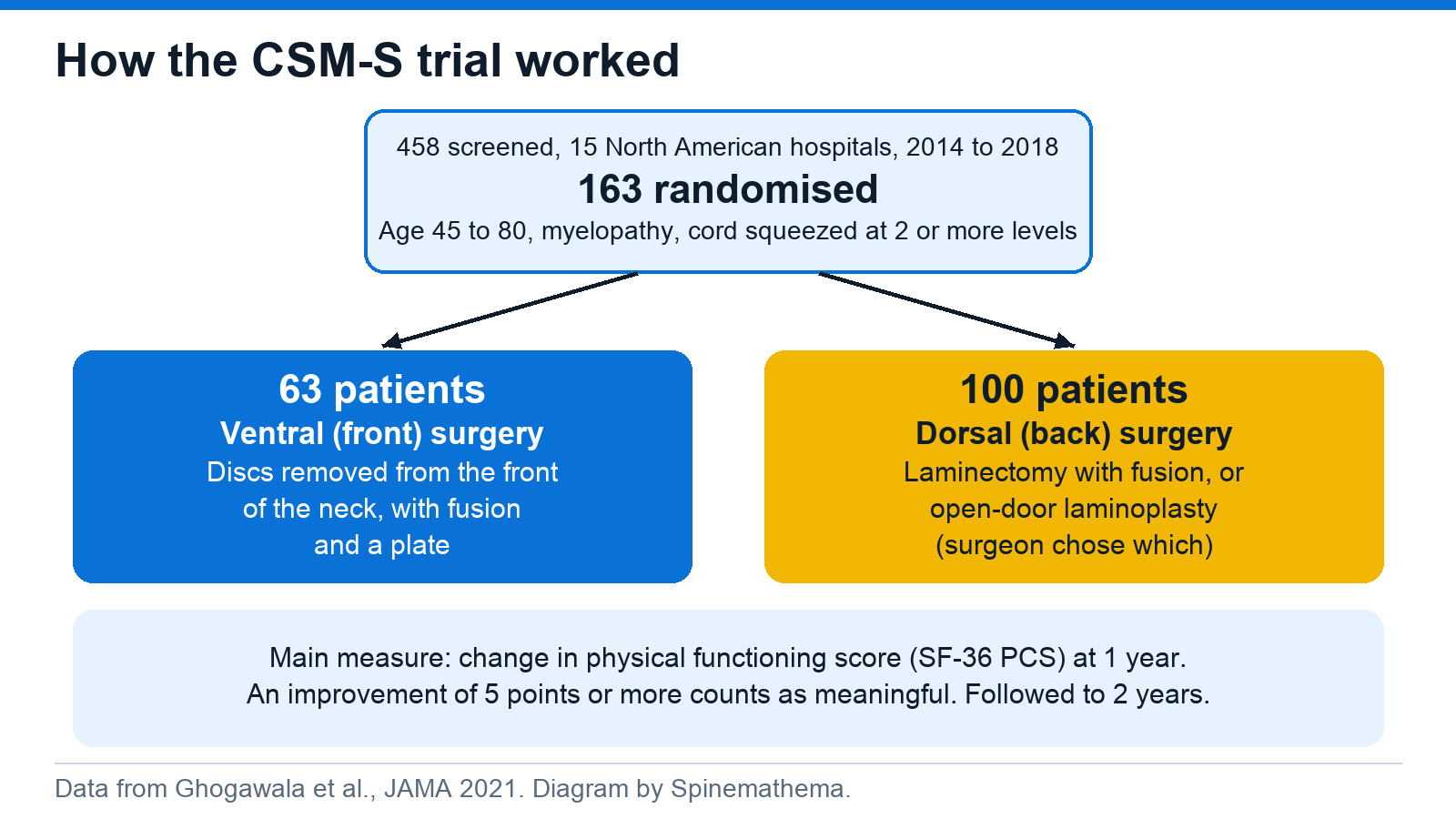
- 163 people aged 45 to 80 at 15 North American hospitals were randomly assigned: 63 to front surgery and 100 to back surgery.
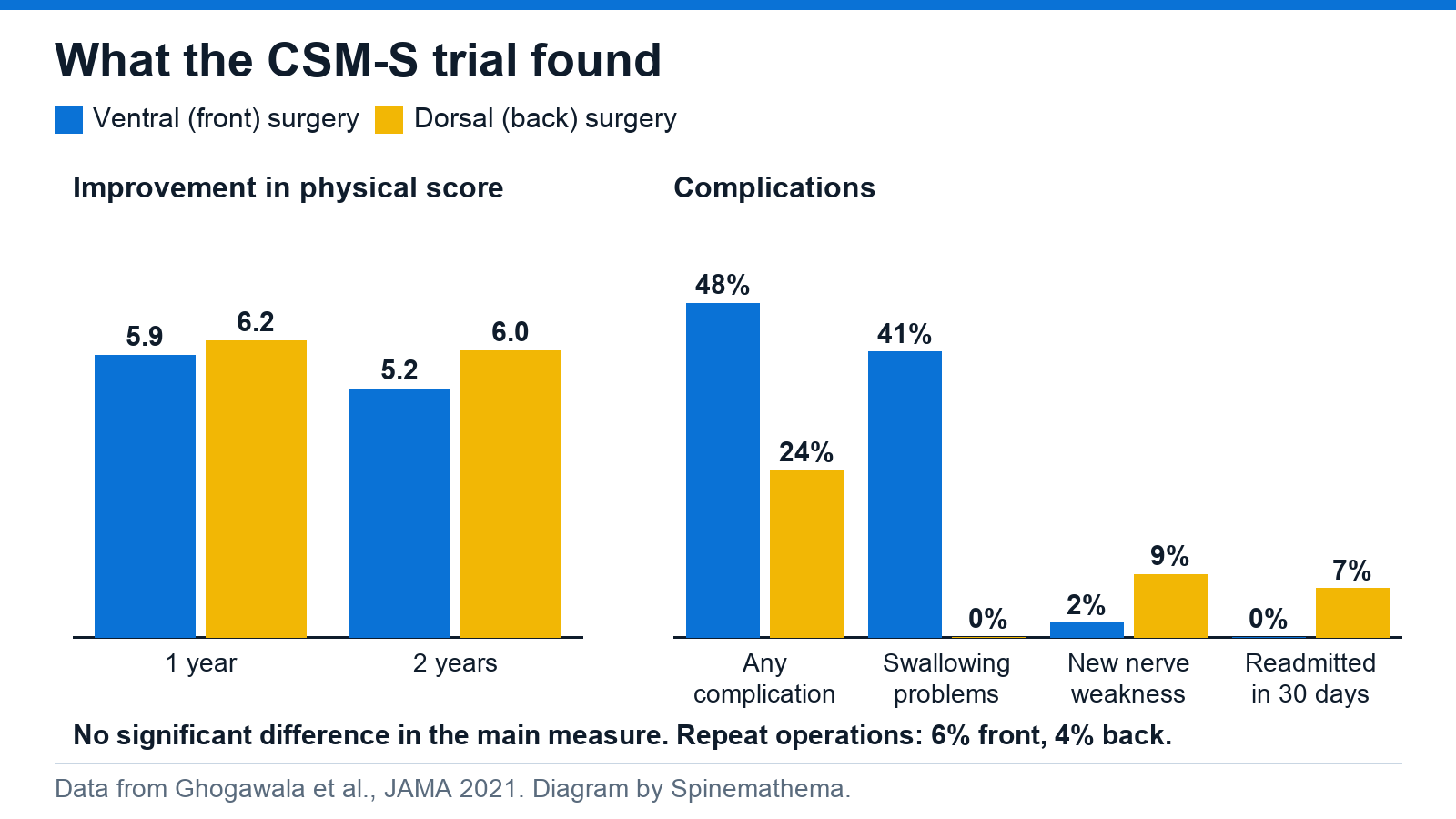
- Physical functioning improved by a similar amount in both groups at 1 year (5.9 versus 6.2 points) and at 2 years.
- Complications were more common after front surgery (48% versus 24%), mainly swallowing difficulty. New nerve weakness and readmission to hospital were more common after back surgery.
- In a non randomised comparison, laminoplasty had the best results, but the authors advise caution because surgeons chose who had it.
Landmark trial: why this question matters
Cervical spondylotic myelopathy is pressure on the spinal cord in the neck caused by age related wear and tear. The trial authors describe it as the most common cause of spinal cord dysfunction worldwide.[1] It usually comes on gradually, with clumsy hands, unsteady walking and sometimes bladder problems (see our cervical myelopathy page). Surgery to take pressure off the cord is often performed when symptoms are severe or getting worse.
Surgeons can reach the cord from the front of the neck, usually by removing the worn discs and fusing the bones with a plate, much like ACDF, or from the back (see our posterior neck surgery page). From the back there are two main choices. Laminectomy with fusion removes the bony roof of the spinal canal and fixes the bones with screws and rods. Laminoplasty opens the roof on one side and hinges it on the other, like a door, holding it open with small plates to make more room for the cord.
Before CSM-S there was no randomised trial comparing these approaches, and practice varies around the world. The authors note that laminoplasty is common in Asia and Europe, whereas fusion operations are favoured in North America.[1]
How the trial worked
CSM-S (the Cervical Spondylotic Myelopathy Surgical trial) ran at 14 hospitals in the US and 1 in Canada between April 2014 and March 2018, with final follow up in April 2020.[1] It included people aged 45 to 80 with at least 2 signs or symptoms of myelopathy, such as clumsy hands, walking difficulty, brisk reflexes or bladder problems, and compression of the cord at 2 or more levels between C3 and C7 on scans.
People were excluded if the neck curved forward (kyphosis) beyond set limits, or if they had significant ossification of the posterior longitudinal ligament (a ligament behind the vertebrae turning to bone), previous neck surgery or serious other illness. A panel of 15 expert surgeons reviewed each case to confirm that either approach would be reasonable before the patient was randomised.
Of 458 people screened, 163 were randomised: 63 to front surgery and 100 to back surgery. More were assigned to back surgery on purpose, in a 2 to 3 ratio, because in the back group the surgeon chose between laminectomy with fusion and laminoplasty.[1] In the end 66 people had front fusion, 69 had back fusion and 28 had laminoplasty. The average age was 62 and 49% were women.
The main measure was the change at 1 year in the physical component summary of the Short Form 36 questionnaire (SF-36 PCS), a patient reported score of physical function. An improvement of 5 points or more is considered meaningful. Questionnaires were collected by study coordinators who did not know which operation the patient had been assigned.
What it found
Both approaches helped. At 1 year the SF-36 PCS improved by 5.9 points after front surgery and 6.2 points after back surgery, a difference that was not statistically significant. At 2 years the improvements were 5.2 and 6.0 points.[1] Six of seven prespecified secondary outcomes also showed no significant difference. Of those working before surgery, 71% had returned to work by 1 year, with no significant difference between groups.
The clear difference was in complications: 48% after front surgery and 24% after back surgery. Difficulty swallowing (dysphagia) was reported by 41% after front surgery and by nobody after back surgery. Most complications after front surgery were minor problems that settled within 3 months, although in 9 people who had front fusion (14%) swallowing difficulty lasted longer. Back surgery led to more new neurological deficits (9% versus 2%) and more readmissions within 30 days (7% versus 0%). Every case of new nerve root weakness after surgery involved the C5 nerve root, and most of these followed back fusion. Repeat operations were needed in 6% after front surgery and 4% after back surgery, and major complications did not differ significantly (22% versus 17%).[1]
| Outcome | Front (ventral) | Back (dorsal) |
|---|---|---|
| Improvement in SF-36 PCS at 1 year | 5.9 points | 6.2 points |
| Improvement in SF-36 PCS at 2 years | 5.2 points | 6.0 points |
| Any complication | 48% | 24% |
| Swallowing difficulty | 41% | 0% |
| New nerve weakness | 2% | 9% |
| Repeat operation | 6% | 4% |
| Readmission within 30 days | 0% | 7% |
Laminoplasty: a hint, not proof
Because surgeons chose between laminectomy with fusion and laminoplasty, the authors also compared the three operations as actually performed. These comparisons were not randomised. Laminoplasty was linked with greater improvement at 1 year (9.6 points, against 4.6 after back fusion and 5.7 after front fusion) and with the fewest complications (11%, against 29% after back fusion and 47% after front fusion).[1] The authors say these results should be interpreted with caution, as there may have been subtle signs of less severe disease in those who had laminoplasty.
Limitations
- Laminoplasty was not one of the randomised options, so its apparent advantage may partly reflect which patients surgeons chose for it.
- Patients and surgeons knew which operation was done. Questionnaires were collected by coordinators unaware of the assigned group, and complications were classified afterwards by investigators unaware of the treatment.
- The trial was moderate in size, with 163 patients. Follow up was 95% at 1 year and 80% at 2 years.
- Five patients had a different operation from the one assigned, because of patient or surgeon preference.
- People with a forward curve of the neck, an ossified ligament or previous neck surgery were excluded. The authors note that front surgery is preferable to laminoplasty when the forward curve is greater than 13 degrees or alignment is poor.
- The trial was run in North America, where few surgeons were trained in laminoplasty at the time: only 8 of the 24 enrolling surgeons offered both back operations.
What it means for you
For people with myelopathy at several levels who fit the trial’s criteria, front and back surgery led to a similar average improvement in physical function, slightly above the 5 point threshold for a meaningful change. The trade off lies mainly in side effects: swallowing difficulty is much more likely after front surgery, while back surgery with fusion carried more C5 nerve weakness and more early readmissions.
The shape of your neck, how many levels are affected and where the pressure on the cord comes from all influence which operation your surgeon recommends, and not every approach suits every person. The laminoplasty findings are encouraging but not conclusive. Ask your surgeon why a particular operation is advised for you, and what the likely benefits and risks are.
Tell your doctor promptly if hand clumsiness, walking or balance problems, or bladder symptoms are getting worse.
References
- Ghogawala Z, Terrin N, Dunbar MR, et al. Effect of Ventral vs Dorsal Spinal Surgery on Patient-Reported Physical Functioning in Patients With Cervical Spondylotic Myelopathy: A Randomized Clinical Trial. JAMA. 2021;325(10):942-951. Link
This article is general information and is not a substitute for advice about your own situation. Please speak to your GP or specialist before making any change to your treatment.


Leave a comment