

Key points
- Foot drop means weakness lifting the foot and toes at the ankle. In the spine it is usually caused by a slipped disc or narrowing pressing on a nerve root in the lower back.
- We searched PubMed and found no randomised trials of surgery, or of surgical timing, specifically for foot drop. The evidence comes from reviews of observational studies and from cohort studies.
- In the largest pooled analysis (20 studies, 918 patients), 82% improved by at least one strength grade after decompression surgery, 60% recovered to near normal strength and 18% did not improve.
- Better recovery was linked with having some strength left before surgery and, in several studies, with earlier surgery. Diabetes was linked with poorer recovery.
- Sudden or worsening foot weakness should be assessed promptly. Bladder, bowel or saddle numbness symptoms need emergency care.
Why this question matters
Foot drop is weakness of the muscles that lift the front of the foot. People notice that the foot slaps down when they walk, that they trip on kerbs, or that they have to lift the knee higher to clear the toes. When the cause is in the lower back, it is usually a slipped disc or lumbar spinal stenosis pressing on a nerve root, most often alongside sciatica.
The questions patients ask are simple: will my foot recover, does an operation help, and how quickly should it be done? These are hard questions to study. Foot drop from the spine is relatively uncommon, and most surgeons would feel uncomfortable randomly delaying surgery for someone with severe weakness. So, unlike our other spotlights, this article is not about a single landmark trial.
There are no randomised trials of surgery, or of surgical timing, specifically for foot drop from a slipped disc or stenosis. This is what the best available studies show.
How the evidence was gathered
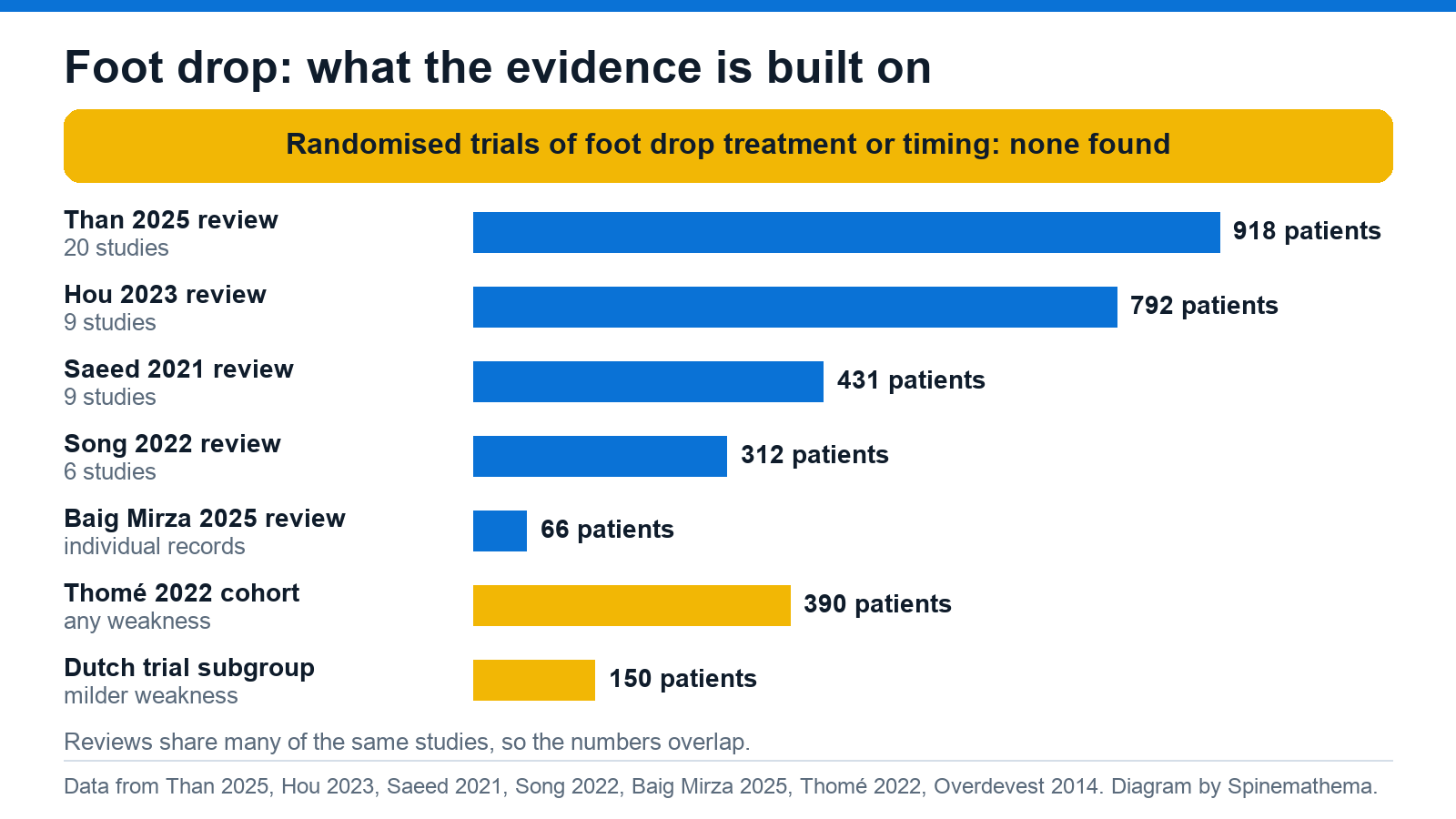
We searched PubMed for randomised trials of treatment or timing for foot drop caused by lumbar disc herniation or degenerative disease and found none. Instead, we looked at the most recent systematic reviews, which gather and combine the results of earlier studies, plus the largest cohort studies.
- A 2025 review and meta-analysis pooled 20 studies with 918 patients. Most had a disc herniation (79%) and the rest mainly stenosis. All 20 studies were observational, and 16 looked back at past records.[1]
- A 2021 review pooled 9 observational studies with 431 patients who had painful foot drop and a decompression.[2]
- A 2023 review pooled 9 studies with 792 patients to look for factors that predict recovery.[3]
- A 2022 review pooled 6 studies with 312 patients to compare surgery within 1 month with later surgery.[4] A later review described these six as retrospective studies.[1]
- A 2025 individual patient data meta-analysis combined the records of individual patients with one-sided foot drop treated by single level surgery, with 66 patients included in the analysis.[5]
Two other studies help on timing. A single centre study followed 390 patients with weakness of any severity from a disc herniation for at least 12 months after urgent disc surgery.[6] And a Dutch randomised trial of early surgery versus prolonged non-surgical care for sciatica included 150 people with weakness. Their weakness was mostly milder than typical foot drop, but this is the closest randomised evidence available.[7]
Strength is graded on the Medical Research Council (MRC) scale, where 0 means no movement and 5 means normal strength. Grades 4 and 5 are usually counted as a good recovery.
What the studies found
How many people recover after surgery
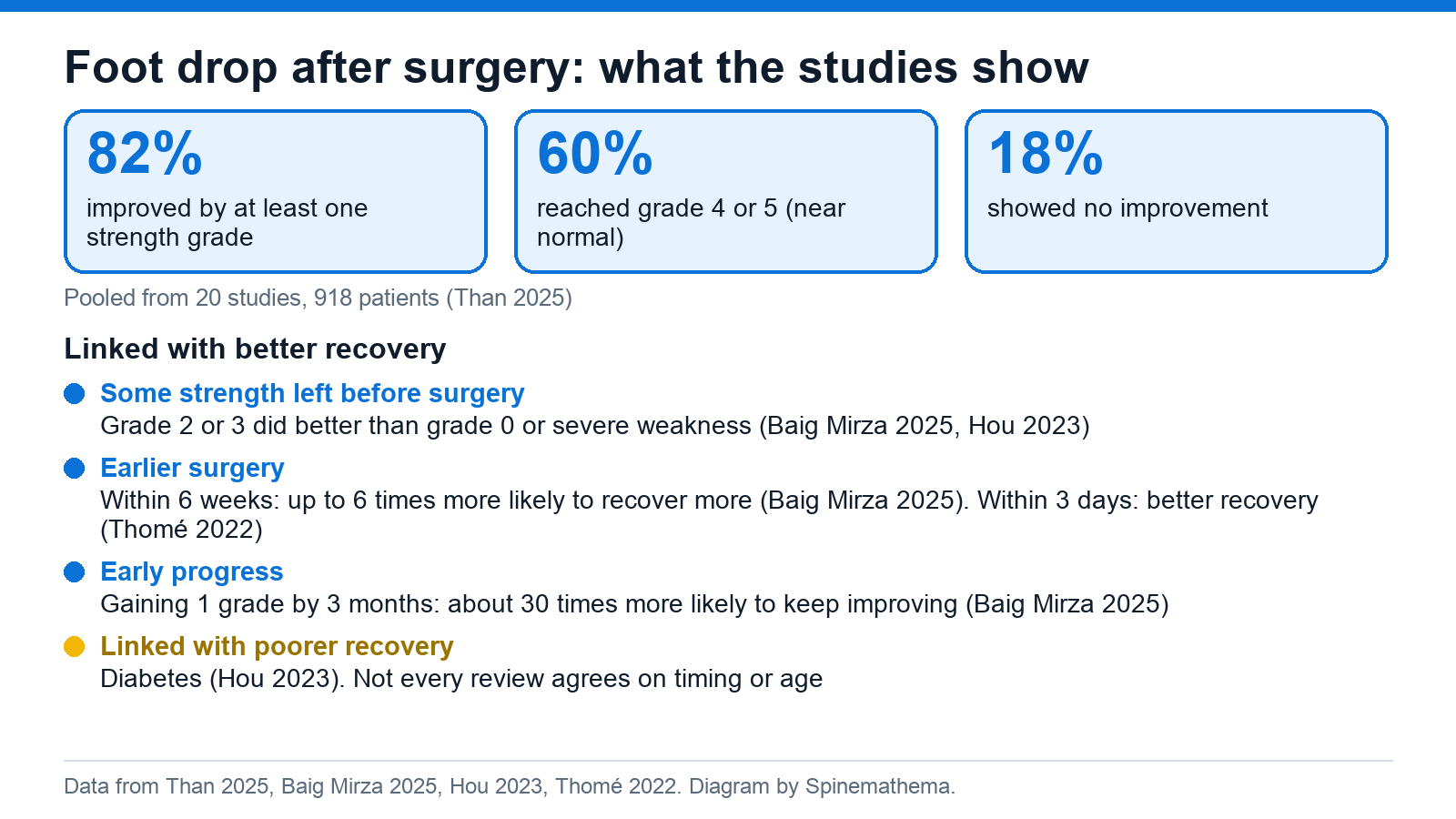
In the largest review, 82% of patients improved by at least one MRC grade after decompression, 60% reached grade 4 or 5, and 18% showed no improvement. Pain scores also fell markedly, and reported complications were low, at about 1%.[1] The 2021 review found a similar pooled improvement rate of 84.5%.[2]
What predicts a better recovery
- Strength before surgery. People with some strength left (grade 2 or 3) did better than those with severe or complete weakness. One review put the odds of a good outcome at about 5.9 times higher with moderate weakness.[3] The individual patient analysis found the same pattern compared with grade 0.[5]
- Timing. The individual patient analysis found that people operated on within 6 weeks of symptom onset were up to 6 times more likely to show greater recovery at a median of 12 months.[5] The 2022 review found better recovery with surgery within 1 month.[4] In the single centre cohort, surgery within 3 days was linked with better recovery for both severe and milder weakness.[6]
- Early progress. Gaining at least one MRC grade within 3 months of surgery was linked with about a 30 fold higher chance of continuing to improve.[5]
- Age and diabetes. Age was a significant factor in two reviews,[2][5] with patients aged 47 or under doing better in the individual patient analysis. Diabetes was linked with poorer recovery in another review.[3]
The findings do not all agree. The 2023 review found no clear link between duration of foot drop or age and recovery.[3] In the Dutch trial, early surgery gave faster recovery of weakness, but by 1 year complete recovery was similar: 81% after early surgery and 80% after prolonged non-surgical care.[7] A multicentre study of 75 patients from the UK and Ireland found that 55% improved, 31% were unchanged and 15% worsened after surgery, with the chance of improvement falling slightly for each day of delay.[8] Painless foot drop is rarer, and a small review suggested it may recover less well, although that comparison was uncertain.[9]
Limitations
- No randomised trial has tested surgical timing for foot drop, so we cannot be sure that earlier surgery causes better recovery. People operated on quickly may differ in other ways, for example in how suddenly and severely the weakness started.
- Most included studies looked back at hospital records. Many were small and judged at serious risk of bias, and results varied a lot between studies.[1]
- The reviews overlap, so they are not independent confirmations of each other.
- Studies defined foot drop, timing and recovery in different ways, and follow up was often short.
- There is little good data on people with foot drop who did not have surgery, so we cannot say how many would have recovered without an operation.
What this means for you
If you develop weakness lifting your foot, get it checked promptly. Most studies suggest that the chance of recovery is better when some strength remains and when the nerve is decompressed sooner rather than later, although the ideal time window is not known. Surgery, usually a lumbar discectomy or decompression, helps most people regain some strength, but not everyone recovers fully, and around 1 in 5 do not improve.
Your spinal team will weigh how severe and how recent the weakness is, what your scan shows, your general health and what matters most to you. If surgery is not chosen, or recovery is incomplete, physiotherapy and an ankle foot splint can help with walking and safety.
Seek prompt or urgent medical help if you have:
- Sudden new weakness lifting your foot or toes, or weakness that is getting worse: contact your GP, NHS 111 or your spinal team the same day.
- Numbness around your back passage, genitals or inner thighs (saddle area): go to A&E straight away.
- New difficulty passing urine, loss of bladder or bowel control, or new sexual problems: go to A&E straight away.
- Sciatica or weakness in both legs: go to A&E straight away.
- These can be signs of cauda equina syndrome, which needs emergency treatment.
Declaration of interest: Mr Sadek was the senior author who led the 2025 individual patient data meta-analysis of foot drop described in this article,[5] and a co-author of the multicentre study of painful foot drop from the United Kingdom and Ireland.[8] He received no funding for either study.
This article summarises research and is general information only. It is not a substitute for advice from your own doctor or surgeon about your situation.
References
- Than CA, Hajeir MY, Al Darwashi LM, et al. Characterizing Spinal Decompression for Foot Drop Caused by Lumbar Degenerative Disease: A Systematic Review and Meta-Analysis of Cohorts. J Clin Med. 2025;14(13):4470. Link
- Saeed F, Mukherjee S, Chaudhuri K, et al. Prognostic indicators of surgical outcome in painful foot drop: a systematic review and meta-analysis. Eur Spine J. 2021;30(11):3278-3288. Link
- Hou Y, Liang L, Zhao T, et al. A meta-analysis of prognostic factors in surgical treatment of foot drop due to lumbar degenerative diseases. World Neurosurg X. 2023;19:100214. Link
- Song SY, Nam DC, Moon DK, et al. Surgical decompression timing for patients with foot drop from lumbar degenerative diseases: a meta-analysis. Eur Spine J. 2022;31(3):551-560. Link
- Baig Mirza A, Khizar Khoja A, Naidu V, et al. Prognostic factors and surgical outcomes of foot drop secondary to lumbar degenerative disease: A systematic review and Individual patient data meta-analysis. Eur Spine J. 2025;34(4):1386-1397. Link
- Thomé C, Kögl N, Grassner L, et al. Motor Recovery Depends on Timing of Surgery in Patients With Lumbar Disk Herniation. Neurosurgery. 2022;90(3):347-353. Link
- Overdevest GM, Vleggeert-Lankamp CL, Jacobs WC, et al. Recovery of motor deficit accompanying sciatica: subgroup analysis of a randomized controlled trial. Spine J. 2014;14(9):1817-1824. Link
- Baig Mirza A, Vastani A, Fayez F, et al. Surgical outcomes of unilateral painful foot drop secondary to lumbar disc herniation: a multicenter retrospective study. J Neurosurg Spine. 2025;42(6):727-736. Link
- Waseem S, Kyriakides J, Amiri AR, et al. Management strategies for the painless foot drop: a systematic review of the literature. Eur Spine J. 2023;32(4):1099-1105. Link
This article is general information and is not a substitute for advice about your own situation. Please speak to your GP or specialist before making any change to your treatment.


Leave a comment