
Key points
- Vertebroplasty injects bone cement into a fractured vertebra to try to relieve pain. It became widely used before it had been tested against a sham (pretend) procedure.
- Two trials published in 2009 (Buchbinder and Kallmes) and a larger Dutch trial in 2018 (VERTOS IV) compared real vertebroplasty with a carefully disguised sham.
- In all three, pain improved a lot in both groups, and vertebroplasty did not do significantly better than the sham.
- A 2018 Cochrane review of five sham controlled trials found no clinically important benefit for pain, disability or quality of life, and noted rare but serious side effects.
- Sham controlled trials matter because pain often improves with time and with the experience of having a procedure, which can make a treatment look better than it really is.
Landmark trials: why this question matters
In people with osteoporosis, a vertebra (one of the bones of the spine) can collapse with little or no injury. These compression fractures can be very painful. In vertebroplasty, a doctor passes a needle into the broken bone under X-ray guidance and injects bone cement (polymethylmethacrylate) to stabilise it.
Before 2009, vertebroplasty had become a routine treatment on the strength of case series and small studies in which patients knew they had been treated.[2] The problem is that pain from these fractures often settles as the bone heals, and simply having a procedure can make people feel better. To find out whether the cement itself helps, you need a trial in which neither the patient nor the person assessing them knows who received it.
Why sham controlled trials matter
In a sham controlled trial, one group has the real procedure and the other has a pretend version that looks and feels the same but leaves out the key step. If both groups improve equally, the improvement is probably due to things other than the key step: natural healing, the local anaesthetic, the attention and expectation that come with treatment, or the tendency for severe pain to ease over time anyway. The 2018 Cochrane review concluded that open trials comparing vertebroplasty with usual care were likely to have overestimated its benefit.[4]
How the trials worked
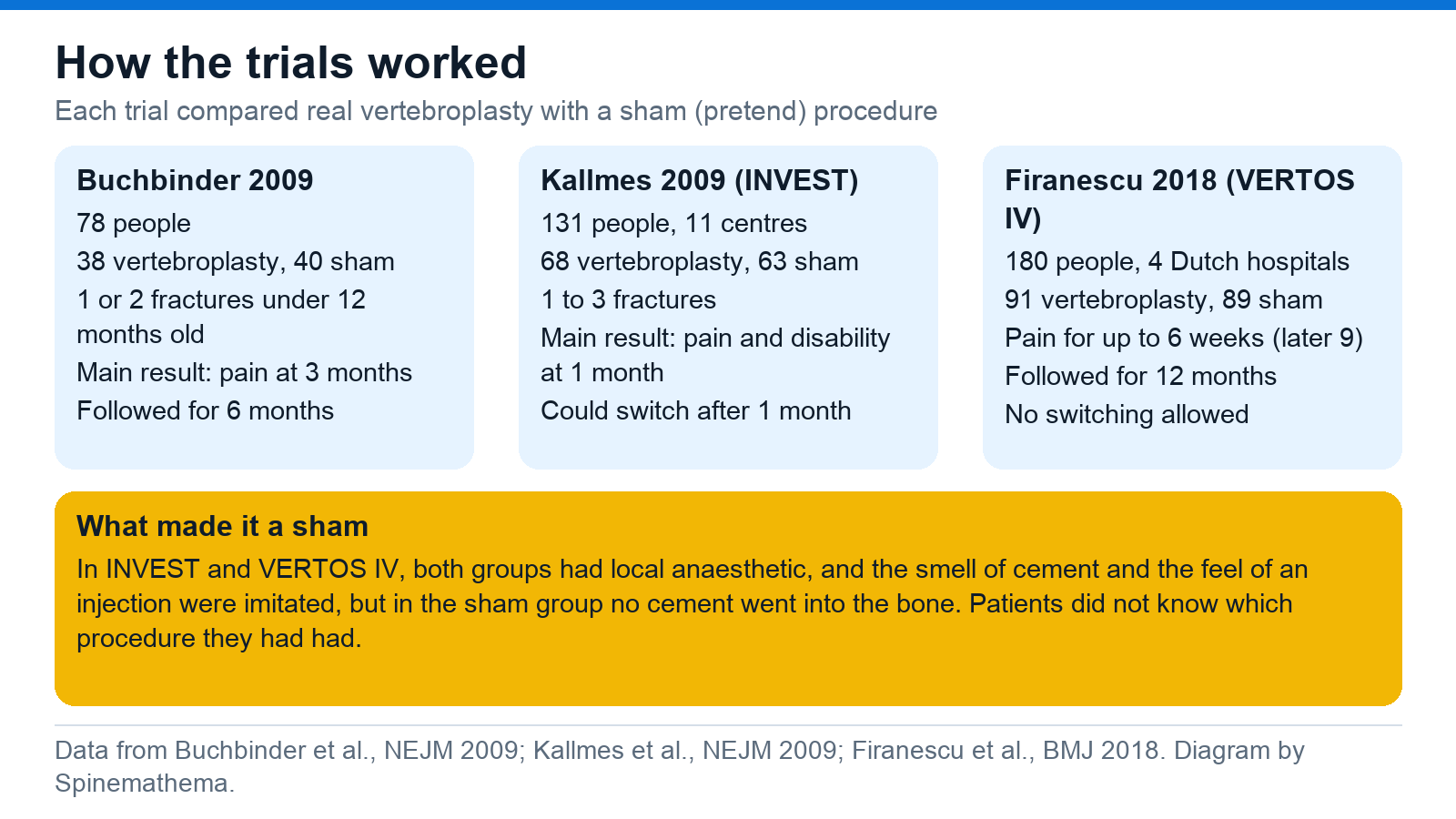
- Buchbinder and colleagues (2009): 78 people with one or two painful osteoporotic fractures less than 12 months old, confirmed as unhealed on MRI, were randomised to vertebroplasty (38) or a sham procedure (40). Pain was measured over 6 months, with the main result at 3 months.[1]
- Kallmes and colleagues, the INVEST trial (2009): 131 people aged 50 or over with one to three painful fractures, from 11 centres in the United States, United Kingdom and Australia, had vertebroplasty (68) or a simulated procedure (63). The main results were disability and pain at 1 month, after which people could switch groups.[2]
- Firanescu and colleagues, VERTOS IV (2018): 180 people aged 50 or over with recent fractures (pain for up to 6 weeks, later extended to 9 weeks) and bone swelling on MRI, from four Dutch community hospitals, had vertebroplasty (91) or a sham (89). They were followed for 12 months and could not switch groups.[3]
The shams were designed to be convincing. In INVEST, everyone had local anaesthetic, the cement ingredient was opened in the room so it could be smelt, and the doctor gave the verbal and physical cues of an injection, but no needle was placed into the bone.[2] In VERTOS IV, everyone had local anaesthetic into the bone surface and needles placed, the cement was mixed nearby so it could be heard and smelt, and the injection was imitated.[3] The day after treatment, 82% of the vertebroplasty group and 81% of the sham group believed they had received cement.[3]
What they found
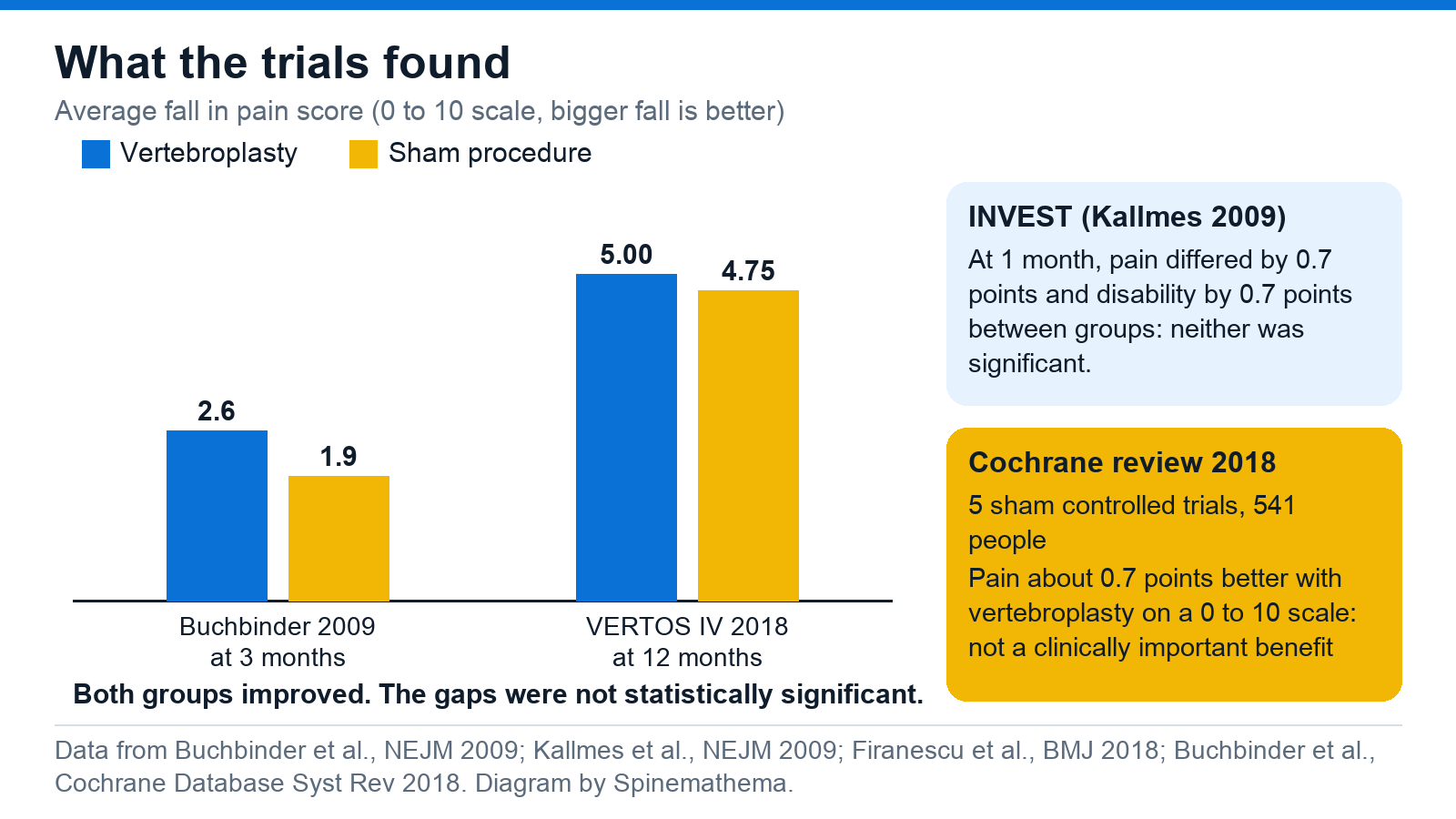
Buchbinder: both groups had less pain at every follow-up. At 3 months, pain on a 0 to 10 scale had fallen by an average of 2.6 points after vertebroplasty and 1.9 points after the sham, a difference that was not significant. Vertebroplasty showed no significant advantage on any outcome at any time.[1]
INVEST: at 1 month, the groups differed by 0.7 points on the disability score and 0.7 points on the pain score, and neither difference was significant. Both groups improved straight after the procedure. There was a trend towards more people with a meaningful fall in pain after vertebroplasty (64% versus 48%), but this was not significant. By 3 months, 51% of the sham group and 13% of the vertebroplasty group had switched to the other treatment.[2]
VERTOS IV: pain fell in both groups from the first day. At 12 months the average pain score had dropped by 5.00 points after vertebroplasty and 4.75 points after the sham, and the groups did not differ significantly at any point. Disability and quality of life also improved similarly.[3]
The Cochrane review
A Cochrane review updated in 2018 pooled five sham controlled trials with 541 participants. Average pain was 5 out of 10 after the sham and 0.7 points lower after vertebroplasty, well below the size of change usually considered important to patients. The reviewers found high to moderate quality evidence of no important benefit for pain, disability, quality of life or treatment success. Serious side effects reported after vertebroplasty included bone infection, spinal cord compression and breathing failure, although the numbers were too small to be sure how often they occur.[4]
Limitations
- Size. The 2009 trials were fairly small, and INVEST allowed switching after 1 month, which makes later results harder to interpret.[2]
- Which patients. VERTOS IV was designed to improve on the 2009 trials, with stricter entry criteria limited to recent fractures, more patients, longer follow-up and no switching, and it still found no significant benefit.[3]
- Not every trial agrees. Another sham controlled trial, VAPOUR (2016), reported better pain relief with vertebroplasty. It included mainly hospital inpatients with very recent fractures and high pain scores.[3]
- Extra findings. In VERTOS IV, analyses that were not planned in advance found that at 12 months more people in the sham group still had pain of 5 or more out of 10 (41% versus 20%), and more had further collapse of the treated bone.[3] Findings like these need confirming in new trials.
- Cement leakage. In VERTOS IV, a scan showed some cement outside the bone in 105 of 115 treated vertebrae (91%).[3]
What it means for you
If you have a painful osteoporotic spinal fracture, the best evidence suggests that most people improve a great deal over the following weeks and months, whether or not cement is injected. For most people, good pain relief, gentle activity, physiotherapy and treatment of the underlying osteoporosis are the mainstays of care.
The Cochrane reviewers advised that patients should be told about both the lack of important benefit and the potential for harm.[4] The VERTOS IV authors suggested that cement might still have a role for a selected group whose pain does not settle, but this has not been proven.[3] If it is suggested to you, it is reasonable to ask why, what the evidence shows for someone in your situation, and what the alternatives are.
Seek urgent help if back pain comes with new weakness, numbness or loss of control of your bladder or bowels, or if you also feel unwell with fever or unexplained weight loss. These need prompt medical assessment.
References
- Buchbinder R, Osborne RH, Ebeling PR, et al. A randomized trial of vertebroplasty for painful osteoporotic vertebral fractures. N Engl J Med. 2009;361(6):557-568. PMID: 19657121. Link
- Kallmes DF, Comstock BA, Heagerty PJ, et al. A randomized trial of vertebroplasty for osteoporotic spinal fractures. N Engl J Med. 2009;361(6):569-579. PMID: 19657122. Link
- Firanescu CE, de Vries J, Lodder P, et al. Vertebroplasty versus sham procedure for painful acute osteoporotic vertebral compression fractures (VERTOS IV): randomised sham controlled clinical trial. BMJ. 2018;361:k1551. PMID: 29743284. Link
- Buchbinder R, Johnston RV, Rischin KJ, et al. Percutaneous vertebroplasty for osteoporotic vertebral compression fracture. Cochrane Database Syst Rev. 2018;11(11):CD006349. PMID: 30399208. Link
This article is general information and is not a substitute for advice about your own situation. Please speak to your GP or specialist before making any change to your treatment.


Leave a comment