Key points
- FACET was a trial in 9 Dutch hospitals comparing two operations for arm pain caused by a single trapped nerve in the neck (cervical radiculopathy).
- 265 adults were randomly assigned to posterior cervical foraminotomy, a keyhole operation from the back of the neck, or anterior cervical discectomy and fusion (ACDF) from the front.
- At 1 year, 88% after foraminotomy and 76% after ACDF had a good or excellent result. The operation from the back met the trial’s test for being no worse (noninferior).
- Arm pain fell by a similar amount in both groups, from about 60 out of 100 before surgery to under 20 at 1 year.
- Results were still similar at 2 years. By then 9 patients (8%) had needed another operation after foraminotomy and 7 (6%) after ACDF.
Landmark trial: why this question matters
Cervical radiculopathy means pain, pins and needles, numbness or weakness running down the arm because a nerve root is pinched as it leaves the neck. A disc bulge or bony spurs (osteophytes) are the usual causes[1] (see our cervical radiculopathy page). When symptoms do not settle and surgery is needed, there are two widely used operations.
The first is anterior cervical discectomy and fusion (ACDF). The surgeon reaches the spine through a small cut at the front of the neck, removes the disc and places a spacer so that the two bones fuse. The second is posterior cervical foraminotomy, done from the back of the neck. The surgeon removes a small amount of bone to widen the hole the nerve passes through (the foramen), without fusing the spine or leaving an implant.
The FACET authors point out that the operation from the back avoids structures at the front of the neck, such as the gullet (oesophagus), the carotid artery and the nerve to the voice box, and needs no costly implants, yet surgeons still tend to prefer the front approach. Before FACET, comparisons came mostly from studies looking back at past patients and one small, low quality randomised trial.[1]
How the trial worked
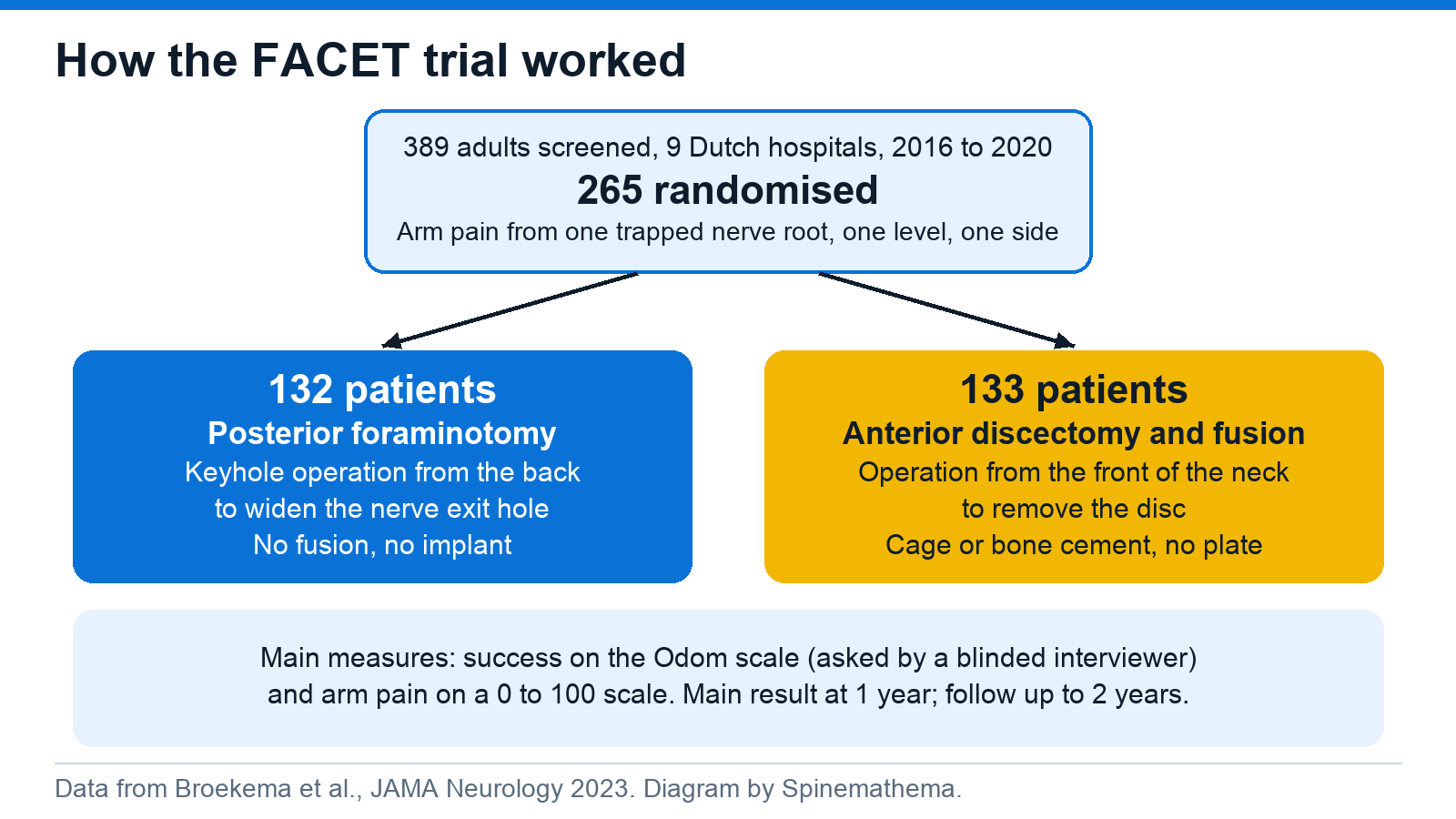
FACET (the Foraminotomy ACDF Cost-Effectiveness Trial) ran in 9 hospitals in the Netherlands from January 2016 to May 2020.[1] It included adults aged 18 to 80 with arm pain from one nerve root, on one side, at a single level, caused by a soft disc or bony narrowing, who needed an operation. People with neck pain alone, without pain spreading into the arm, could not take part.
Of 389 people assessed, 265 were randomly assigned: 132 to posterior foraminotomy and 133 to ACDF. Their average age was 51 and half were women.[1] ACDF used a cage or bone cement in the disc space. Neither operation used a plate, and nobody wore a neck brace afterwards.
FACET was a noninferiority trial. Rather than asking which operation is better, it asked whether the operation from the back is no worse than ACDF by more than a set margin, here 10%. There were two main outcomes at 1 year: the proportion with a good or excellent result on the Odom criteria, a simple 4 point rating of overall outcome collected by telephone by an interviewer who did not know which operation the patient had, and arm pain on a 0 to 100 scale.[1] Patients were then followed to 2 years.[2]
What it found
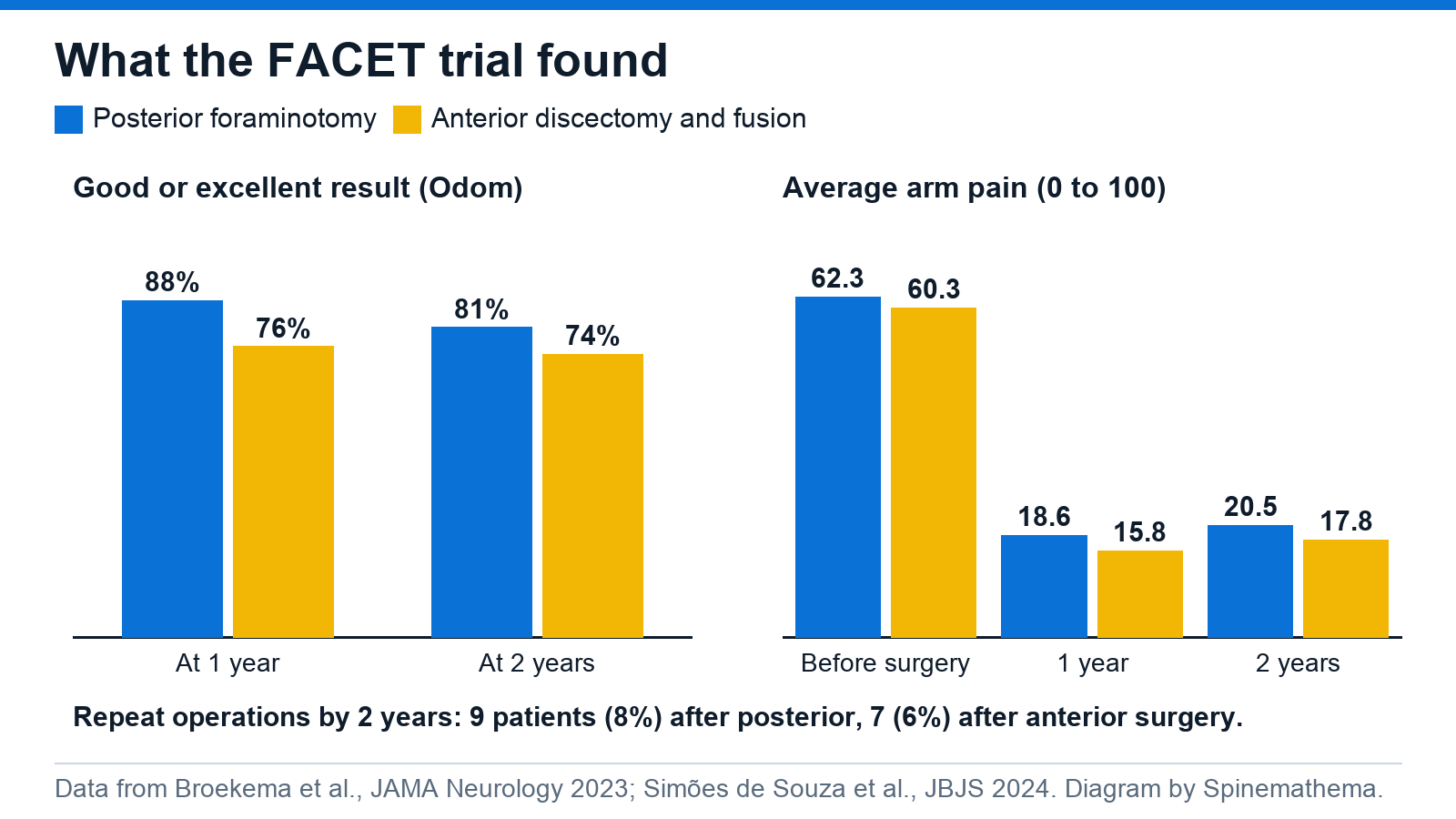
At 1 year, 86 of 98 patients (88%) after foraminotomy and 81 of 106 (76%) after ACDF, among those with available data, had a good or excellent result.[1] This met the test for noninferiority, and the authors noted that this one measure also met the bar for superiority.
Average arm pain fell from 62.3 to 18.6 after foraminotomy and from 60.3 to 15.8 after ACDF. Arm pain at 1 year met the noninferiority test. The size of the drop in arm pain narrowly missed it, crossing the margin by 1.8 points, which the authors regarded as a small difference of no clinical relevance.[1] Neck pain, disability, quality of life, work ability and satisfaction were similar in the two groups.
| At 1 year | Foraminotomy (back) | ACDF (front) |
|---|---|---|
| Good or excellent result (Odom) | 86 of 98 (88%) | 81 of 106 (76%) |
| Arm pain before surgery (0 to 100) | 62.3 | 60.3 |
| Arm pain at 1 year (0 to 100) | 18.6 | 15.8 |
| Satisfied or very satisfied | 70 (73%) | 76 (77%) |
| Serious surgery related adverse events | 7 (6%) | 7 (6%) |
| Repeat operations | 6 (5%) | 4 (3%) |
Side effects
The type of problem differed between the operations. In the first year, swallowing difficulty or a lump in the throat feeling was recorded in 6 patients after ACDF and 1 after foraminotomy, and in one ACDF patient it had not resolved by 1 year. Hoarseness was also more frequent after ACDF, while wound infections were more common after foraminotomy.[1] Persistent arm pain that did not need a further operation was recorded in 8 patients after foraminotomy and 2 after ACDF.
Two year results
The 2 year report, published in 2024, had main outcome data for 236 of the 243 patients in the analysis (97%).[2] Using a statistical model, the estimated proportion with a good or excellent result was 81% after foraminotomy and 74% after ACDF, again meeting the noninferiority test. Average arm pain was 20.5 and 17.8 respectively, and both arm pain measures now met the noninferiority test.
By 2 years, 9 patients (8%) had needed another operation after foraminotomy and 7 (6%) after ACDF, a difference that was not statistically significant. All 9 repeat operations after foraminotomy were done from the front. Recurrent arm pain without a further operation was more common after foraminotomy (8 patients, 7%) than after ACDF (1 patient, 1%).[2]
Limitations
- Patients and surgeons could not be blinded to the operation, although the Odom rating was collected by a blinded interviewer.[1]
- The trial recruited fewer people than planned (265 against a target of 308), partly because of COVID-19. An interim analysis suggested this was still enough, but the trial was powered on the Odom score rather than arm pain.
- Of those randomised, 25 did not have their allocated operation, most often because their symptoms improved on their own, and 3 patients crossed over to the other operation.
- The 10% noninferiority margin was chosen by the investigators, because no agreed margin exists. Some surgeons had strong preferences, mostly for ACDF, which may have affected who was enrolled.
- Only people with one trapped nerve, on one side, at one level were included. The results do not apply to spinal cord compression (myelopathy), neck pain alone or problems at several levels.
- ACDF was done without a plate, which the authors note is common in Europe but differs from countries such as the US.
What it means for you
If you have arm pain from a single trapped nerve in the neck and an operation is being considered, FACET suggests that both operations give similar results for most people over 2 years. The choice can be guided by what your scan shows, your own priorities and the different side effects: the front approach involves fusing two bones and carries a risk of swallowing problems and hoarseness, while the back approach avoids fusion and implants but was followed by recurrent arm pain, and sometimes a second operation, in a minority of people.
FACET compared two operations in people who already needed surgery. It does not tell us whether surgery is better than non-surgical care such as physiotherapy. Some people improve without an operation: in FACET itself, 11 of the 25 patients who did not have their allocated operation had improved before surgery.[2]
Tell your doctor promptly if you notice clumsy hands, unsteady walking or new bladder problems. These can be signs of pressure on the spinal cord itself (see our cervical myelopathy page), which was not studied in FACET.
References
- Broekema AEH, Simões de Souza NF, Soer R, et al. Noninferiority of Posterior Cervical Foraminotomy vs Anterior Cervical Discectomy With Fusion for Procedural Success and Reduction in Arm Pain Among Patients With Cervical Radiculopathy at 1 Year: The FACET Randomized Clinical Trial. JAMA Neurol. 2023;80(1):40-48. Link
- Simões de Souza NF, Broekema AEH, Reneman MF, et al. Posterior Cervical Foraminotomy Compared with Anterior Cervical Discectomy with Fusion for Cervical Radiculopathy: Two-Year Results of the FACET Randomized Noninferiority Study. J Bone Joint Surg Am. 2024;106(18):1653-1663. Link
This article is general information and is not a substitute for advice about your own situation. Please speak to your GP or specialist before making any change to your treatment.


Leave a comment