Key points
- The MRC Spine Stabilisation Trial randomly assigned 349 people in the UK with chronic low back pain to spinal fusion surgery or a 3 week intensive rehabilitation programme.
- Both groups improved over 2 years. Disability scores were 4.1 points better with surgery, a difference that only just reached the level the trial was designed to detect.
- Walking ability and general health scores did not differ significantly between the groups.
- Surgery cost more (an average of £7,830 per patient against £4,526) and 19 surgical patients had complications.
- Most people in the rehabilitation group avoided surgery over 2 years, although 28% went on to have an operation.
Landmark trial: why this question matters
Chronic low back pain, meaning pain that has lasted for months or years, is one of the most common reasons people see a doctor. For some people with long-standing pain and wear-related changes on their scans, surgeons have offered a spinal fusion: joining two or more vertebrae so that the painful segment no longer moves.
When this trial was planned, the evidence for fusion in chronic back pain was weak. The authors noted that a Cochrane review in 1999 had found no randomised trials at all.[1] At the same time, rehabilitation programmes combining exercise with psychological approaches were being recommended for chronic pain. The UK Medical Research Council (MRC) funded a trial to compare the two strategies directly.[1]
How the trial worked
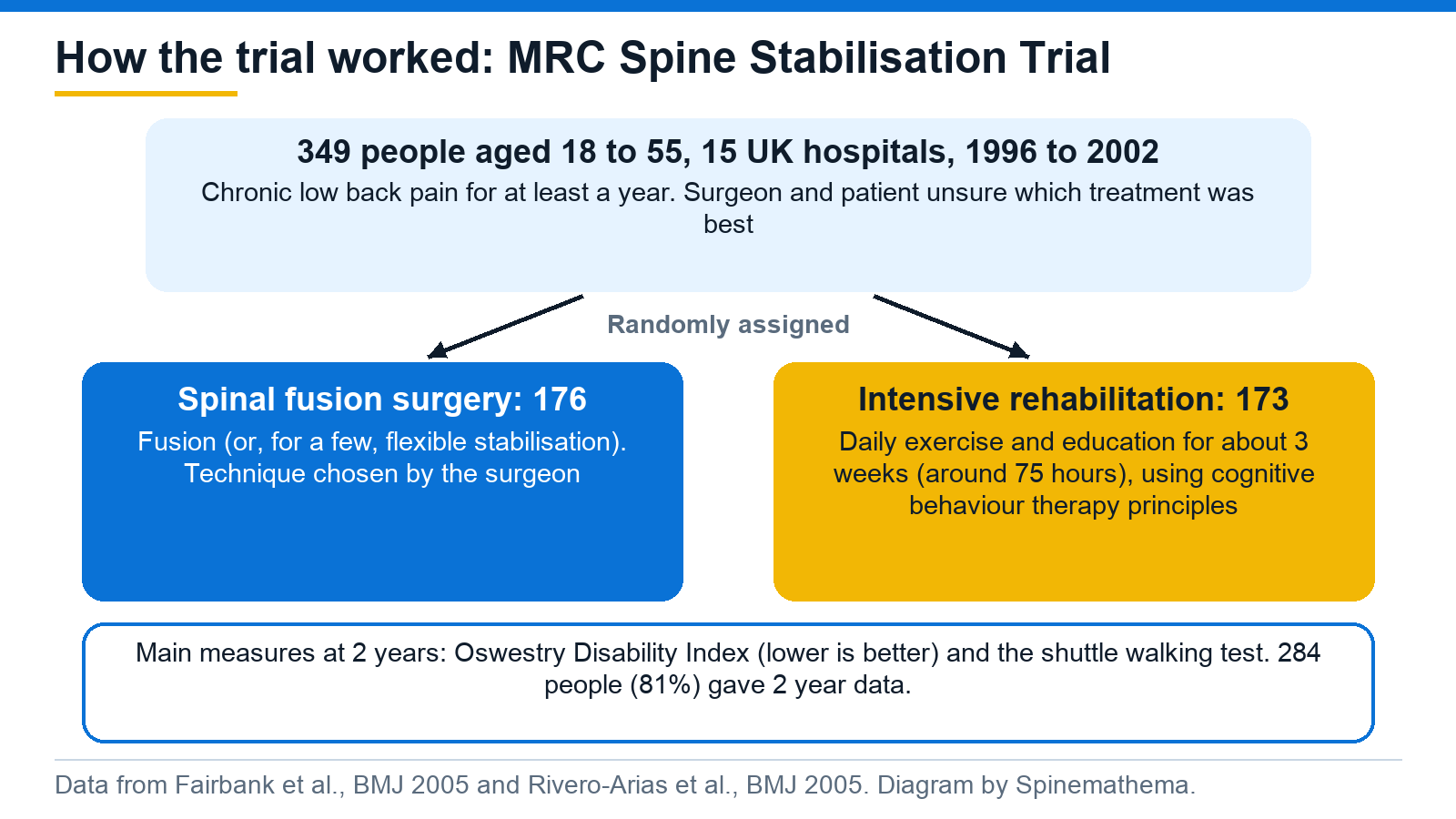
Between June 1996 and February 2002, 349 people were recruited from 15 hospitals across the UK.[1] All were aged 18 to 55, had had low back pain for more than a year, and had been judged by their surgeon to be candidates for a fusion. They joined only if both they and their surgeon were genuinely unsure which treatment was better. Most (about 80%) had chronic low back pain without a slip; smaller numbers had a spondylolisthesis or pain after a previous decompression.[1]
176 people were assigned to surgery and 173 to rehabilitation.[1] The surgeon chose the type of operation. Most planned operations were fusions, but about 1 in 6 were a flexible stabilisation technique (the Graf procedure). The rehabilitation programme ran every weekday for 3 weeks, usually about 75 hours in total, with follow-up sessions later. It was led by physiotherapists, usually with a clinical psychologist, and combined tailored exercise, stretching, aerobic fitness and hydrotherapy with cognitive behaviour therapy to tackle fears and unhelpful beliefs about pain.[1] You can read more about physiotherapy on our site.
There were two main measures at 2 years: the Oswestry Disability Index (ODI), a 0 to 100 questionnaire where higher scores mean more disability, and the shuttle walking test, which measures how far someone can walk at increasing speed. 284 people (81%) provided 2 year data.[1]
What it found
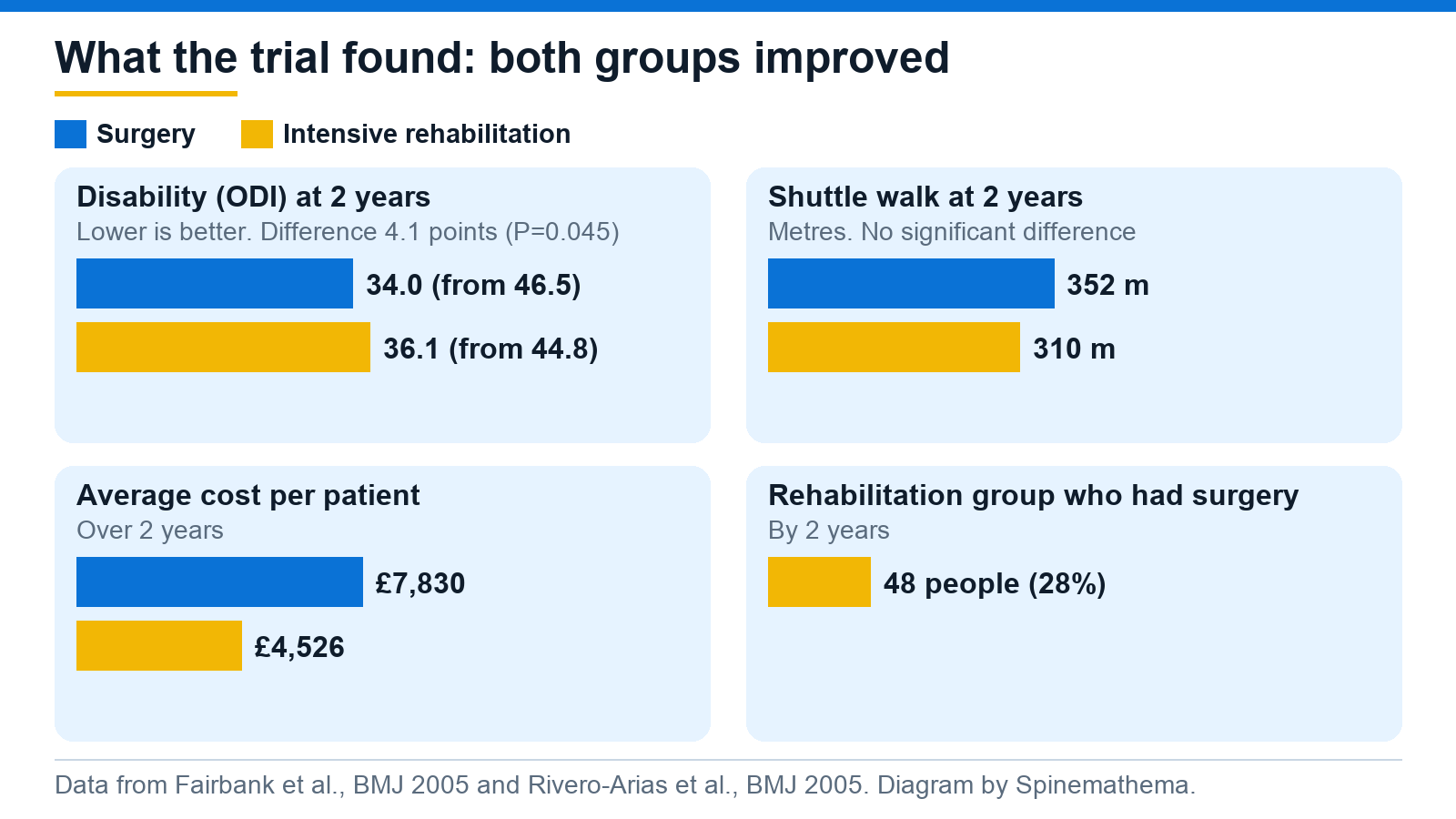
Both groups improved. In the surgery group, the average ODI score fell from 46.5 to 34.0. In the rehabilitation group, it fell from 44.8 to 36.1. After allowing for starting scores, the difference was 4.1 points in favour of surgery, which was only just statistically significant (P=0.045).[1] The trial had been designed to detect a difference of 4 points, and the authors described the gap as small given the risks and extra cost of surgery.
There was no significant difference in the shuttle walking test (352 metres after surgery against 310 metres after rehabilitation) or in any of the other measures, including general physical and mental health.[1]
19 surgical patients had complications, such as a tear in the lining around the nerves, heavy bleeding or problems with implants, and 11 needed further operations on their lower spine within 2 years. No specific complications of rehabilitation were found.[1] By 2 years, 48 people (28%) in the rehabilitation group had gone on to have surgery.[1]
A cost analysis published alongside the trial found an average cost of £7,830 per patient for surgery and £4,526 for rehabilitation. The authors concluded that surgery may not be a cost effective use of NHS resources, although this could change if more rehabilitation patients later needed surgery.[2]
Eleven years later
A later study combined long-term follow-up from three trials in Norway and the UK, including this one, with 473 patients in all. After an average of 11.4 years, there was no meaningful difference in disability between those assigned to fusion and those assigned to rehabilitation. Only 55% of patients took part in this follow-up, however.[3]
Limitations
- Recruitment and follow-up. Recruitment was slower than planned, and 20% of patients were missing at 2 years. The authors used statistical methods to fill gaps and got similar answers.[1]
- Crossover. 28% of the rehabilitation group had surgery within 2 years, which blurs the comparison between the two groups.[1]
- No blinding. The therapists who assessed patients knew which treatment each had received.[1]
- Mixed operations. Surgeons chose their own technique, including some flexible stabilisation, so the trial tests a surgical strategy rather than one operation.[1]
- Who took part. Only people whose surgeon was unsure were included. Surgeons may have kept back patients they felt sure would do well with fusion.[1]
- Age of the trial. Patients were treated between 1996 and 2002. Surgical techniques have changed since, and intensive rehabilitation programmes like this one were not routinely available in the NHS at the time.[1]
What it means for you
This trial suggests that for many people with long-standing low back pain, a well-run intensive rehabilitation programme can achieve results close to those of spinal fusion, without the risks of an operation. NICE guidance for England now says that spinal fusion should not be offered for low back pain except as part of a randomised controlled trial.[4] In July 2026, NICE removed its recommendation on combined physical and psychological programmes after a review found it may be out of date.[4]
This trial was about back pain itself. It does not apply to leg pain from a trapped nerve, such as sciatica, or to lumbar spinal stenosis, where surgery is assessed differently. If you are considering surgery for back pain, it may help to ask:
- Is my main problem back pain, leg pain, or both?
- Have I had a full trial of structured exercise and support for coping with pain?
- What benefit could I realistically expect from surgery, and what are the risks?
- What would happen if I chose not to have an operation?
If back pain comes with numbness around the bottom or genitals, new problems passing urine or controlling your bowels, or rapidly worsening weakness in the legs, seek urgent medical help. These can be signs of cauda equina syndrome.
References
- Fairbank J, Frost H, Wilson-MacDonald J, Yu LM, Barker K, Collins R; Spine Stabilisation Trial Group. Randomised controlled trial to compare surgical stabilisation of the lumbar spine with an intensive rehabilitation programme for patients with chronic low back pain: the MRC spine stabilisation trial. BMJ. 2005;330(7502):1233. PMID: 15911537. Link
- Rivero-Arias O, Campbell H, Gray A, et al. Surgical stabilisation of the spine compared with a programme of intensive rehabilitation for the management of patients with chronic low back pain: cost utility analysis based on a randomised controlled trial. BMJ. 2005;330(7502):1239. PMID: 15911536. Link
- Mannion AF, Brox JI, Fairbank JC. Comparison of spinal fusion and nonoperative treatment in patients with chronic low back pain: long-term follow-up of three randomized controlled trials. Spine J. 2013;13(11):1438-1448. PMID: 24200413. Link
- National Institute for Health and Care Excellence. Low back pain and sciatica in over 16s: assessment and management (NG59). Published 30 November 2016, last updated 29 July 2026. Recommendations 1.2.14 and 1.3.9. Link
This article is general information and is not a substitute for advice about your own situation. Please speak to your GP or specialist before making any change to your treatment.


Leave a comment