
Key points
- This American trial randomly assigned 169 people aged 50 or over with lumbar spinal stenosis, all of whom had already agreed to surgery, to a decompression operation or to a structured physiotherapy programme.
- At two years, physical function had improved by a similar amount in both groups: 22.4 points after surgery and 19.2 points after physiotherapy, with no clear difference between them.
- More than half (57%) of the physiotherapy group went on to have surgery, which makes the results harder to interpret.
- The trial was smaller than planned and the range of possible true differences was wide, so it cannot rule out a meaningful benefit for either treatment.
- The authors concluded that patients and doctors should share the decision, with full information about both options.
Landmark trial: why this question matters
Lumbar spinal stenosis is a narrowing of the spinal canal in the lower back, usually caused by wear and tear. It often causes pain, heaviness or cramping in the buttocks and legs when walking or standing, which eases on sitting or bending forward. It is common in older adults, and in the United States it is the most often cited reason for lumbar spine surgery.[1]
The authors noted that earlier trials comparing surgery with non surgical care had used a carefully standardised operation, while the non surgical care was often loosely defined.[1] This trial set out to compare decompression surgery against a specific, structured physiotherapy programme, in people whose surgeon had already recommended an operation.
How the trial worked
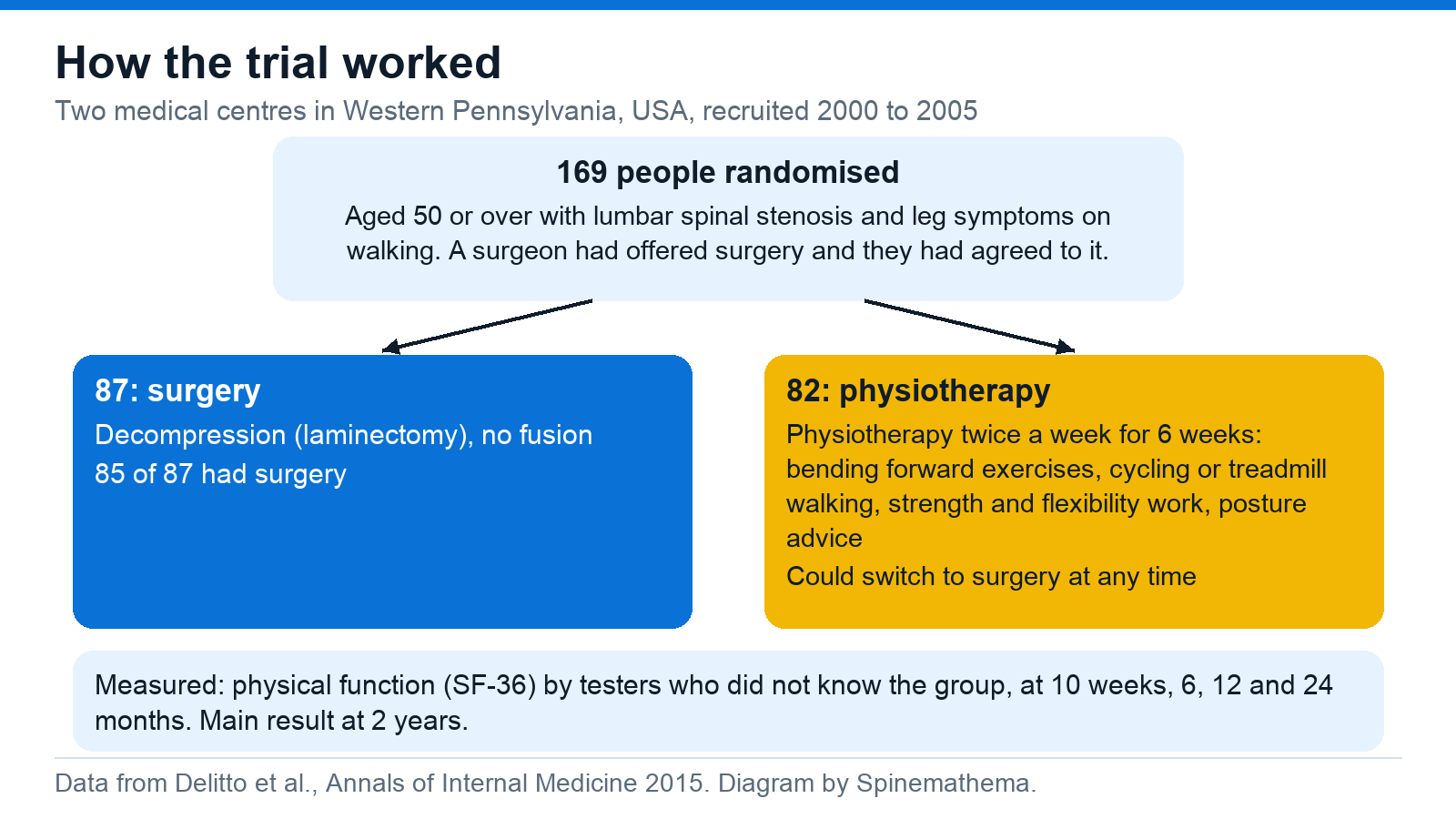
People were recruited between November 2000 and October 2005 through two medical centres in Western Pennsylvania, USA.[1] To take part, they had to be aged 50 or over, have stenosis confirmed on a CT or MRI scan, have leg symptoms on walking (for example, being unable to walk a quarter of a mile because of leg pain or cramping), and have been judged suitable for surgery. Importantly, everyone had already agreed to have surgery before joining. People with a slipped vertebra needing fusion (more than 5 mm of slip, see degenerative spondylolisthesis), severe vascular disease, serious dementia or a fracture at the level to be treated were excluded.[1]
Of 481 eligible people, 312 declined to take part, most because they did not want to risk being assigned to physiotherapy and chose to go straight to surgery. The remaining 169 people were randomly assigned:[1]
- Surgery (87 people): decompression, removing bone and tissue pressing on the nerves at the narrowed levels. No one had a fusion. The average hospital stay was three days. All but 2 people in this group had surgery.[1]
- Physiotherapy (82 people): two sessions a week for 6 weeks, with exercises that bend the lower back forward, cycling or treadmill walking, leg strengthening and stretching, and advice to avoid arching the back. People could switch to surgery at any time.[1]
The main measure was physical function on a standard questionnaire (the SF-36) at two years, scored from 0 to 100. Assessors did not know which treatment each person had had, and patients were asked to wear t-shirts to hide surgical scars at follow-up visits.[1]
What it found
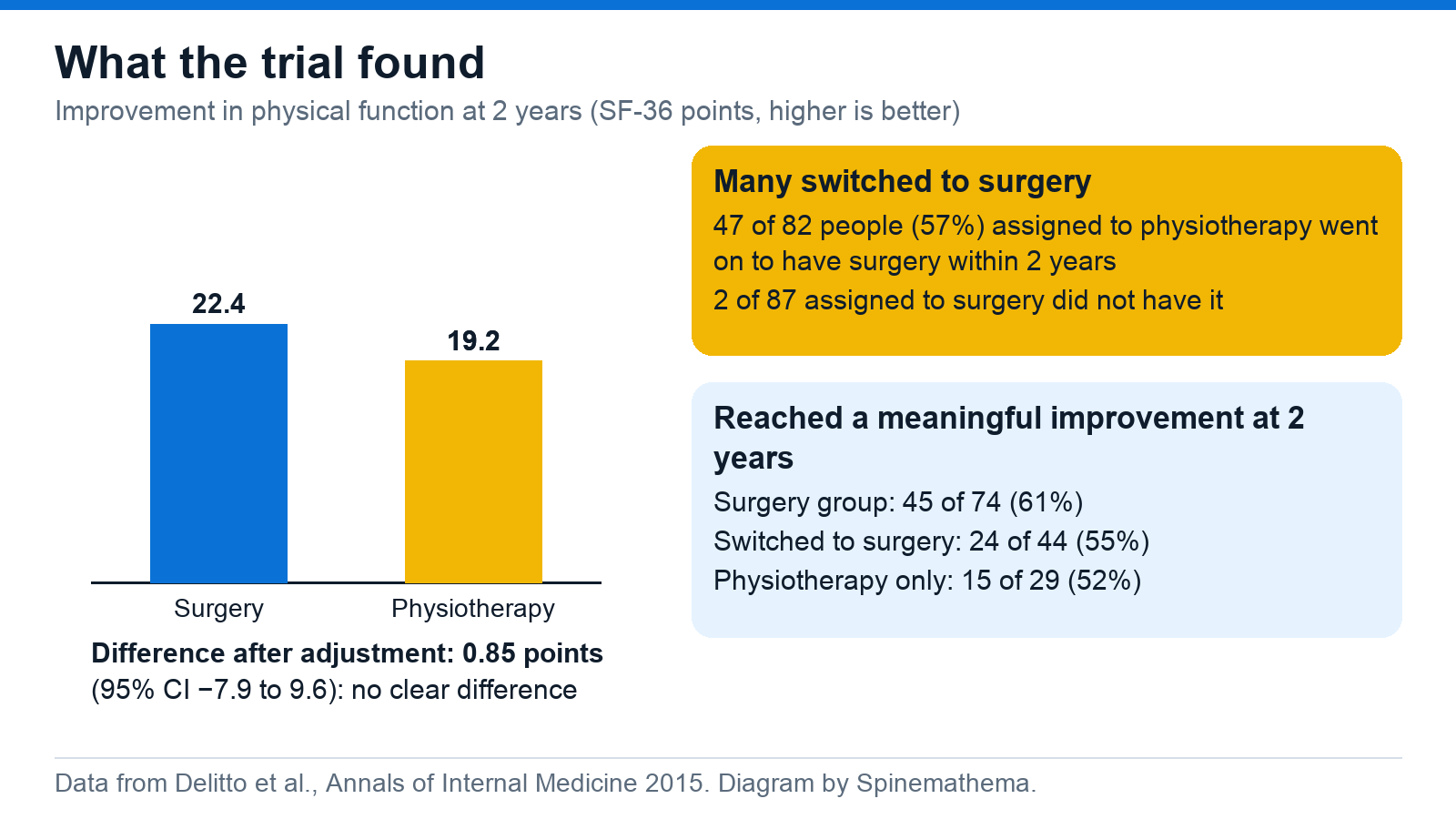
Both groups improved, starting from around 10 weeks and continuing to about six months, and the improvement then held at two years. Physical function improved by an average of 22.4 points in the surgery group and 19.2 points in the physiotherapy group. After adjusting for the trial design, the difference between groups at two years was 0.85 points, which is not statistically significant.[1]
However, 47 of the 82 people (57%) assigned to physiotherapy had surgery during the two years, about two thirds of them within the first 10 weeks. Extra analyses designed to allow for this switching also found no significant difference.[1]
The researchers also looked at how many people achieved a meaningful improvement at two years. This happened in 61% of the surgery group (45 of 74 with data), 55% of those who switched from physiotherapy to surgery (24 of 44), and 52% of those who stayed with physiotherapy alone (15 of 29).[1] Put another way, 35 people (43%) assigned to physiotherapy avoided surgery for at least two years.
Side effects
There were 33 complications related to surgery, 11 of them in people who had switched from physiotherapy. The most common were a further operation and slow wound healing or wound infection. There were 9 complications linked to physiotherapy, all reports of symptoms getting worse. Six people died during the study (4 in the surgery group and 2 in the physiotherapy group), and none of these deaths was related to the trial.[1]
Limitations
- Smaller than planned. The trial aimed for 96 people per group but stopped recruiting early because recruitment was slow.[1] The authors described the results as likely to be indeterminate: the true difference could plausibly be up to 7.9 points in favour of physiotherapy or up to 9.6 points in favour of surgery.[1]
- A lot of switching. With 57% of the physiotherapy group having surgery, the comparison is really between starting with surgery and starting with physiotherapy.
- Who took part. About two thirds of eligible people declined. Those who joined may differ from typical patients.[1]
- No untreated group. Without a group who had neither treatment, it is impossible to say how much improvement was due to treatment rather than natural ups and downs.[1]
- Age of the trial. Patients were treated between 2000 and 2007. Surgical techniques, including less invasive options such as tubular decompression, have continued to develop since then.
A Cochrane review published in 2016 pooled five randomised trials of surgery against non surgical treatment for stenosis (643 participants). The reviewers said they had very little confidence in concluding which approach is better, noting side effects in 10% to 24% of surgical cases in the trials that reported them.[2]
What it means for you
If you have lumbar spinal stenosis without warning signs, this trial suggests that a proper course of physiotherapy is a reasonable first step even if surgery has been mentioned, and that a good number of people avoid an operation. It also shows that many people do go on to choose surgery, and that those who do so still tend to improve. The evidence is not strong enough to say one option is clearly better for everyone.
Your decision is likely to depend on how far you can walk, how much your symptoms limit you, your general health and your own priorities. The authors of this trial specifically recommended shared decision making between patients and their doctors, and that is exactly the conversation to have with your surgeon.
Seek urgent help if you develop numbness around the bottom or genitals, new problems controlling your bladder or bowels, or rapidly worsening leg weakness. These can be signs of cauda equina syndrome, which needs emergency assessment.
References
- Delitto A, Piva SR, Moore CG, et al. Surgery versus nonsurgical treatment of lumbar spinal stenosis: a randomized trial. Ann Intern Med. 2015;162(7):465-473. PMID: 25844995. Link
- Zaina F, Tomkins-Lane C, Carragee E, Negrini S. Surgical versus non-surgical treatment for lumbar spinal stenosis. Cochrane Database Syst Rev. 2016;(1):CD010264. PMID: 26824399. Link
This article is general information and is not a substitute for advice about your own situation. Please speak to your GP or specialist before making any change to your treatment.


Leave a comment